

What do you think?

The Giant Bear: An Inuit Folktale
One of the most terrifying creatures to be found in traditional Inuit stories is the nanurluk, a massive bear the size of an iceberg that lives under the sea ice. Its monstrous size and ice-covered fur make it an almost impenetrable foe. But when a lone hunter spots the breathing hole of the nanurluk on the sea ice near his iglu, he uses his quick thinking and excellent hunting skills to hatch a plan to outsmart the deadly bear.
Jose Angutinngurniq, a gifted storyteller and respected elder from Kugaaruk, Nunavut, brings to life a story of the great nanurluk that has been told in the Kugaaruk region for generations.
Jose Angutinngurniq, a gifted storyteller and respected elder from Kugaaruk, Nunavut, brings to life a story of the great nanurluk that has been told in the Kugaaruk region for generations.
32 pages, Paperback
First published July 27, 2012
Ratings & Reviews
Friends & Following
Create a free account to discover what your friends think of this book!
Community Reviews
Displaying 1 - 21 of 21 reviews

February 9, 2014
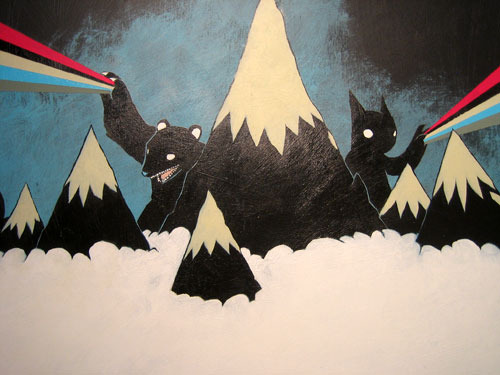
The above is Deth Sun, not Eve Widerman -- I just liked it. The illustrations in this book aren't as awesome, but they're not bad, either. The cover image is the best. The bits with the giant bear are better than the people, who seem a little generic and over-processed. Part of that may be due to the oddly glossy paper.
The writing is, likewise, fine but nothing special. It is straightforward, aside from the Foreward by Neil Christopher, which is full of awkward and overly-difficult words for a picture-book: In a page worth of text we get populated, circumpolar regions, malevolent, marine, opportunity, preternatural, traditional, massive, colossal, lemmings, fragile, sculpin, legendary, ursine behemoths, predators, appetites, invulnerable, harpoons, penetrate. I think I knew most of these words as a child or could figure them out from context, but guessing words from context is harder when so many unfamiliar ones are presented close together. Parents reading to younger kids may want to skip or paraphrase the intro.
Another warning: The violence in this is fairly graphic for a kids' book. The hunter harpoons the bear in the eye, and there are several panels of splattered blood, bloody snow, the bear with bloody goop pouring from his eye. I'm not criticizing the author, as I suppose he is being faithful to the story he learned from his grandfather. Just mentioning it in case you or your child are sensitive to gore!
A husband and wife move to a lonely spot by the sea. While hunting for seals, the man sees a hole in the ice and realizes it is the breathing hole of a nanurluk, a giant bear (really giant, like almost King Kong sizes, not just a big polar bear). To make a long story short, he lures the bear out and stabs its eyes before it can climb out of the hole. Then he waits while it dies a slow and agonizing death. Then he butchers it. Yay!
This story is probably better if you're living at bare subsistence in the Arctic.

December 28, 2018
Long ago, when giant polar bears known as Nanarluit roamed the far north, an Inuit hunter discovered that his home and family were in danger from one of these fearsome creatures, sleeping underneath the ice near his iglu. Knowing full well that he lacked the strength to defeat such an enemy, the hunter cleverly set out to even the odds, slowly icing over the Nanarluk's aglu, or breathing hole. When his ursine adversary attempted to emerge from his watery home and kill the hunter, he had first to dig his way through his unexpectedly smaller aglu, giving the hunter time to seriously injure him...
Published by Inhabit Media, an Inuit-owned publishing house based in Iqaluit, Nunavit, The Giant Bear: An Inuit Folktale is a wonderfully engaging story about the triumph of brain over brawn, and the use of cunning and strategy to defeat a much more powerful enemy. Inuit elder Jose Angutinngurniq heard this story from his grandfather, and retells it here for the benefit of all. Illustrator Eva Widermann, who seems to have undertaken a number of project for Inhabit Media, creates vivid and colorful artwork to accompany the tale. Recommended to folklore lovers young and old, to anyone searching for stories with an Inuit background, and to young children who enjoy exciting tales of adventure.
Published by Inhabit Media, an Inuit-owned publishing house based in Iqaluit, Nunavit, The Giant Bear: An Inuit Folktale is a wonderfully engaging story about the triumph of brain over brawn, and the use of cunning and strategy to defeat a much more powerful enemy. Inuit elder Jose Angutinngurniq heard this story from his grandfather, and retells it here for the benefit of all. Illustrator Eva Widermann, who seems to have undertaken a number of project for Inhabit Media, creates vivid and colorful artwork to accompany the tale. Recommended to folklore lovers young and old, to anyone searching for stories with an Inuit background, and to young children who enjoy exciting tales of adventure.

July 12, 2021
This is an Inuit folktale told by an Indigenous elder and storyteller, and does not sugar coat the process of the hunting of the fabled man-killing giant polar bear. Some people may not appreciate the descriptive words and images, but to stay true to the story it has been presented as it was passed down through generations.
It begins with a foreword that can be adapted to younger readers by someone with a broader vocabulary. In the foreword (which is followed by a pronunciation guide) is explained the ancient ways of the Inuit who lived in the Arctic regions, and the legendary massive, powerful animals they tried to outsmart. This stunningly illustrated story is about how a man and his wife outsmarted one such giant polar bear.
It begins with a foreword that can be adapted to younger readers by someone with a broader vocabulary. In the foreword (which is followed by a pronunciation guide) is explained the ancient ways of the Inuit who lived in the Arctic regions, and the legendary massive, powerful animals they tried to outsmart. This stunningly illustrated story is about how a man and his wife outsmarted one such giant polar bear.

January 15, 2014
There are at least five ways in which THE GIANT BEAR is outstanding. There is much to learn from the Foreword, for example, and the Word Pronunciation guide, too. The story is way-cool and the art is stunning. Did you know there is a teaching guide for it? I provide more depth on why I give this book five stars at my site: http://americanindiansinchildrenslite...

April 27, 2018
I have been happily going through as much Inhabit Media content as I can get my hands on, and this is my latest grab from the library. The Giant Bear is not my first go at a story about a nanurluk, as Inhabit Media has published other stories about them, but I definitely enjoyed it. Jose Angutingunrik is a wonderful storyteller here, and brings the tale to life. The illustrations are great. I generally prefer them (children's books, illustrations, nanurluit stories) to be a little less graphic than this one got, but it wasn't senseless, and it didn't hinder my enjoyment of it.
Definitely enjoyed this. Recommended for all ages (provided the individual kid can handle blood from the nanurluk's face injuries).
Definitely enjoyed this. Recommended for all ages (provided the individual kid can handle blood from the nanurluk's face injuries).
December 6, 2020
The Giant Bear is written by an author of Inuit descent. He brings his personal knowledge of Inuit folklore and culture in writing this story. I would recommend this book for older elementary/intermediate grades. The use of different language and the amount of blood involved in the hunting may be too much for some younger readers, hence my recommendation for older children. I respected the diversity and history behind this book, but I did not particularly enjoy the story. Like many folktales, there was more violence than I generally care for in children's stories. I could not give it 5 stars based on personal preference, but would still recommend it as a great way for older children to learn about another culture.

June 30, 2019
My son is obsessed with monsters and I hoped he would like this book, but at the point when the hunter closed the aglu my son asked to stop reading. He hates the build up of suspense combined with hunting. He is too sensitive about animals to read stories with hunting. Ironically this same week we tried to read Paul Galdone's Puss in Books and again when he realized that the cat was killing things for bragging rights he lost interest. So I enjoyed it, some kids may not.

December 2, 2018
What an incredible book. Inhabit Media is among my favourite children’s publishers. Angutinngurniq (Inuit) from Nunavut retells this story that was told to him by His grandfather Alakannuaq. I love the author’s biography that clearly outlines the roots of this story. The art is great and even a little edgy with blood from the hunt. I know a pair of Inuit children that would love this book.
February 23, 2022
This book was a pleasant surprise. The art & story don’t shy away from the contents themes of survival. It actually spawned an amazing conversation with my kids about safety, hunting for food & clothing. i would use this in my classroom

November 2, 2022
The pictures were amazing and very detailed - love the story being told. Some parts have a little gore in them but still a good story. Not enough people write about the nanurluit and it was great to hear more about the legends that surround them.

February 19, 2025
I listened to this as an audiobook, so I can't say what the illustrations look like. However, the audiobook includes the English version and the same story told in the native language. That was really cool to hear!
September 30, 2018
I feel really bad for the bear....

March 17, 2022
A very interesting Inuit folktale. I enjoyed it.
September 14, 2026
14 mins

September 24, 2020
This is the retelling of an Inuit legend by Inuit writer Jose Angutinngurniq. It tells the story of an Inuit hunter who discovers the aglu or breathing hole of a nanurluk, a ferocious giant polar bear the size of an iceberg. He goes home to secure his igloo so his wife is safe and then returns to the aglu to outwit the bear and kill it.
He succeeds at this, providing meat and prosperity for his family.
The story illustrates the values of resourcefulness and courage and is an interesting artifact of Inuit culture. But like another Inuit tale, the myth of Sedna, it is rather cruel and bloody. The hunter kills the bear by harpooning its eyes and nose. The creature stumbles around until it bleeds to death.
The book is marvelously illustrated by Eva Widermann who does not spare us the gory details. There are three pages that are particularly gruesome and may be disturbing to young children.
It is not a book I will be reading to my four year old granddaughter though I may give it to her when she is considerably older.
He succeeds at this, providing meat and prosperity for his family.
The story illustrates the values of resourcefulness and courage and is an interesting artifact of Inuit culture. But like another Inuit tale, the myth of Sedna, it is rather cruel and bloody. The hunter kills the bear by harpooning its eyes and nose. The creature stumbles around until it bleeds to death.
The book is marvelously illustrated by Eva Widermann who does not spare us the gory details. There are three pages that are particularly gruesome and may be disturbing to young children.
It is not a book I will be reading to my four year old granddaughter though I may give it to her when she is considerably older.

June 12, 2013
This traditional Inuit folktale was illustrated in a way that most young readers would find unsettling. My daughter and my niece, who normally has no reservations about blood, thought the pictures were too gory and only saw the Giant Bear as a victim of the cruel Inuit hunter. My attempts to describe how the Inuit family living on the bears meet, fur and bones is much better than how most people live today off McDonalds or similar fast food restaurant. My words fell on deaf ears though due to the images of the blinded, smell-less, bloody bear that seemed to say much more than I could.

July 17, 2013
This book combines a great story with terrific art. I cannot praise it enough. As to the reviewers who found it too violent, the polar bear is the largest land carnivore and it hunts and eats people. Polar bears are not cute cuddly animals; they are man killers. I think it is perfectly appropriate to share this fact with children. So many of them have had their brains addled by modern Coca Cola culture that it might do them some good to realize that the world around them is an all too real, and sometimes unfriendly place.

April 5, 2013
Quite a fierce and no-nonsense look at an Inuit hunting legend. Not for small children or those unaccustomed to a culture of hunting and survival. The images were striking.

November 18, 2014
A traditional Inuit folktale - the illustrations are wonderful, but they are extremely graphic, so I wouldn't give this one to anyone under 8 years of age.
November 11, 2015
good story of how an Inuit man tricks a nanurluk (giant polar bear) and saves his home and village

Read
February 24, 2018This story does what it says it's going to, though I was still a little surprised at the bloody depictions. I think for readers who aren't really familiar with polar bears as the really terrifying carnivorous creatures they are, it can be difficult to really feel how much a threat the nanurluk poses. (The Foreword talks about the giant polar bears, and the story text itself *says* that the polar bear is giant, but we don't really *feel* what a threat the creature poses -- which makes it easy to feel bad about it's bloody death.)
The illustrations are well-done -- and I love that it ends with a warm family scene inside the iglu, since for many non-Inuit, igluit are something we only see external images of and I suspect I'm not alone in having a mental image of them as just all cold and ice inside.
The illustrations are well-done -- and I love that it ends with a warm family scene inside the iglu, since for many non-Inuit, igluit are something we only see external images of and I suspect I'm not alone in having a mental image of them as just all cold and ice inside.
Displaying 1 - 21 of 21 reviews