

What do you think?

The Pebbled Beach at Pentecost
Vernon Lee Walker, a young Englishman from industrial Wolverhampton, meets his death on a beach on Pentecost Island in the South Pacific on the eve of Christmas 1887.
Why did Vernon die, in what circumstances, and who was responsible? Was he, as once branded, simply a ‘bad colonist’? Or was he a Candide, an innocent abroad, mixing invisibly with the rich and famous, manipulated by a calculating brother, unable to change the world around him?
An historian finds Vernon’s letters home to England, spanning a dozen years. With decreasing frequency, these follow his trajectory, first in Melbourne and Sydney, then as he yields to the spell of the Pacific. But what happens between the lines? Does he fall in love with his brother’s wife? What does a boy not tell his mother?
The novelist steps in. This is a unique fusion of authentic history and informed invention – a tragic story of colonialism in Australia and the Pacific, told with compassion, humor and a deep understanding of time and place.
Why did Vernon die, in what circumstances, and who was responsible? Was he, as once branded, simply a ‘bad colonist’? Or was he a Candide, an innocent abroad, mixing invisibly with the rich and famous, manipulated by a calculating brother, unable to change the world around him?
An historian finds Vernon’s letters home to England, spanning a dozen years. With decreasing frequency, these follow his trajectory, first in Melbourne and Sydney, then as he yields to the spell of the Pacific. But what happens between the lines? Does he fall in love with his brother’s wife? What does a boy not tell his mother?
The novelist steps in. This is a unique fusion of authentic history and informed invention – a tragic story of colonialism in Australia and the Pacific, told with compassion, humor and a deep understanding of time and place.
422 pages, Paperback
First published January 1, 2021
Ratings & Reviews
Friends & Following
Create a free account to discover what your friends think of this book!
Community Reviews
Displaying 1 - 2 of 2 reviews

July 9, 2022
Is it fair to say that until recently (apart from FIFO holiday destinations) Australians didn't think much about 'the Pacific Family' as our politicians like to call it? I bet I wouldn't be the only one surprised to learn that back in 2018 we were launching a "new chapter in relations with our Pacific family" and that 'the Pacific Step-up is one of Australia's highest foreign policy priorities'. This declaration is made at DFAT's 'Pacific Step-up' webpage, which (a-hem) needs a fair bit of updating since the election seven weeks ago has given us a new Prime Minister and a foreign minister who has made it her business to engage with Pacific nations most of us couldn't place on a map. (I mean, we know, duh, that they're in the Pacific. But exactly where, in relation to us and each other?) I suspect that a lot of us are on the bottom step of the ladder, though I also hope it's true that plenty of us have been ashamed and angry about Australia's indifferent stance on climate change which is affecting these nations.
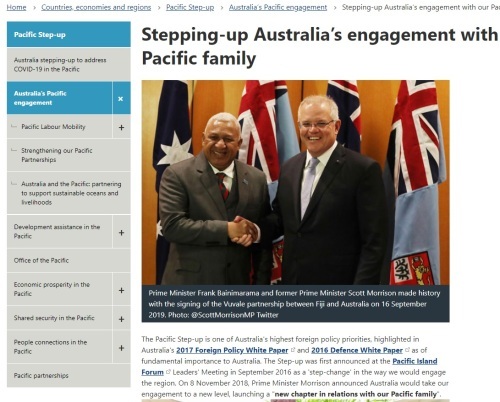 Screenshot: DFAT Pacific Step-up page viewed 9 July 2022
I'm also willing to hazard a guess that most of us know very little about the colonial history of these nations. Which is why Andrew Lemon's The Pebbled Beach at Pentecost is so interesting. It's set amid 19th century colonialism in the Pacific, tracing the events that led up to the death of a young Englishman on Pentecost Island in 1887.
Award-winning historian Andrew Lemon, delivering the recent Weston Bate Oration at the RHSV (Royal Historical Society of Victoria), explored the writing of Australian history as literature. Christina Browning from RHSV Marketing kindly sent me the text of his wide-ranging speech which considered the reasons why journalists and storytellers outsell academic historians when writing on historical subjects and also the impact of Australian novels, plays and poetry on Australians’ understanding of their history.
(He doesn't mention Indigenous historical novelists, so I'll just mention those that come to mind: Anita Heiss, Sienna Brown, Julie Janson, Leah Purcell, and Marie Munkara, and I'll also suggest that all the First Nations fiction that I've read involves a reckoning with Australia's Black History.)
To read the rest of my review please visit https://anzlitlovers.com/2022/07/09/t...
Screenshot: DFAT Pacific Step-up page viewed 9 July 2022I'm also willing to hazard a guess that most of us know very little about the colonial history of these nations. Which is why Andrew Lemon's The Pebbled Beach at Pentecost is so interesting. It's set amid 19th century colonialism in the Pacific, tracing the events that led up to the death of a young Englishman on Pentecost Island in 1887.
Award-winning historian Andrew Lemon, delivering the recent Weston Bate Oration at the RHSV (Royal Historical Society of Victoria), explored the writing of Australian history as literature. Christina Browning from RHSV Marketing kindly sent me the text of his wide-ranging speech which considered the reasons why journalists and storytellers outsell academic historians when writing on historical subjects and also the impact of Australian novels, plays and poetry on Australians’ understanding of their history.
Let’s start with historical novels, ubiquitous in Australia. Many take their historical settings very seriously indeed—so much so that the authors become our quasi historians. Their names are legion, from Marcus Clarke, Henry Handel Richardson, Miles Franklin (writing as ‘Brent of Bin Bin’), Ernestine Hill and Eleanor Dark through to contemporary novelists such as Thomas Kenneally, Robert Drewe, Kate Grenville and now Hannah Kent. Martin Boyd in The Cardboard Crown and Lucinda Brayford was a historical novelist. Patrick White was, with soaring flights of imagination, in novels such as The Tree of Man and A Fringe of Leaves. Peter Carey has long used history as a canvas for his dark satire.
(He doesn't mention Indigenous historical novelists, so I'll just mention those that come to mind: Anita Heiss, Sienna Brown, Julie Janson, Leah Purcell, and Marie Munkara, and I'll also suggest that all the First Nations fiction that I've read involves a reckoning with Australia's Black History.)
To read the rest of my review please visit https://anzlitlovers.com/2022/07/09/t...

February 27, 2023
“If Adolphe Joske, brother of Alexander Joske the wine merchant, had not fallen through a trap door at the warehouse of Webster Brothers in Queen Street, Melbourne, then Vernon Lee Walker of Wolverhampton might never have been hatcheted to death on the pebbled beach at Pentecost.” Page 1, paragraph 1.
In The Pebbled Beach at Pentecost Andrew Lemon takes two notable risks, either calculated or subliminal, that are both about the butterfly effect. One risk is at the outset, the other is pervasive. First, in the opening paragraph he reveals the finale: the lethal outcome of a complex and often banal set of causes and effects that will unfold in the novel. Second, as the butterfly flaps and wanders through the work, the author presents a risky flow of microscopic character and contextual detail that might be suicidal for a lesser writer.
The risks pay off, largely because they combine to create foreboding; a tension that allures the reader and lingers throughout, without over-intrusion. The fate of the young protagonist, Vernon Lee Walker, is always present as we watch him work his way through sometimes exciting but often humdrum decision-making, indecision, mistakes, successes, relationships and other minutiae of life, with no sense of the fate that we know will be his: a hatchet in his skull, a world away from his lost love and his frustrating but beloved mother. The effect is similar to the feeling generated by war novels in which young people are eager to slake their thirst for experience as they proceed, in a game that is often routine and boring, towards a finale that we know from the start will be oblivion for many in jungles, muddy trenches, ravaged cities, or oceanic depths. Or on beachheads, pebbled or otherwise?
The contextual detail does much more than foster the reader’s sense of the slow but sure momentum of Vernon’s meandering course to the pebbled beach and the hatchet. The rich character development of Vernon and other players in his orbit depends in large part on the web of intricacy. In addition, Lemon uses his insight and research skills as a veteran historian to engage us in the finer points of 19th Century Australian and Pacific colonial society, much of it transplanted from Europe and adapted, with mixed success, by people who in many cases want to retain the umbilical cord while they yearn to cut it.
Like all first-rate authors of literary fiction, Lemon inspires musing far beyond the novel’s immediate ambit. Universal, intertwined themes include politico-economic power at local and international levels, social class, family dynamics, unfulfilled romance, megalomania, colonialism, race relations, violence, greed, exploitation, clashes between and within cultural groups, and inconsistent accounts of broad and particular events.
Take your time to digest this novel as you consume it. Make the most of your voyage with a masterly novelist and historian.
In The Pebbled Beach at Pentecost Andrew Lemon takes two notable risks, either calculated or subliminal, that are both about the butterfly effect. One risk is at the outset, the other is pervasive. First, in the opening paragraph he reveals the finale: the lethal outcome of a complex and often banal set of causes and effects that will unfold in the novel. Second, as the butterfly flaps and wanders through the work, the author presents a risky flow of microscopic character and contextual detail that might be suicidal for a lesser writer.
The risks pay off, largely because they combine to create foreboding; a tension that allures the reader and lingers throughout, without over-intrusion. The fate of the young protagonist, Vernon Lee Walker, is always present as we watch him work his way through sometimes exciting but often humdrum decision-making, indecision, mistakes, successes, relationships and other minutiae of life, with no sense of the fate that we know will be his: a hatchet in his skull, a world away from his lost love and his frustrating but beloved mother. The effect is similar to the feeling generated by war novels in which young people are eager to slake their thirst for experience as they proceed, in a game that is often routine and boring, towards a finale that we know from the start will be oblivion for many in jungles, muddy trenches, ravaged cities, or oceanic depths. Or on beachheads, pebbled or otherwise?
The contextual detail does much more than foster the reader’s sense of the slow but sure momentum of Vernon’s meandering course to the pebbled beach and the hatchet. The rich character development of Vernon and other players in his orbit depends in large part on the web of intricacy. In addition, Lemon uses his insight and research skills as a veteran historian to engage us in the finer points of 19th Century Australian and Pacific colonial society, much of it transplanted from Europe and adapted, with mixed success, by people who in many cases want to retain the umbilical cord while they yearn to cut it.
Like all first-rate authors of literary fiction, Lemon inspires musing far beyond the novel’s immediate ambit. Universal, intertwined themes include politico-economic power at local and international levels, social class, family dynamics, unfulfilled romance, megalomania, colonialism, race relations, violence, greed, exploitation, clashes between and within cultural groups, and inconsistent accounts of broad and particular events.
Take your time to digest this novel as you consume it. Make the most of your voyage with a masterly novelist and historian.
Displaying 1 - 2 of 2 reviews