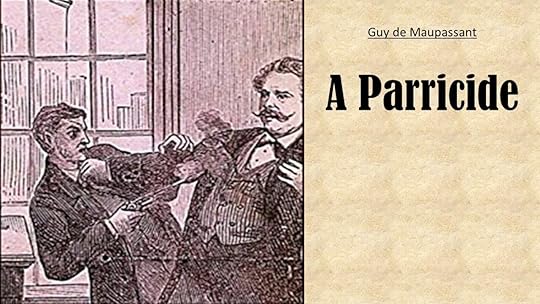
Henri René Albert Guy de Maupassant was a popular 19th-century French writer. He is one of the fathers of the modern short story. A protege of Flaubert, Maupassant's short stories are characterized by their economy of style and their efficient effortless dénouement. He also wrote six short novels. A number of his stories often denote the futility of war and the innocent civilians who get crushed in it - many are set during the Franco-Prussian War of the 1870s.
Guy de Maupassant's "A Parricide" is a disturbing story of a man killing a married couple that gave him business in his carpenter shop but why?
"One morning, in the grass near Chatou, two bodies had been found, a man and a woman, well known, rich, no longer young and married since the preceding year, the woman having been a widow for three years before. They were not known to have enemies; they had not been robbed. They seemed to have been thrown from the roadside into the river, after having been struck, one after the other, with a long iron spike."
Georges Louis finds out that this couple are his real parents that abandoned him long ago but they recently married. They had an affair years ago during her first marriage, so she had left the baby with a nurse and never came back. They were interested in finding him but didn't want to claim him because how it would look. The father even went as far as calling his son "common people". I don't condone this murder in the least but the parents should have accepted and loved him, and not worried about what others thought. I would think he would get the death sentence but it might be life in prison. Sad all around!
“I had known the man for two years, the woman for six months. They often had me repair old furniture for them, because I am a clever workman.” And when he was asked: “Why did you kill them?” He would obstinately answer: “I killed them because I wanted to kill them.” They could get nothing more out of him. This man was undoubtedly an illegitimate child, put out to nurse and then abandoned. He had no other name than Georges Louis, but as on growing up he became particularly intelligent, with the good taste and native refinement which his acquaintances did not have, he was nicknamed “the Bourgeois,” and he was never called otherwise. He had become remarkably clever in the trade of a carpenter, which he had taken up. He was also said to be a socialist fanatic, a believer in communistic and nihilistic doctrines, a great reader of bloodthirsty novels, an influential political agitator and a clever orator in the public meetings of workmen or of farmers. His lawyer had pleaded insanity."
“Your honor, as I do not wish to go to an insane asylum, and as I even prefer death to that, I will tell everything. “I killed this man and this woman because they were my parents. “Now, listen, and judge me. “A woman, having given birth to a boy, sent him out, somewhere, to a nurse. Did she even know where her accomplice carried this innocent little being, condemned to eternal misery, to the shame of an illegitimate birth; to more than that — to death, since he was abandoned and the nurse, no longer receiving the monthly pension, might, as they often do, let him die of hunger and neglect! “The woman who nursed me was honest, better, more noble, more of a mother than my own mother. She brought me up. She did wrong in doing her duty. It is more humane to let them die, these little wretches who are cast away in suburban villages just as garbage is thrown away."
“I owed them life — but is life a boon? To me, at any rate, it was a misfortune. After their shameful desertion, I owed them only vengeance. They committed against me the most inhuman, the most infamous, the most monstrous crime which can be committed against a human creature."
“As I have said, this man, my father, came to me for the first time two years ago. I suspected nothing. He ordered two pieces of furniture. I found out, later on, that, under the seal of secrecy, naturally, he had sought information from the priest. “He returned often. He gave me a lot of work and paid me well. Sometimes he would even talk to me of one thing or another. I felt a growing affection for him. “At the beginning of this year he brought with him his wife, my mother. When she entered she was trembling so that I thought her to be suffering from some nervous disease. Then she asked for a seat and a glass of water. She said nothing; she looked around abstractedly at my work and only answered ‘yes’ and ‘no,’ at random, to all the questions which he asked her. When she had left I thought her a little unbalanced."
"me of my life, of my childhood, of my parents. I answered: ‘Madame, my parents were wretches who deserted me.’ Then she clutched at her heart and fell, unconscious. I immediately thought: ‘She is my mother!’ but I took care not to let her notice anything. I wished to observe her. “I, in turn, sought out information about them. I learned that they had been married since last July, my mother having been a widow for only three years. There had been rumors that they had loved each other during the lifetime of the first husband, but there was no proof of it. I was the proof — the proof which they had at first hidden and then hoped to destroy."
“I answered: ‘Not in the least. I know that you are my parents. I cannot be thus deceived. Admit it and I will keep the secret; I will bear you no ill will; I will remain what I am, a carpenter.’ “He retreated towards the door, still supporting his wife who was beginning to sob. Quickly I locked the door, put the key in my pocket and continued: ‘Look at her and dare to deny that she is my mother.’ “Then he flew into a passion, very pale, terrified at the thought that the scandal, which had so far been avoided, might suddenly break out; that their position, their good name, their honor might all at once be lost. He stammered out: ‘You are a rascal, you wish to get money from us! That’s the thanks we get for trying to help such common people!’ “My mother, bewildered, kept repeating: ‘Let’s get out of here, let’s get out!’"
“Then, when he found the door locked, he exclaimed: ‘If you do not open this door immediately, I will have you thrown into prison for blackmail and assault!’ “I had remained calm; I opened the door and saw them disappear in the darkness. “I soon caught up with them. It was now pitch dark. I was creeping up behind them softly, that they might not hear me. My mother was still crying. My father was saying: ‘It’s all your own fault. Why did you wish to see him? It was absurd in our position. We could have helped him from afar, without showing ourselves. Of what use are these dangerous visits, since we can’t recognize him?’ “Then I rushed up to them, beseeching. I cried: “‘You see! You are my parents. You have already rejected me once; would you repulse me again?’ “Then, your honor, he struck me. I swear it on my honor, before the law and my country. He struck me, and as I seized him by the collar, he drew from his pocket a revolver. “The blood rushed to my head, I no longer knew what I was doing, I had my compass in my pocket; I struck him with it as often as I could. “Then she began to cry: ‘Help! murder!’ and to pull my beard. It seems that I killed her also. How do I know what I did then? “Then, when I saw them both lying on the ground, without thinking, I threw them into the Seine. “That’s all. Now sentence me.”
A man is on trial after having come forward to confess to the seemingly inexplicable murder of a wealthy couple that had baffled the authorities. In court he explains how he discovered that the couple were in fact his biological parents who had abandoned him at birth.