Jump to ratings and reviews
Rate this book

Three Dreams

Rate this book
Three epic, cosmic dream visions from two of the greatest writers of the late 18th century.

CONTENTS
- Jean Paul, “Dream Upon the Universe”, trans. De Quincey
- Laurence Sterne, “A Dream”
- Jean Paul, “The Dead Christ Proclaims That There Is No God”

This version of the "The Dead Christ" is a new version of Jean Paul's famous “Rede des toten Christus vom Weltgebäude herab, dass kein Gott sei”, which was first published in Germany in his 1797 novel Siebenkäs.

ABOUT THE AUTHORS
Jean Paul Fr. Richter, most often know to his readers simply as Jean Paul (1763–1825) was a German writer of long novels noted for their digression, warmth, and humor. His many books translated into English during the 19th century include The Invisible Lodge (1793), Hesperus, or 45 Dog-Post Days (1795), Flower, Fruit, and Thorn Pieces (1797), Titan (1803), and Walt and Vult (1805). After being long out of print, Jean Paul's novella "Maria Wutz" (1793) is newly available in a revised and restored version.

Laurence Sterne (1713–1768) was an Anglo-Irish author and cleric, best known for the novel The Life and Opinions of Tristram Shandy, Gentleman, as well as the novel A Sentimental Journey Through France and Italy and his collected sermons. “Fiction had scarcely gotten started,” wrote William Gass of Sterne, “and, already, Sterne saw all round it—as well as through.”

40 pages, Paperback

Published April 1, 2021

50 people want to read

About the author

Jean Paul Friedrich Richter

1,675 books83 followers
Humorous and sentimental novels of German writer Jean Paul Friedrich Richter under pen name Jean Paul include Titan (1800-1803) and Years of Indiscretion (1804-1805).

In the Fichtelgebirge mountains of Bavaria, his father worked as an organist. This fathre served in 1765 as a pastor at Joditz near Hof and in 1767 at Schwarzenbach but died on 25 April 1779, leaving the family in great poverty. After attending the gymnasium at Hof, Jean Paul went in 1781 to the University of Leipzig. His original intention was to enter his father's profession, but theology did not interest him, and he soon devoted himself wholly to the study of literature. Unable to maintain himself at Leipzig, he returned in 1784 to Hof, where he lived with his mother. From 1787 to 1789 he served as a tutor at Töpen, a village near Hof; and from 1790 to 1794 he taught the children of several families in a school he had founded in nearby Schwarzenbach.
Jean Paul began his career as a man of letters with Grönländische Prozesse ("Greenland Lawsuits", published anonymously in Berlin) and Auswahl aus des Teufels Papieren ("Selections from the Devil's Papers", signed J. P. F. Hasus), the former of which was issued in 1783-84, the latter in 1789. These works were not received with much favour, and in later life Richter himself had little sympathy for their satirical tone. A spiritual crisis he suffered on 15 November 1790, in which he had a vision of his own death, altered his outlook profoundly. His next book, Die unsichtbare Loge ("The Invisible Lodge"), a romance published in 1793 under the pen-name Jean Paul (in honour of Jean Jacques Rousseau), had all the qualities that were soon to make him famous, and its power was immediately recognized by some of the best critics of the day.
Encouraged by the reception of Die unsichtbare Loge, Richter composed a number of books in rapid succession: Hesperus (1795), Biographische Belustigungen unter der Gehirnschale einer Riesin (1796), Leben des Quintus Fixlein (1796), Der Jubelsenior (1797), and Das Kampaner Tal (1797). Also among these was the novel Blumen- Frucht- und Dornenstücke, oder Ehestand, Tod und Hochzeit des Armenadvokaten Siebenkäs in 1796-97. The book's slightly supernatural theme, involving a Doppelgänger and pseudocide, stirred some controversy over its interpretation of the Resurrection, but these criticisms served only to draw awareness to the author. This series of writings assured Richter a place in German literature, and during the rest of his life every work he produced was welcomed by a wide circle of admirers.
After his mother's death in 1797, Richter went to Leipzig, and in the following year to Weimar, where he started work on his most ambitious novel, Titan, published between 1801-02. Richter became friends with such Weimar notables as Herder, by whom he was warmly appreciated, but despite their close proximity, Richter never become close to Goethe and Schiller, both of whom found his literary methods repugnant; but in Weimar, as elsewhere, his remarkable conversational powers and his genial manners made him a favorite in general society. In 1801 he married Caroline Meyer, whom he had met in Berlin the year before. They lived first at Meiningen, then at Coburg; and finally, in 1804, they settled at Bayreuth.
Here Richter spent a quiet, simple and happy life, constantly occupied with his work as a writer. In 1808 he was fortunately delivered from anxiety about outward necessities by Prince Primate Karl Theodor von Dalberg, who gave him a pension. Titan was followed by Flegeljahre (1804-5), two works which he himself regarded as his masterpieces. His later imaginative works were Dr Katzenbergers Badereise (1809), Des Feldpredigers Schmelzle Reise nach Flätz (1809), Leben Fibels (1812), and Der Komet, oder Nikolaus Marggraf (1820-22). In Vorschule der Aesthetik (1804) he expounded his ideas on art; he discussed the principles of education i

Ratings & Reviews

What do you think?
Rate this book

Friends & Following

Create a free account to discover what your friends think of this book!

Community Reviews

5 stars
2 (25%)
4 stars
3 (37%)
3 stars
3 (37%)
2 stars
0 (0%)
1 star
0 (0%)
Displaying 1 of 1 review
Profile Image for W.D. Clarke.
Author 3 books358 followers
July 23, 2022
As Jean Paul states in "Dream Upon the Universe," the first of his two "Dreams" collected in this brief, intense little book (the third is by his friend and, stylistically speaking near-doppelganger, Laurence Sterne), our "spirit can bear only earthly images of the unearthly"; though it both longs for and fears the dangerously dark, steep, vast, fathomless, self-annihilating chasm of the infinite (the Romantic "sublime", in other words, for what in art only possibly threatens us with utter destruction also cleanses, invigorates, and infuses with meaning —not to mention sublim-ates, in the Freudian sense these little lives of ourn), at bottom it must make do with finite conjurings of the infinite via the painter or author's (Wizards of Oz, all) powers of artifice. Thus does Jean Paul state, in the second half of the above sentence, "now then I cleanse thy sight with euphrasy," or the herb eyebright. (9)

That cleansing Jean Paul relates (in the dream) to the another of our desires: to remove at last the figurative, eternally covert secret to all creation, the "veil of Isis, which veil is hung over the whole creation, and lengthens as any finite attempts to raise it. And in sight of this immeasurability of life, no sadness could endure; but only joy that new no limit, and happy prayers." Jean Paul's emotional flight as his dream literally transports him to the end of the universe is so majestic, so marvelous, it sets the wonders produced by our best telescopes to shame and reading it, it almost feels as if we all contain the power to cast Isis's veil clean away....

But alas…morning always comes.

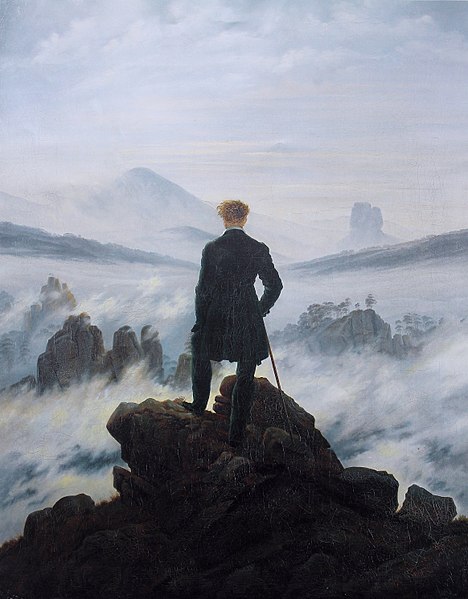
Sterne's own dream in "A Dream" is similarly adventuresome and full of the promise of potential enlightenment, and sets out the virtues accruing to the solitary Wanderer Above the Sea of Fog... ...whose only "acquaintance and friends" are the crags and chasms and vast vistas of the perilous heights:
O the mountains, rivers, rocks and plains, which ages had familiariz'd to my view! With you I seemed at home; here [awake] I am like a banish'd man; every thing appears strange, wild and savage! […]How one blast of wind dashed you to pieces! (26)
If Sterne is as bereft to awake from all of this as Jean Paul is in his own first piece, in his second, "The Dead Christ Proclaims That There is No God" is a true nightmare, one which begins thusly:
When we are told in childhood that, at midnight, when sleep draws near to our souls and darkens our dreams, the dead arise from their sleep and in churches act out the masses of the living, we shudder then at death, on account of the dead; and in the lonliness of night we turn our eyes in terror from the tall windows of the silent church, fearful to examine whether the glitter comes from the moonlight, or from something else.
Hint: it's something else, all right, one which ends as all dreams do, with morning, but which in this particular case harrows the dreaming souls of writer and reader alike a-meanwhile, with the dead Son declaiming in frankly quite spectacular writing that He has no heavenly Father, at all—and nor do we. Instead, it's all just "the nothingness and boundless void, saying, "O dead dumb nothingness! Eternal, cold Necessity! O mad Chance! When will you rend this fabric into atoms, and me as well?

Answer: in time, my Son, in time.

But look, the morn in russet mantle clad walks o’er the dew of yon high eastward hill! Exit ghost, and the Wiz(zes). These three dreams have both delighted and have put our our eyes the while, have spirited us to those vast, reason-stultifying places where we test just what losing ourselves utterly (yes, and Toto too, alas) is really like, before returning us safely to Kansas, back into the still-warm embrace of old Aunty Em.
Displaying 1 of 1 review

Can't find what you're looking for?

Get help and learn more about the design.