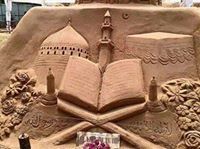
In Allah Miyan Ka Karkhana, Mohsin Khan paints a vivid picture of Jibran, a boy whose poverty can’t dim his imagination. He finds joy in kites and butterflies. He refers to God as Allah Miyan and innocently seeks answers. What is the world’s origin? Why does he show partiality? Why is he not fair? In this novel, Mohsin Khan shows the dark and painful side of life for a deeply conservative yet humble family in a hostile world. Allah Miyan Ka Karkhana is a story of innocence, loss, and faith. It will make you cry, think, and question everything.
Why read it?
Reason 1: "Allah Miyan ka Karkhana" is a unique novel in modern Urdu fiction. It tells the story of a young boy who grows up in a confusing and troubled world. He does not become an adult or a moral person, but he learns from his experiences. He is often amazed, sad or lost in his thoughts. His experiences show the writer's sharp criticism of the culture around him. Some may doubt if a child can ask such big and complex questions about society, morality and politics. But the writer skillfully uses the novel form and the child's mind to create a powerful fiction.
Reason 2:
"Allah Miyan ka Karkhana" is a novel unlike any other in Urdu fiction today. It takes us inside the mind of a boy who grows up in a world that makes no sense to him. He never becomes an adult or a good person, but he tries to understand his life through his experiences. Sometimes he is amazed, sometimes he is sad, sometimes he is lost in his dreams. His experiences are not just simple and childish, they are also a way for the writer to show us the problems and flaws of the culture he lives in. Some people may think that a child cannot ask such big and hard questions about society, morality and politics. But the writer knows how to use the novel form and the child's perspective to create a powerful and moving story.
Reason 3:
This novel reminds me of how Anton Chekhov & Fyodor Dostoevsky wrote their stories. They showed us the thoughts and feelings of their characters. In "Allah Miyan ka Karkhana", the writer does the same thing, but he hides his questions and criticisms in the innocence of Jibran, the main character, and other children. The innocence and wonder in the story make me think of the mystery and magic of Wordsworth’s poems. For example, why did Allah Miyan make the cat when he had made the hen? or, how the cold Friday bath is a nightmare for kids. The story has a strong moral vision and a subtle irony that makes it fun and interesting to read.
Reason 4:
Mohsin Khan is one of the few Urdu writers who tried this genre and used its multiple possibilities. He shows us a real and believable world, with its people, their habits, beliefs, traditions, religious views, relationships, their honesty and dishonesty. It’s a living culture, full of life. He shows us this world with irony and humor, like a photo with a twist. He also shows us how this world is wrong and unfair in many ways. He criticizes the institutions of religion, justice, education and economics. But he does not forget to make his story beautiful and artistic. "Allah Miyan ka Karkhana" will be remembered for its insights, skills and language.
Story Plot
अल्लाह मियां का कारखाना or His Divine Worshop
The story is about a destitute family: a father, a mother and two progeny who attend a madarsa. The protagonist is the younger son. The family subsists on the verge of penury and ostracism. The father is a devout Muslim who espouses madarsa education, the hereafter, and the iniquities of television. His sole aspiration for his son is to make him recite the Quran. He operates a diminutive shop and embarks on religious expeditions every year, forsaking his family and commerce. He confides in Allah to provide for everything.
But one day he departs on a trip to Gujarat and vanishes. He is apprehended by the police as a terror suspect and incarcerated in jail. His family is pulverized. His wife perishes during parturition. His offspring are appropriated by his brother, who is affluent and progressive, but has no dominion over his family. His wife and son maltreat the children and ruin their lives.
The story is articulated by the young son, who is replete with antics and merriment despite the austere conditions of his madarsa and abode. He makes the reader guffaw with his witty and humorous narration.
The story also lampoons our society with subtle and innocuous satire. The author does not affront anyone, but makes some sagacious points. This satire is the strength of the book.
I recommend this book to anyone who can read it. It is worth reading for its wit and humor alone.
....
About The Author:
Mohsin Khan hit the Urdu literary scene with his short story collection 'Khwab Kahani,' in 1993, featuring the famous story Zehra which has since been translated into multiple languages. His Play 'Khwab Ki Tabeer' won first prize in a radio play contest drawing participants from 19 Indian languages.
Since then, Khan has also been a prolific writer of Children's Literature having contributed over several books of plays and stories, published by Urdu Academy (Linguistic Department, Govt. of Uttar Pradesh) and NCPUL (Ministry of HRD, Govt. of India).
His outstanding debut Novel, "Allah Miyah Ka Karkhana," which has been rendered into several Indian languages, has recently showered him with wider fame.
His story collections, 'Anda Kaise Phoota', 'Kawwa Jhoot Bolta Hai', 'Khwab Kahani' won awards by Uttar Pradesh Urdu Academy. He has also been bestowed with Lifetime Achievement Award, Awadh Ratan Award, Jashn-e-Adab Award, Mussanefeen Adab Award, Azad welfare and educational society Award, Pasban-E-Adab Award and International Urdu foundation Award. Born in Malihabad, he lives in Lucknow.