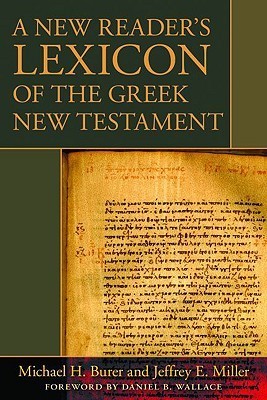
"What Kubo did for the last generation, Burer and Miller's A New Reader's Lexicon will do for the next." -from the foreword by Daniel B. Wallace Improving on earlier lexical works, A New Reader's Lexicon of the Greek New Testament incorporates all words that occur fewer than fifty times in the New Testament. In canonical order, it catalogs a word's frequency in each book, in each author's writings, and in the entire New Testament. References to rare or noteworthy word usages are included, allowing the reader to quickly identify words of special significance. "This lexicon . . . has overcome the noticeable shortcomings of Kubo and should well serve the person who wants to keep up their Greek by daily reading, but gets frustrated by having to spend so much time looking up words." -Gordon D. Fee Professor of New Testament Studies Regent College "A New Reader's Lexicon is a step forward for the student of Greek and is sure to be of benefit to those who teach Greek. . . . The use of A Greek-English Lexicon of the New Testament and Other Early Christian Literature (BDAG) is a great touch." -Darrell L. Bock Research Professor of New Testament Studies Dallas Theological Seminary "Very usable, exceedingly helpful, and a fine contribution to any student of the Word interested in serious reading of the Greek New Testament." -Grant Osborne Professor of the New Testament Trinity Evangelical Divinity School Michael H. Burer is assistant professor of New Testament studies at Dallas Theological Seminary, where he received his Ph.D. He has published a number of scholarly works and contributed as an editor to the New English Translation-Novum Testamentum Graece New Testament. Jeffrey E. Miller earned his Th.M. from Dallas Theological Seminary and is senior pastor at Trinity Bible Church in Richardson, Texas. He has published both scholarly and popular works. RELIGION/Biblical Reference/General Kregel A&P
"Unfamiliar vocabulary proves to be an enduring challenge for students of New Testament Greek. Even students who understand the rules of the language get bogged down having to look up uncommon words while translating. Nevertheless the correct interpretation of many passages of Scripture hinges on the meaning of its rare words."
--Michael H. Burer and Jeffrey E. Miller, Preface
Vocabulary acquisition is key to being able to read any language, but so is just reading a text straight through. A "reader's lexicon" or "reader's Bible" seeks to bridge the gap so students can both improve their vocabulary and engage in a continuous reading of the text. To that end, Kregel Academic and Professional has published A New Reader's Lexicon of the Greek New Testament by Michael H. Burer and Jeffrey E. Miller.
But why a new reader's lexicon when the old one (by Kubo) has been useful to students of the Greek New Testament for so long? That's been the primary question before me as I've reviewed the New Reader's Lexicon (NRL). Daniel B. Wallace in the preface gives the reasons for this new lexicon:
"But as helpful as Kubo was, there were weaknesses. First, it was not updated to the glosses found in the third edition of the Bauer Lexicon (BDAG). Second, there were numerous errors (involving word frequency numbers, omissions of words, inappropriate glosses, etc.) that went uncorrected. Third, the special vocabulary section at the beginning of each book, involving all the words that occurred more than five times in that book but less than fifty times in the New Testament, created its own problems: designed for efficiency of space, it did not prove helpful for efficiency in learning."
While I think Wallace has it right on the first two points, I (sort of) disagree with the third--that list that Kubo offers at the beginning has actually been helpful to me for learning a given book's vocabulary, since it groups some of that book's common words together. However, it does mean that words in that beginning list don't then appear in Kubo's lexicon throughout the rest of the book. To overcome this, I would make a copy of the list and use it as a bookmark, referring to it often so I didn't have to keep flipping pages.
Herein lies one area of strength for the New Reader's Lexicon. There is no common vocabulary list at the beginning of each book (users now can generate those easily enough through Bible software), but it means that every word that occurs less than 50 times in the New Testament is in this lexicon... in the verse in which it appears. So as I'm beginning my way through Mark 6, I can look in the NRL to quickly see that ἐκεῖθεν in verse 1 means "from there."
To Wallace's first two points, that the NRL uses the updated BDAG is a great relief--readers now don't have to guess whether recent advances in lexicography or discoveries of new papyri mean that the word in front of them actually has a slightly different nuance. The NRL updates Kubo here well.
In addition to "concisely defin[ing] in context" each word, the NRL gives statistics for how many times that word appears. (Names and proper nouns are included.) There are up to three numbers listed:
*How many times the word appears in that given book of the New Testament *How many times that word appears "in all canonical works by the traditional author of the book at hand" *How many times the word appears in the whole NT
Kubo had the first and third numbers. This second statistic now allows me to see not only how many times ἀνάθεμα appears in 1 Corinthians (twice) and in the NT (six times), but it tells me that five of the six uses of this word in the NT are with Paul.
And here's where the lexicon is unique and really stands out--in the instance of such a rarely occurring word, it lists cross references, so I can quickly see that the other use of ἀνάθεμα in I Corinthians is at 16:22, and that Paul also uses the word in Romans 9:3, Galatians 1:8,9, and that the only non-Pauline NT occurrence of the word is at Acts 23:14.
The NRL truly does improve upon Kubo's lexicon. It accomplishes its mission quite well.
But don't take my word for it. I've found that what original language resources to own and invest in is often a matter of personal preference and what works best for an individual. If you're still on the fence about this resource, download a free sample of the lexicon for Colossians here (pdf). Read through Colossians with it in hand and see how it goes. Personally I've found this to be an indispensable resource for making my way through the Greek New Testament.
One huge bonus: the book is designed well. The pages are smooth and thick and bright. The font is clear and easy to read. And the binding is sewn! This means it will stand the test of time well, which you'd hope a reference work like this would.
My thanks to Kregel Academic for providing me with a review copy of this book.
This title caught my eye when I was browsing Kregel's list of upcoming releases earlier this fall. If you were to take a look at the bookshelves in my office, you'd probably come to the conclusion that I certainly don't need another lexicon. Chances are you'd be right. Normally, I'd quickly skim the description of a forthcoming lexicon and move on. However, there were two things that piqued my interest. First, I was drawn to the beautiful image of codex 2882 (courtesy of the Center for the Study of New Testament Manuscripts) on the cover. Second, I noticed that the foreword was written by Daniel B. Wallace. Dr. Wallace's contribution to the study of New Testament Greek in the past few decades is envious and commendable. The fact that he wrote the forward for this new lexicon told me it deserved more than just a cursory glance.
The commendations from various Bible scholars in the front of the book and on the back cover have two common themes. First, the majority of them describe this work as a much needed update and improvement on a similar work by Sakae Kubo published by Zondervan. Second, they are very pleased that the vast majority of the contextual definitions come from BDAG. In the forward, Daniel Wallace touches on the two themes mentioned by the other scholars. He also mentions the importance of the three-fold tagging of word frequency in this volume, noting it will be of great value to the beginning and intermediate Greek student as well as the experienced exegete. Dr. Wallace has great hopes for this new work, which is expressed best in the following quote from the end of the foreword, "What Kubo did for the last generation, Burer and Miller's NRL will do for the next."
The student, pastor, and serious layperson will appreciate the layout and features of the entries in this lexicon. Every word, including proper names and place names, that occur fewer than fifty times in the New Testament are defined in context. The word frequency statistics based on the NA27/USB4 Greek New Testament are computer generated. The frequency information for each entry contains some or all of the following: number of times the word appears in the verse, number of times the word occurs in the book, number of times the word occurs in works by the same author, and number of times the word occurs in the entire new Testament. In addition to word frequency, each entry has some or all of the following cross references where the word occurs less than three times: occurring in 3 or fewer verses in the same book, occurring in 3 or fewer verses within the author's writing outside the current book, and occurring in 3 or fewer verses outside the current author's writing. There is a wealth of statistical information for each and every entry.
Every serious student of New Testament Greek should consider adding this lexicon to their library. Coming in at just under thirty dollars, the reasonable price makes this book accessible to even those with the smallest of book budgets. This book will become a mainstay on my desk and I'm confident it will enhance my study of the Greek New Testament. I agree with Dr. Wallace, that A New Reader's Lexicon of the Greek New Testament will have a great impact on this next generation of aspiring Greek scholars.
Michael H. Burer is assistant professor of New Testament studies at Dallas Theological Seminary, where he received his Ph.D. He has published a number of scholarly works and contributed as an editor to the New English Translation--Novum Testamentum Graece New Testament.
Jeffrey E. Miller earned his Th.M. from Dallas Theological Seminary and is senior pastor at Trinity Bible Church in Richardson, Texas. He has published both scholarly and popular works.