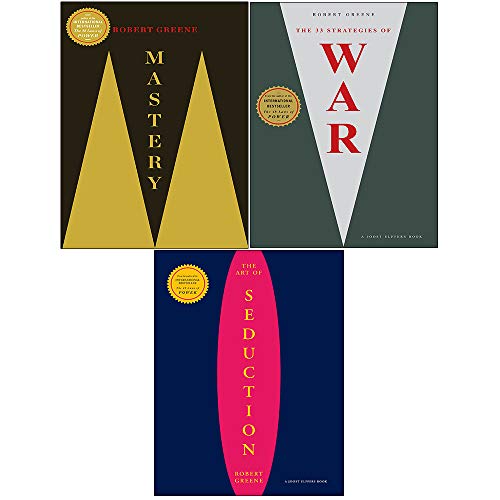
The Concise Mastery The perfect pocketbook gift for the power-hungry - from 'the modern Machiavelli', Robert Greene, international bestselling sensation author of The 48 Laws of Power, Seduction and War. This concise version of the business classic Mastery provides a shortcut to Greene's powerful new tools for achieving greatness. Around the globe, people are facing the same problem - that we are born as individuals but are forced to conform to the rules of society if we want to succeed. The Concise Art Of Seduction The companion book to the bestselling Concise 48 Laws of Power, which has now sold over 125,000 copies in the UK. Amoral, ruthless, clever and cunning, this is the essential guide to the art of seduction. The Concise 48 Laws of Power The perfect gift book for the power hungry (and who doesn't want power?) at an excellent price. The Concise Edition of an international bestseller. At work, in relationships, on the street or on the 6 o'clock the 48 Laws apply everywhere.
There is more than one author by this name on Goodreads.
Best-selling author and public speaker, Robert Greene was born in Los Angeles. He attended U.C. California at Berkeley and the University of Wisconsin at Madison, where he received a degree in classical studies. He has worked in New York as an editor and writer at several magazines, including Esquire; and in Hollywood as a story developer and writer.
Robert has lived in London, Paris, and Barcelona; he speaks several languages and has worked as a translator. In 1995 he was involved in the planning and creation of the art school Fabrica, outside Venice, Italy. There he met Joost Elffers, the New York book packager and discussed with him his idea for a book on power and manipulation, the ultimate modern version of Machiavelli's The Prince.
Robert and Joost became partners and in 1998, The 48 Laws of Power was born. The book has been a national and international bestseller, and has been translated into 17 languages. In 2001, Robert released his second book, The Art of Seduction, which is more than a sequel to The 48 Laws; it is both a handbook on how to wield the ultimate form of power, and a detailed look at the greatest seducers in history.
The third in this highly anticipated series of books, The 33 Strategies of War, hit bookstores January 2006 and offers a strategic look behind the movements of War in application to everyday life. In addition to having a strong following within the business world and a deep following in Washington, DC, these books are also being hailed by everyone from war historians to some of the heaviest hitters in the rap world (including Jay-Z and 50 Cent).
The popularity of these books along with their vast and fiercely loyal audience proves these are profound, timeless lessons from historical leaders that still ring true in today's culture. Robert currently lives in Los Angeles.
I was told recently that I had more than a touch of Sun-Tzu to me. At the time, I didn't give it much thought, but having read Robert Greene's The 33 Strategies of War, whether this observation was intended as compliment or insult is even more uncertain.
Greene's War aims to distill the laws of battlefield strategy and psychology into tips and tricks for navigating everyday life. Using a rich battery of examples from the ancient Greeks and Romans to the American Civil War generals, the Viet Cong, and especially Napoleon, Napoleon, Napoleon, Greene illustrates his arguments with examples from, well, war. (He also incorporates numerous examples from Hollywood, particularly of Joan Crawford and Alfred Hitchcock, which make for an interesting juxtaposition with Hannibal and the Mujahideen.) The examples, which provide a fascinating history lesson in themselves - given their depth and breadth I couldn't help but wonder how many hours of research had gone into War - serve to illustrate everything you've been told about life: keep your friends close and your enemies closer; think about the long game; prepare an exit strategy; you catch more flies with honey than you do with vinegar. The enemy of my enemy is my friend. Actions speak louder than words. It's better to go down swinging than looking. It's better to ask forgiveness than permission. Perhaps most importantly, as Greene spells out explicitly, "in life, as in war, nothing ever happens just as you expect it to."
As I reflected on my own actions combatting a former boss, I realized how very well I had practiced many of the arts of war...and why I'd been told I had a touch of Sun-Tzu. Oh, I knew I'd done my work well, but it was only in reading Greene that I understood all the nuances of my actions, not least of which was rendering it a "moral battle for public consumption." (Some might say I had to be crazy like a fox to take on the fight in the first place, but either way, I only brought it to fruition because, after I lost the first round, someone who clearly knew which of my buttons to push asked if I was going tout looking or swinging. Greene would approve of her strategy and my response.) My experience also proved his aphorism that the only way to be truly unorthodox is to imitate no one...refusing to follow common patterns will make it hard for people to guess what you'll do next.
All of which is to say, Green's ideas resonated with me. The last line of his 28th strategy stopped me in my tracks, though: "wise courtiers always seem to be paragons of civilized behavior, encasing their iron fist in a velvet glove." For in the midst of the imbroglio with the boss, a student wrote to me requesting advice as she entered the workplace. I began by telling her she must always advocate for herself; encouraged her to always to fight for herself, her team, and what she knew to be right; told her that when backed into a corner, she could decide whether to go out looking or go out swinging - but that, if swinging, it better be for the fences; and finally, that she should cultivate the art of an iron fist in a velvet glove. Sun-Tzu, indeed.
One final thought: Greene schooled me in geography. Evidently the Rubicon is not the mythological river I inexplicably thought it to be, but an actual, Italian one. Who knew? (Don't answer.)
While I don’t agree with everything I can say these have changed my life and perspective on said life. These books are great for those who like to educate themselves and find philosophical study interesting. So many stories within stories to read and it was very enjoyable. I took a long time reading here and there but finally finished and I reflect often on the pages I’ve read so it’s done what it was meant to do. Thought provoking.