

What do you think?

Το όνειρο του Εδουάρδου
Ο πρωτοπόρος των κόμικς Γουλιέλμος Μπους (1832-1908) είναι παγκοσμίως γνωστός για τις εικονογραφημένες ιστορίες του. Ένας αριθμός όμως εκλεκτικών λογοτεχνών υπήρξαν θαυμαστές του λογοτεχνικού του έργου, ανάμεσά τους και ένας από τους σημαντικότερους φιλοσόφους του 20ού αι., ο Λούντβιχ Βιτγκενστάιν, ο οποίος κυκλοφορούσε με τα βιβλία του Μπους στην τσέπη του και τα διάβαζε σε κάθε ευκαιρία. Με αυτήν την έκδοση παρουσιάζεται για πρώτη φορά στα ελληνικά ο λογοτέχνης Γουλιέλμος Μπους. Η σειρά «αρθούρος» των εκδόσεων Γαβριηλίδης εμπλουτίστηκε με το βιβλίο Το όνειρο του Εδουάρδου στην εξαιρετική μετάφραση του Γιάννη Κοιλή. Στην ίδια έκδοση περιλαμβάνεται η αυτοβιογραφία του Μπους, με τίτλο Όσο για εμένα, σχόλια του μεταφραστή μαζί με την Μαρία Τσατήρα, καθώς και ένα επίμετρο σε μορφή βινιετών από τον Νικήτα Σινιόσογλου. Στη νουβέλα Το όνειρο του Εδουάρδου παρελαύνουν ποικιλόμορφοι τύποι οικείων ή εξωτικών ανθρώπων κι εννοιών, φιλόσοφοι και πολιτικοί, καλλιτέχνες και κριτικοί, διάβολοι και άγγελοι, λυτρωτές και τιμωροί, όπως αναφέρει ο Γιάννης Κοιλής στα σχόλια.
«Ο κόσμος μοιάζει με τον χυλό. Μόλις βγάλεις το κουτάλι, όσο μεγάλο κι αν είναι, η ιστορία τα κουκουλώνει και πάλι όλα, σαν να μην έχει συμβεί τίποτα» Γ.Μ.
«Ο κόσμος μοιάζει με τον χυλό. Μόλις βγάλεις το κουτάλι, όσο μεγάλο κι αν είναι, η ιστορία τα κουκουλώνει και πάλι όλα, σαν να μην έχει συμβεί τίποτα» Γ.Μ.
128 pages, Paperback
First published January 1, 1891
About the author
Wilhelm Busch
986 books47 followersHeinrich Christian Wilhelm Busch was an influential German caricaturist, painter, and poet who is famed for his satirical picture stories with rhymed texts.
After initially studying mechanical engineering and then art in Düsseldorf, Antwerp, and Munich, he turned to drawing caricatures. One of his first picture stories, Max and Moritz (published in 1865), was an immediate success and has achieved the status of a popular classic and perennial bestseller.
After initially studying mechanical engineering and then art in Düsseldorf, Antwerp, and Munich, he turned to drawing caricatures. One of his first picture stories, Max and Moritz (published in 1865), was an immediate success and has achieved the status of a popular classic and perennial bestseller.
Ratings & Reviews
Friends & Following
Create a free account to discover what your friends think of this book!
Community Reviews
Displaying 1 - 2 of 2 reviews

December 22, 2016
Those of you who heard about the author Wilhelm Busch probably know him by his comic strips, of which MAX UND MORITZ is the most famous one.
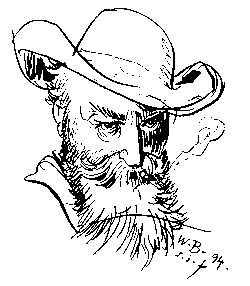
[Wilhelm Busch - self portrait, 1894]
EDUARDS TRAUM (EDWARD’S DREAM), however, doesn’t contain pictures, at least none that were drawn. In this novella the narrator, Edward, talks about a dream he had. It all starts when he feels like he’s getting smaller:
[…] he experienced a feeling as if his spirit, his soul, or whatever you may call it, began to shrink. His ego became smaller and smaller; first like a potato, then like a pill, then like a pin’s head, then still smaller, and at last it was a point. But he was a thinking point and active he was too, moving about in all directions, manufacturing his demand of time and space quite “en passant” as a by-product. In this shape he makes several excursions.I took this (and the other English quotes) from the “translation” of the story that you can find here:
https://archive.org/stream/edwardsdre...
This is no ordinary translation though, because for reasons I cannot fathom the original first-person narrative of Edward becomes a third-person narrative, some sort of commentary actually, with many of Edward’s original quotes only embedded. I find this confusing and it takes away a lot of the story’s momentum and spontaneity. There are also some parts missing altogether in the translation!
The first of Edward’s excursions take him to the “World of pure forms”, in which everything revolves around numbers and (very simple) mathematics:
Two fellows whom I met in the park promenade introduced themselves to me twice; first as Mr. A and Mr. B; then again as Mr. B and Mr. A; and they asked me conceitedly whether it wasn’t all the same, for A + B = B + A.This and a number of other occurrences reminded me of Caroll’s masterpiece ALICE’S ADVENTURES IN WONDERLAND (published about 30 years before EDWARD’S DREAM). Another part carries a strong resemblance to Abott’s FLATLAND:
Edward slept in the hotel and when he awoke the next morning in the geometrical plane, he found that everybody had to crawl around on his stomach. “High and low are difficult to distinguish at first sight, and if one has cause to be polite one must look out with great circumspection, for as there is no height, there are no shadows, and everybody, even the most square fellow of great contents appears as a simple line.I think it can be fairly assumed that Busch was familiar with these two works and has incorporated parts of them in his own story.
But it’s not all fun and fancy that Edward experiences. Busch has put a lot of social/cultural/human critic into his story. Like the over-ambitiousness and eagerness or the career-mindedness that seems so typical for the German people at the beginning of the industrial age (and still is):
In another farm-house our all-observing dreamer finds the dainty little daughter of the farmer sitting at the piano. There is a knock at the door. “Is your father at home?” asks the man who buys sheep. “No, sir,” she replied, in a ladylike way, “papa is hauling dung.”To which Edward/Busch leaves this sardonic comment:
What a pleasant instance of increasing culture which still has something of the strong odor of the soil from which it sprang!Connected to this we find instances in which the drive for some profitable business and materialism is satirized. For example, I think this little scene in which a farmer’s wife has cut herself so badly that a doctor has to be called in, speaks volumes about “values”:
The hatchet was rusty and the finger began to swell. There were symptoms of blood poisoning; the doctor came. He understood the case. He cut off her finger, but it wouldn't do; he cut off her arm, but it wouldn't do; he cut off her head, but it wouldn't do; he cut off her waist, but it wouldn't do; he cut off her knees, but it wouldn't do; and when he came to her sensitive corns a shriek was heard and she was dead. The farmer would not be comforted, for the doctor's fee was $53.75.A rather sensitive topic is Edward’s commenting on Jews. In Busch’s time, there was a prevalent hatred against Jews as they are thought to be strong competitors for amassing wealth. There are a few references in the text that left me puzzled about Busch’s own mindset. Some are obviously meant to be ironic (like an antisemitic parachutist who jumps out of a balloon and whose parachute doesn’t open and then he gets caught by the lightning rod of a synagogue), others, however led me to believe that Busch had a somewhat ambiguous attitude. It’s really hard to say. Interestingly enough all of these references were left out from the English translation!
Another memorable quote I like to share is the one about Otto von Bismarck (first chancellor of Germany from 1871 to 1890). Bismarck (who is only hinted at in the German original, but explicitly named in the translation) was considered indispensable by most and his resignation a great loss. Not so by Busch:
Surely that would create a commotion! But no, the world is like a pot of porridge. If you take the spoon out, and be it the largest, the whole business will close up again, and be as if nothing had happened.I only scratched the surface of this relatively short text. There’s much more in it to discover. But that is also probably the biggest fault of it: It delivers too much in too little space and gave this reader no real pleasure to follow Edward’s fanciful dream-scape.

This work is licensed under a Creative Commons Attribution-NonCommercial-ShareAlike 3.0 Unported License.

January 28, 2013
Wilhelm Busch is incredibly influential in German-speaking culture. He practically invented the cartoon, and has a role in German culture somewhat like Mark Twain has in US culture. I read this b/c of his (possible) influence on Wittgenstein. His ideas are incredibly interesting. But I discovered that this edition is so severely edited/paraphrased from the original German that it is closer to a plot summary, and not much use for my purposes.
Displaying 1 - 2 of 2 reviews