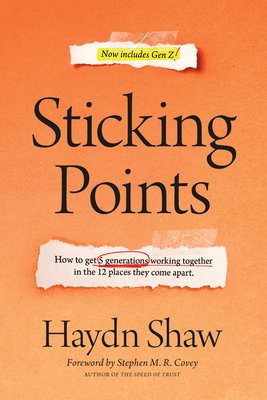
Updated with new findings on Gen Z! With five generations in the workplace at once, there’s bound to be some sticking points. This is the first time in American history that we have five different generations working side-by-side in the the Traditionalists (born before 1945), the Baby Boomers (born 1946–1964), Gen X (born between 1965–1980), Millennials (born 1981–2001) and Gen Z (born 1996–present). Haydn Shaw, popular business speaker and generational expert, has identified 12 places where the 5 generations typically come apart in the workplace (and in life as well). These sticking points revolve around differing attitudes toward managing one’s own time, texting, social media, organizational structure, and of course, clothing preferences. If we don’t learn to work together and stick together around these 12 sticking points, then we’ll be wasting a lot of time fighting each other instead of enjoying a friendly and productive team. Sticking Points is a must-read book that will help you understand the generational differences you encounter while teaching us how we can learn to speak one another’s language and get better results together.
Haydn Shaw is a leading expert on understanding generational differences and transforming negative work environments and employees. He is a full-time speaker and consultant for FranklinCovey specializing in leadership, execution, and personal productivity methodologies. Before that, he was a minister for nine years and has a seminary degree. Haydn has worked with more than 1,000 businesses, not-for-profit organizations, and governmental agencies. He speaks and consults in excess of 170 days each year for clients who consistently invite him back. Recently hailed as a “leadership guru” by the Washington Post, Haydn Shaw has delivered hundreds of convention keynote or intimate off-site addresses. Known for taking groups from hilarity to deep reflection, he combines rich content with modern teaching methods. Having worked with hundreds of organizations, Haydn employs practical and inspiring examples from the boardroom and from the front line of business. Haydn Shaw travels from Chicago, where he lives in a multigenerational household with his family.
3.5 stars - I thought this book was super interesting, just got a little repetitive towards the end. An insightful look into the 5 different generations and their expectations in the workplace. Also helped me identify as a “cusper” between millennials and Gen X (s/o to that ‘96 bday) and how I never feel like I fully relate to either group.
I used this book as a resource for a lecture I was giving for a leadership training for educators on generations. The book was well written and organized. It did not fit my purpose for my lecture, because it is mainly for businesses. It's a shame that generations are mainly studied for the purpose of just companies to use to have a more successful and productive business.
"Sticking Points: How to Get 5 Generations Working Together" by Haydn Shaw examines a challenge that has quietly become one of the most disruptive forces in modern workplaces: generational friction. Many people recognize the feeling of leaving meetings irritated without quite knowing why, sensing tension in debates about communication, flexibility, technology, or expectations around loyalty and feedback. Shaw argues that these frustrations are rarely personal, even though they often feel that way. Instead, they stem from a historically new reality. For the first time, organizations regularly include employees shaped by vastly different life experiences, from those who entered adulthood before television to those who have never known a world without smartphones. The book’s central message is reassuring: while generational conflict is real, it is also predictable, understandable, and manageable when leaders and teams approach it with curiosity rather than blame.
Shaw explains that for most of human history, both families and workplaces operated according to a simple logic of succession. Authority moved slowly from old to young, and patience was rewarded with influence. That structure made sense in stable economies where roles changed little over time. Today, that rhythm has broken down. People live and work longer, often remaining capable and ambitious well into what used to be considered retirement age. As leadership positions stay occupied for longer stretches, younger workers frequently feel stalled, unsure whether waiting will ever lead to meaningful opportunity. At the same time, older workers may feel pressure to justify their continued presence, even as they contribute experience and judgment that organizations still rely on.
Speed intensifies this tension. Technology and information now move so quickly that expertise no longer follows age in a neat line. Younger employees often master tools and systems that did not exist when their managers were trained, giving them early access to data and influence. This shift disrupts traditional hierarchies and invites challenges from unexpected directions. Authority based solely on tenure becomes harder to defend in an environment where knowledge spreads instantly and widely. Shaw emphasizes that this is not a failure of respect, but a structural change that organizations must learn to navigate.
Cultural upbringing adds another layer. Several generations were raised as consumers, encouraged to ask questions, compare options, and expect choice. That mindset naturally carries into the workplace, where people want early input, frequent feedback, and work that feels meaningful rather than merely dutiful. When these expectations collide with older norms built on patience, deference, and delayed rewards, misunderstandings arise. Shaw points out that organizations often respond poorly, either pretending generational differences do not exist or trying to force one group to adapt entirely to another. Both approaches waste energy and deepen resentment.
Instead, Shaw argues that leadership, not correction, is the solution. Effective leaders focus on understanding how work looks from different generational perspectives and create space for negotiation and shared problem solving. This becomes especially important when deciding how much flexibility to allow. The book makes a clear distinction between genuine business needs and inherited preferences. Rules that protect safety, customers, or revenue deserve firm enforcement. Rules that exist mainly because they feel familiar deserve scrutiny. Shaw illustrates how clinging to outdated norms, whether around dress codes, schedules, or communication styles, can quietly drive disengagement and turnover, particularly among younger employees who notice misalignment quickly.
Training and learning preferences offer a clear example. Some people learn best in structured, in-person environments, while others prefer short, repeatable digital formats. Shaw suggests that arguing over which method is superior misses the point. The real measure of success is whether people learn the skill well enough to use it. Offering multiple paths to the same outcome, then checking for effectiveness, reduces friction and improves results. This flexible, outcome-focused thinking applies across policies and practices, allowing organizations to adapt without sacrificing standards.
Communication emerges as one of the most sensitive fault lines. Every generation wants to feel informed and respected, but they differ in how messages should be delivered. Older workers may value face-to-face discussion and sustained attention, while Gen X often favors email as a practical middle ground. Millennials and Gen Z, shaped by social and mobile technologies, expect interaction and responsiveness rather than one-way broadcasts. Shaw stresses that none of these styles is inherently better. Each has strengths and blind spots. Problems arise when teams assume their preferred method is the only reasonable one.
The book encourages teams to treat communication as a shared skill rather than a personal habit. Customer needs and business outcomes should guide choices, not comfort alone. Strong teams flex in both directions, with older employees experimenting with new tools and younger employees slowing down to absorb context and institutional memory. Learning each other’s 'native language' allows teams to choose the right channel for each situation instead of fighting over a single standard.
Knowledge transfer presents another major challenge. As experienced employees approach retirement, organizations worry about losing decades of insight. Shaw notes that older workers often prefer to teach through conversation and demonstration, while younger workers want information that is searchable, visual, and easy to revisit. When this tension is ignored, knowledge remains locked in people’s heads or gets lost in translation. The book offers a practical compromise: capture experience in formats that suit both sides, such as informal videos, short guides, and transcripts. The goal is not perfection, but continuity.
Meetings, finally, reveal generational differences in real time. Some participants see meetings as essential to collaboration, while others view them as interruptions. Behaviors like multitasking can be interpreted as either engagement or disrespect, depending on perspective. Shaw argues that banning devices or enforcing rigid rules rarely solves the underlying issue. More effective changes include sharing updates in advance, reserving meeting time for discussion and decisions, and creating psychological safety so people feel comfortable asking questions or admitting confusion. When time feels respected and voices feel heard, meetings become more productive across age groups.
In conclusion, "Sticking Points: How to Get 5 Generations Working Together" by Haydn Shaw offers a practical and humane guide to navigating one of today’s most common workplace challenges. The book shows that generational conflict is not a sign of failure, but a predictable outcome of rapid social and technological change. By distinguishing business needs from personal preferences, encouraging flexibility, and designing systems that capture strengths across ages, organizations can turn generational diversity into an advantage rather than a liability. Shaw’s core insight is simple but powerful: when leaders move beyond blame and focus on understanding, five generations working together becomes not a burden, but a resource.
Were you born between 1945 and 2000? Do you work with people born between 1945 and 2000?
If you answer yes to either of these questions, you need to read Sticking Points by Hayden Shaw. This book will help you navigate the world of working with 5 Generations.
This book is not a concept book but a "how-to" manual. Sticking Points walks you through the backstories for each of these 5 Generations and the "Ghost Stories" that help define the perspective of each Generation.
It then points out the 12 Sticking Points that most companies and teams face and provides you with a 5 step process to help your team navigate bringing your 5 Generations together.
Here's the truth, we old guys (I'm on the Cusp between Boomer and GenX) are going to work longer than ever and the Gen Z's are going to take over the workplace in the next 10 years so we are all going to have to learn to work together. This book will help us get there.
Could have been a nice pamphlet or presentation, but shouldn’t have been a whole book. Lots of focus on generalizations based on generations, but then using the same basic formula for “unsticking” that you would use for any conflict. It also has a very scoped and singular perspective that completely ignores the intersectionality of experience. I did not take anything useful away from this book and ended up just skimming the last bit because it was so repetitive. I would have given up on it quickly if it were not for a work book club, but it didn’t get better as it went.
Ironically seemed to be written by and for Gen X and Boomer generations without a strong understanding of or input from other generations.
I just used this book as the lunch and learn topic for our Diversity team presentation at a factory. We have all five generations working in the factory. Take home thought..why do we think it is ok to stereotype and use “they” and make fun of other age groups when we don’t think it is ok to talk about others race or ethnicity etc in those ways. We cannot change what year we were born or what generations before us taught us or what technology was available when we group up.
I seriously don’t know how I communicated very effectively before reading this book. I was often frustrated with colleagues from a different generation, and how they thought, felt, and interacted. Now I have a better understanding of each generations’s culture and communication styles. This book is a must read for anyone in today’s workforce.
Five different generations in the workplace create a large amount of issues. This book articulates what those differences are, why they are, and what to do to get them all to co-exist towards a common goal. Very interesting and well worth the read.
TLDR. I resorted to just the bullet point at the end of the last few chapters. I took what I could to relate to my situation, but this is much more for organizations or companies dealing with all generations.
This book help me with how to communicate more easily with the many generations I deal with on a daily basis . Definitely will reference back incase I experience any other dilemmas