The Roofing Ceremony is a powerful, ultimately hopeful short novel that will revise the narrow view of August Strindberg as merely a misogynist and the gloomiest of Scandinavian writers. This novel has an inwardness, irreducibly and complexly human, that looks back to Tolstoy's The Death of Ivan Ilyich and forward to Samuel Beckett's Krapp's Last Tape. Published in Sweden in 1906 and never before translated into English, The Roofing Ceremony (Taklagsöl) anticipates in its turbulent intensity the chamber plays Strindberg was soon to write. It is about a dying man, once an explorer but now a museum curator, who reviews his tumultuous life aloud as he drifts in and out of a morphine-induced sleep. Sometimes fragmentary, sometimes episodic, this impressionistic monologue builds up a vivid and nuanced portrait of the curator and his estranged wife, chronicling passionately but also humorously the descent of their marriage from island idyll into bitter comedy into tragic estrangement. Strindberg anticipated in this work the modern psychological novel and the technique of stream-of-consciousness. A curious, brief narrative Strindberg meant to incorporate into The Roofing Ceremony but never did is also included in this book, as well as a story called The Silver Lake written in 1898, which also appears in English for the first time. A museum curator, summering on a Baltic island, seeks out a forbidden lake and shares its enchantment with his wife and children. But his marriage is doomed, and when he returns to the lake alone, its mystery turns sinister.
Johan August Strindberg, a Swede, wrote psychological realism of noted novels and plays, including Miss Julie (1888) and The Dance of Death (1901).
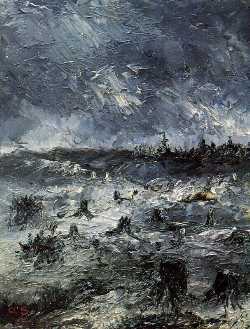
Johan August Strindberg painted. He alongside Henrik Ibsen, Søren Kierkegaard, Selma Lagerlöf, Hans Christian Andersen, and Snorri Sturluson arguably most influenced of all famous Scandinavian authors. People know this father of modern theatre. His work falls into major literary movements of naturalism and expressionism. People widely read him internationally to this day.
A psychological novella (85 pages) from 1906, translated from the Swedish. And a short story.
We could subtitle the novella “Reflections on an Unhappy Marriage.” A dying old man drifts in and out of consciousness as he lies in a morphine stupor. He lies there thinking of his life, mostly on the dissolution of his marriage. He was an academic, a scientific man, married to a woman he considers emotional and superficial.
Although he is a scientist, he thinks a lot about fate, the Greek gods, superstitions, ghosts and numerology. The man is the type who had many ‘enemies’ and much of the story is about the man’s estrangement from his relatives. His wife attempts to befriend them and smooth things over, which leads to worsened relations between the husband and wife.
The novella takes its name from the completion of a house in a nearby vacant lot that the man watches while he lies dying. The house will block the view of one of his enemy’s houses.
A short story, The Silver Lake, is included in the book. A man learns not to cross traditional folk myths. He fishes in a cursed lake with predictable results.
Wikipedia tells us that Strindberg was a prolific writer, especially of plays – he wrote 60 of them. He is considered the "father" of modern Swedish literature and his The Red Room (1879) has frequently been described as the first modern Swedish novel. He was also a painter (see image at top).
Edited and pictures added 8/21/2021
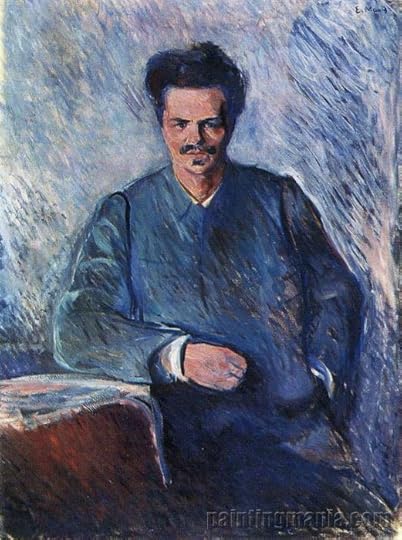
Painting "Land Clearing" by the author from wikipedia A portrait of the author by Edvard Munch from paintingmania.com