Jonathan Carroll is a writer whose name I have been hearing over the years, but whose fiction I've never tried. An American living in Vienna for many years, he has developed a quiet but steadfast cult following - much like the city itself, with its with its unlimited supply of quiet coffee houses - the famous Viennese cafés, described by UNESCO as places "where time and space are consumed, but only the coffee is found on the bill". Legend has it that soldiers from the Polish-Habsburg army found sacks full of strange beans while liberating Vienna from the Turks in the 1600's. They initially wanted to burn them as they thought that they were camel food, but Polish king Jan III Sobieski gave them to one of his officers, who recognized what they were and soon started the first coffee house. Many Viennese cafés hang the picture of the officer - whose name was Jan Franciszek Kulczycki - in their windows.
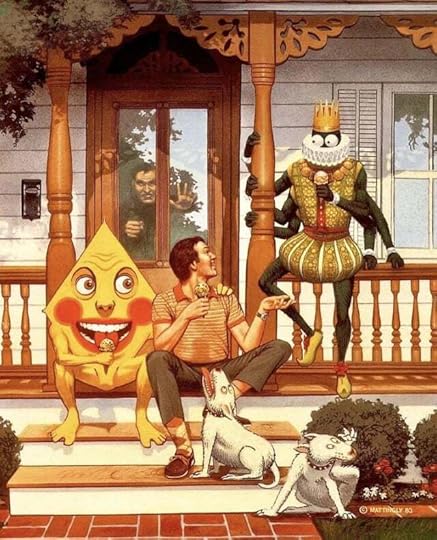
The Land of Laughs is Carroll's debut novel, published in 1980. It's both a fan favorite and a cult classic, having been reprinted by Orion Books in 2000 as the ninth volume of their Fantasy Masterworks series. The Orion edition brough it back to print, as it has fallen out of it for a number of years, and became a reason for despair for many Carroll fans who couldn't get their hands on their favorite author's debut, which grew in value and expectations. Of course now the age of digital publishing has largely eliminated such problems, as the Kindle immortalized hundreds of thousands of volumes which would otherwise share the same fate - which is both a blessing and a curse: the blessing being an eternal digital life of novels, with readers not fearing that their favorites will go out of print and that they will be unable to read them, as there is no print to speak of - but also a curse, resulting decreasing sales of paper books made of trees in favor of their Kindle counterparts made of ones and zeroes. I fear for independent mom-and-pop book stores going out of business, places where you could walk in and browse the books and talk with the owners about them. I would very much miss such places, as I would miss the paper book - with its smell and feel and history. Most of my books come from second hand, and I always wonder about the previous readers and owners. Where did they get it? How did they like it? What was the book's journey before it reached my part of the world? Sometimes readers would inscribe short notes on the book, a dedication to someone they gave it to - and I wonder, what made that person to give it away?
I hope that you'll excuse this longish introduction, which I felt was appropriate for Carroll's novel, which also deals with books. It's narrated in the first person by Thomas Abbey, a man famous for being the son of his father - a famous actor. Thomas is a man stuck in a limbo - he teaches English in a prep school in Connecticut and feels that his life is as interesting as watching grass grow. Desperate for a change, Thomas decides to do something which is interesting to him - write a biography of his favorite writer, the late Marshall France. France wrote children's books which Thomas loved when growing up, and remained very much interested in. Although France was renowned for his imaginative and unique work, almost nothing is known about his personal life. Motivated by curiosity about France's life and staleness of his own, Thomas sets out on an ambitious project which will take him to the small midwestern town of Galen, Missouri, where France was born and lived. He will be accompanied by Saxony Gardner, a fellow France-fanatic whom he met by chance in a bookstore while shopping for a rare book by his idol. With their combined efforts they hope to convinve France's surviving daughter, Anna, into letting them her write father's biography. To their surprise, Anna welcomes them warmly and find her excited about their proposal - even eager to have the biography written as soon as possible. But it won't be long before Thomas and Saxony will discover that in Galen not everything is what it seems.
Carrol doesn't hesitate to use all the tropes: a troubled male protagonist and a female sidekick, a mysterious woman and a town with its own secrets, and the last but not least - books full of wonder. Who could resist such a mix? Beginning The Land of Laughs feels like sitting down to relax in an old and comfortable armchair - a personal favorite, creaky and wobbly but still very relaxing. But in Carroll's case the armchair is filled with holes, and its arm rests dangle dangerously, threatening to fall apart at any moment.
Published in 1980, the book is charmingly dated with having no contemporary technology which we grew so used to - forget about cell phones, personal computers, iPads and Facebook. To do his research Thomas has to go to a library, and actually browse through huge volumes. But the sheer fact that he was so obsessed with a writer's work and never in all these years developed any interest in learning anything about his life seems wildly implausible - even if he had no Google. (imagine if he had a Kindle - so many problems solved! But then you can't hit anybody on the head with a Kindle. Well, you can, but the thing is so light and thin that it'd break in two and would feel like a mosquito bite, so what would be the point?).
I did not find any of the characters likable, and found Thomas to be
unsympathetic, ungrateful and boring. None of the characters was paricularly interesting and all of them were very undeveloped - especially both women. Anna is presented as little more than a mysterious minx, and Saxony never rises above the label of the devoted nerd. There's a ton of sex scenes in this book which it really could have done without, which made it seem as if they were the only reason for inclusion of two female characters. This smelled strongly for sexism, even for an 80's fantasy novel. Perhaps the biggest flaw is that along with technical aspects the plot itself has dated - after so many versions of a similar story done in film, television and literature I did not find any of the developments particularly surprising, and the sudden and unsatisfying end left me feeling let down.
The Land of Laughs was praised by Neil Gaiman, who also chose it as his selection for Audible. Pat Conroy has described Jonathan Carroll as a "cult waiting to happen", and it has happened indeed - but I would never have guessed it from this rather weak and predictable debut. I do not understand why Orion books chose it as a representation of a Fantasy Masterwork, and why it's considered a cult classic - it reads more like a clunky creative writing assignment commisioned to a young writer, fresh out of college. The plot is largely predictable, the characters and their relationships shallow, and the sudden resolution lets any tiny amount of suspense swoosh away quickly like air from a punctured balloon. Perhaps his later novels are better - I sure hope so - but only in the eighties could anyone begin a longlasting career with an effort like this.