A Tale of Two Women Painters: Sofonisba Anguissola and Lavinia Fontana is the first book to compare the works of two pioneering women in the history of painting. These artists represent two different models of creators whose personality, recognition, and life story played a decisive role in blazing new trails for subsequent female painters to follow. They were both born in Italy, an environment that was advantageous to women’s art and where there was furthermore considerable concern throughout the sixteenth century with dignifying and educating women in settings other than convents, the main centres for their cultural enrichment and artistic development since the Middle Ages. Likewise, they both received essential encouragement from their fathers, who viewed their daughters’ artistic talent as a source of family livelihood.
This catalogue analyses the features common to both women as well as the differences stemming from their social backgrounds. The early fame achieved by the noble-born Sofonisba Anguissola as a painter infused women’s practice of the art with dignity and led to her appointment as lady-in-waiting to Queen Isabel de Valois, though her post at the Spanish court conditioned and constrained her artistic career. Back in Italy, her long, eventful life was accompanied by a recognition that has lasted until the present, earning her mythical status. Lavinia Fontana’s life story is more in keeping with that of other female artists: she trained with her father, a prominent painter, who helped her become the first professional woman artist with a workshop of her own.
A recent exhibition in the Prado Museum confronted two Italian female painters from the Renaissance, Sofonisba Anguissola (1532-1625) originally from Cremona and the considerably younger Lavinia Fontana (1552-1614) from Bologna.
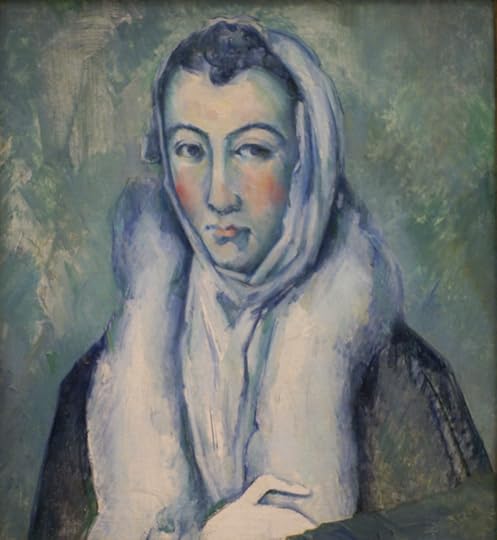
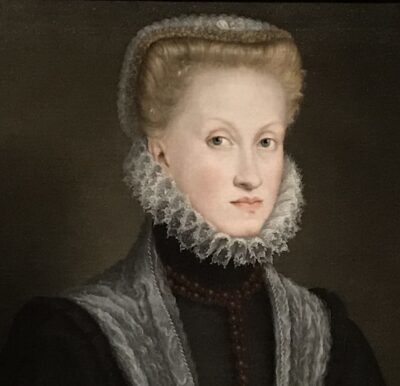
The idea for this exhibition sprung from another one on El Greco and Modernism, back in 2014. The beautiful painting Lady in Ermine ascribed until recently to the Greek painter, came to the exhibition to be paired off with Cézanne’s copy (from a black and white print in a book – which also came to the exhibition). Lady in Ermine was cleaned and studied technically in the Prado with the conclusion that it just did not have the Greco texture.
Two other possibilities in the attribution came up, Sofonisba Anguissola (which was my guess) and Alonso Sánchez-Coello (1531-1588), the official portraitist in the Spanish court. . The Prado then concluded that they needed to look with a greater technical focus into the court portraiture produced during the reign of Felipe II. So, they decided to start with their four Sofonisba paintings.
As it happens with reading, I imagine that in art investigation something similar takes place. One book leads you onto another, sometimes derailing you from your original reading plans. Sofonisba led them to compare her with Lavinia Fontana. There is really no explicit link between the two female painters, and this baffled me about the exhibition. Granted, the older artist, who enjoyed great notoriety from an early age, very probably had a bearing in Lavinia’s choices, particularly when it came to self-portraits, but all painters had a bearing on the others. Anyway, I enjoyed looking at the selection of both and this somewhat forced pairing was certainly inviting.
Sofonisba’s career as a painter went through a very atypical path even in a time when there was no typical career as a painter for a woman. She was promoted for her abilities by her father, Amilcare, with a fervour that many artists managers would like to secure for themselves. Amilcare, who came from a second tier of the nobility, had six daughters and only one son. He must have felt the pressure of what to do with so many daughters since, whether they married or entered a convent, a dowry was needed. Instead she was raised following the precepts expounded by Castiglione in his The Courtier that were expected of a well elevated lady. She played music, she sewed, she read and she painted, the last ability extraordinarily well.
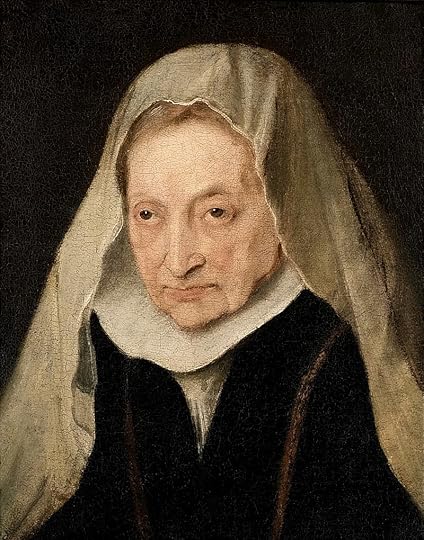
As Cremona belonged to the Duchy of Milan and as this Duchy was incorporated into the Spanish kingdom in 1535, Amilcare managed to find a place for Sofonisba in the court of the new Queen, Élisabeth Valois, to whom Sofonisba would teach to paint (again Castiglione’s precepts). In Spain Sofonisba stayed for fifteen years, well beyond the death of the beautiful queen in 1568. The King married her off to a Sicilian nobleman (her preference was to marry an Italian rather than a Spaniard, even if Sicily belonged at the time also to the Spanish crown) and she left. Her husband died at sea in an episode suitable for a novel when his boat was captured by pirates. Sofonisba found however a new husband and married him without waiting for the required license - neither from her (younger) brother nor from the King (who was still paying her pension). She died in old age and Van Dyck has left us an indelible portrait when he visited her in Palermo.
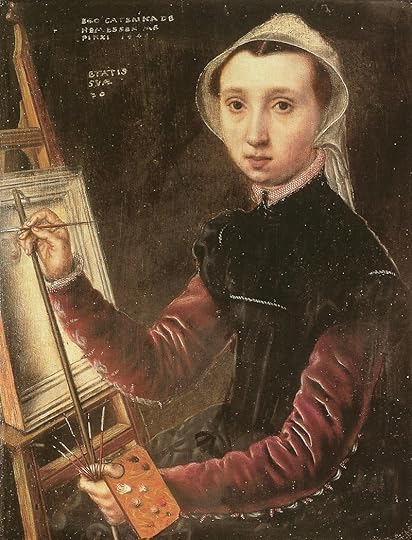
The exhibition makes clear that there were three periods in Sofonisba’s career: in Cremona before she moved to the Spanish court. Then she painted mostly portraits, of her family or of herself. The self-portraits served as models for Lavinia, but we cannot say that Sofonisba was the first woman to tackle this. The Prado has included Caterina van Hemessen’s delicious self-portrait now in Basilea, dating from 1548.
This Caterina, originally from Antwerp, set a precedent for Sofonisba also in that she had also been in the court of female royal in the Spanish court. She had moved to Madrid following the widowed Mary of Hungary, who came to live in the court of her brother the Emperor; her role was also one of teaching the other ladies to paint. Caterina depicts herself painting but she was close to music since her husband was the organist of the Antwerp Cathedral Chrétien de Morien. Sofonisba depicts herself either painting or playing a spinet or holding a book, thereby showing all her abilities.
The second period, encompassing her time at the court, is the most problematic for art historians. Her main role was that of a lady-in-waiting and had therefore no workshop of her own, a having to use that of Sánchez-Coello. The works she carried out are then not signed and she would not have been paid explicitly for them, receiving at most a few gifts such as expensive brocades. She probably collaborated with other painters in the realization of some of the works. Attribution for the whole production of court portraits is proving extremely complex. Four portraits however seem to have come out of her hand. They are lovely in the delicacy of their execution. And they make me wonder at a claim in the catalogue – that Sofonisba did not go much beyond her Cremona abilities while in Spain. I disagree since I find them very luminous, and the technical analysis explains that they should be so since Sofonisba did not use the brownish base while in Madrid she used a light and warm grey that filters through her very delicate brushstrokes.
The last period extends from her departure from Spain until her death. This period seemed less interesting to me. Her work changes, leaving no portraits and the delicacy of host of her work is religious and very much based on the work of Luca Cambiaso (1527-1585).
It is difficult not to wonder what would have happened to Sofonisba’s art had she not subsumed it into the life and duties of a court lady.
Lavinia comes across as a painter I would like to know more about. I first encountered her during my last visit to Bologna a couple of years ago. This exhibition offers but a small sample of her work. Lavinia had her own workshop and produced portraits, religious, and particularly fascinating, mythological works (read ‘nudes’), and often in a large scale. Bologna belonged at that time to the Papal territories and with its university became a bastion of the Counterreformation. The painters in Bologna, however, had no guild of their own until 1599, remaining as just ‘artisans’. Lavinia’s father was a painter but whose renown began to dwindle while the economic needs mounted (the need for those dowries for daughters!) and similarly to Sofonisba’s case, the father began promoting the abilities of the daughter.
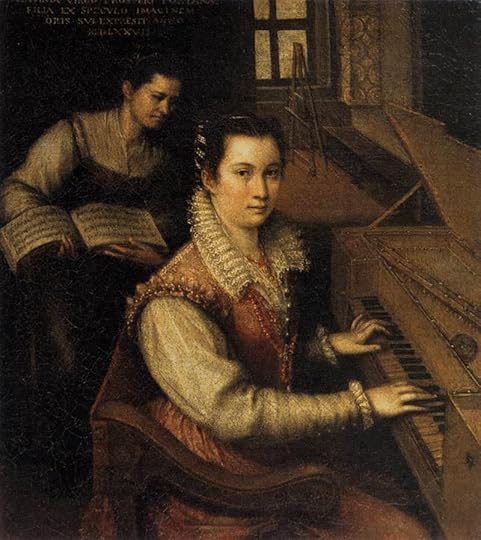
Lavinia’s early works, from the 1570s, are still small and devotional. We find though a self-portrait in the manner of Caterina and Sofonisba. But offering greater economy of means, she presents herself both as able in painting and in music.
In the foreground Lavinia is playing her harpsichord, but in the background we see an easel next to a well-lit window (with no canvas on it, though). There is a servant carrying a musical score and the keys in the harpsichord are painted with greater musical accuracy than in Sofonisba’s. Interestingly, Lavinia depicts herself wearing more lavish clothes than did Sofonisba even if, or possibly because, she belonged to a lower stratus in society.
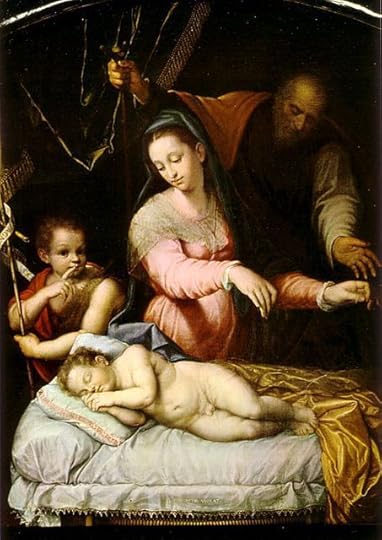
The Prado, although it has no Lavinia of its own, has managed to present a well-balanced selection of her paintings. There is a lovely Virgin of Silence that belongs to the Spanish Patrimony which must have entered the Royal Collection at an early time and I was drawn to a Noli me Tangere from the Uffizi based clearly on Correggio’s version (currently in the Prado) but a greater range of browns and less blue. Its air of privacy or closeness between Christ as a gardener and the surprised woman is particularly appealing.
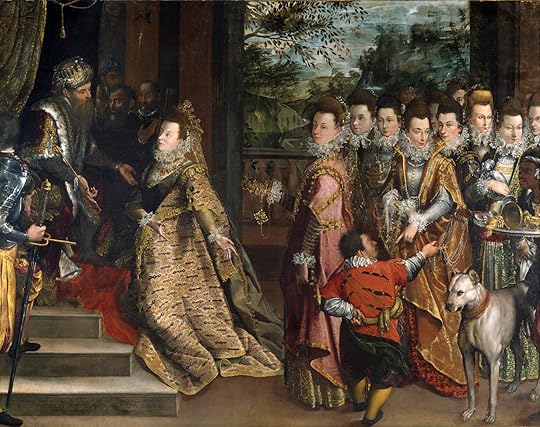
Although the museum has succeeded in bringing a few paintings of large scale, we realize from the essays in the catalogue, that there are a few others that as they did not travel to the exhibition, call for a journey to visit them. For me the Old Testament scene with ‘hidden portraits’ in the Dublin National Gallery is one such magnetic work.
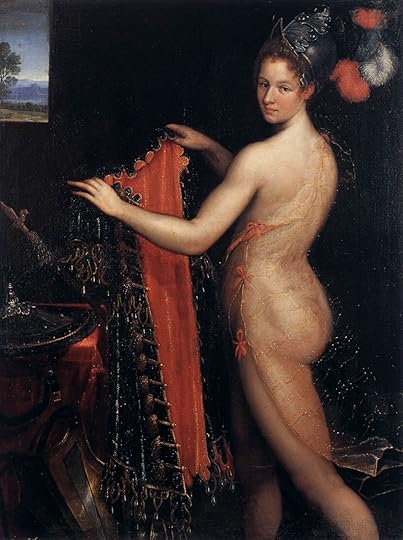
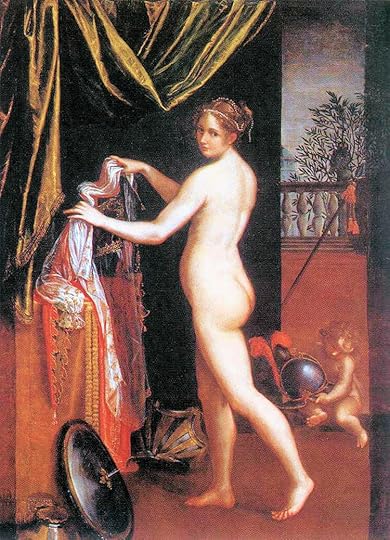
But it is the mythological paintings that strike most the viewer. One of them welcomes the visitor, (which I included at the top of this review), with its second version offering the farewell.
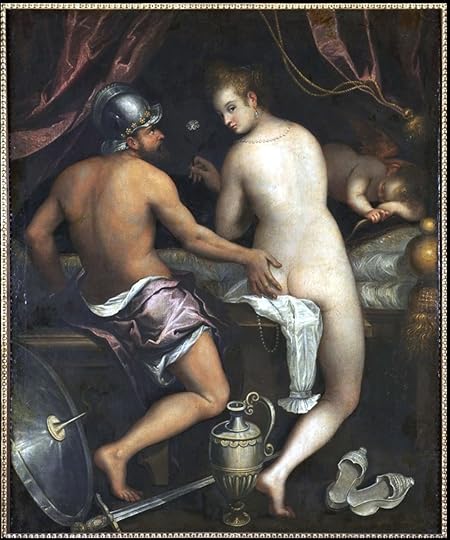
And in this category the most mischievous is one in a Spanish private collection, which has been relatively recently attributed to Lavinia. Her Mars and Venus has particularly fascinated the Italian scholar, Enrico dal Pozzolo, who gave a lecture in the Prado and who has studied it in his "Colori d'Amore". Differently to our current preferences, the view from the back of a nude female was considered highly enticing, as has transpired from an exchange of letters by Titian. But it is her coy regard back to the viewer while she offers a flower to her ardent Mars.
More work needs to be done in rescuing female artists from past history in particular when they were already highly considered in their own time.
The Prado has drawn on a wall a fantastic diagram that maps out the painters, male and female, from the renaissance until the late baroque, and there were so many women we cannot name.
How sad, but hopefully our shortcoming will gradually dissolve as more of these exhibitions are organized across the world.
Two women who chose to be artists and were supported in their quest be enlightened parents. Their works enjoyed widespread recognition across Otaly and France and were in demand by Kings and minor aristocrats and admired by top ranking artists from across Europe.