Twenty-seven years after his death, Roger Hilton's reputation as a leading figure in British 'abstract expressionism' continues to rise. Following the major retrospective exhibition at the Hayward Gallery in 1993 and the drawings survey at the Tate St Ives in 1997, this lavishly illustrated account is the first to provide a comprehensive overview of the life and work of this important artist.
Monographs on Roger Hilton are somewhat difficult to track down. They are meant to be out there but when you try and get hold of them they seem somewhat like hens teeth. Like most works on near contemporary artists it comes down to commonly the way art education has changed. Now in order to gain anything like some teaching or part-time lecturing time one has to possess a PhD. in Fine Art or Art History. In order to gain that one has to undertake a piece of original research. This rather excellent monograph on Hilton’s art has been undertaken by Adrian Lewis, himself a painter but principally a senior lecturer in History of Art and Material Culture (what?) at De Montfort University, Leicester. Of course, Hilton himself did little to endear himself to the art world of gallerists, academics, curators and what not, considering them to be a plague and a set of leeches on the backs or artists. Coming across this work by Lewis was a bit of a find and it is a worthy piece of work on Hilton and a chance to look at his excellent paintings again. Ashgate publishing have compromised a little between the number of colour illustrations and black and white photos of his work, particularly of the gouaches, but then a monograph like this with all colour illustrations of the work would have driven it up in price extortionately. It takes its place alongside the excellent ‘Roger Hilton: Night Letters: Drawings & Gouaches’ and some of the excellent exhibition catalogues like the 1993 Hayward Gallery catalogue of his solo show there from 4/11/93 – 6/2/94.
I came to the book as Hilton is an artist that has influenced my work and whose painting ‘style’ I have appreciated for many many years. Along with Peter Lanyon they represent for me the best of the St Ives School and I was struck by them as a teenager. When he hit the headlines was with his winning of the John Moores prize for painting in 1963 with the painting March 1963 shown at the Walker Gallery in Liverpool
Prior to this Hilton had gradually gained a following that comes with having a dealer and showing work regularly and selling and teaching. Lewis looks at the early work through the 30s and 40s, through his associations with COBRA artists, the Tachistes and what Lewis describes as ‘the Brutalists Jean Dubuffet, Eduardo Paolozzi and Alberto Burri. By this time (1955) Hilton had developed a style pretty much of his own and was represented by the gallery Gimpel Fils. His work was beginning to be sought after like the July 1953 painting bought by the Stedelijk Museum Amsterdam and an Untitled painting sold to the Tate in 1953
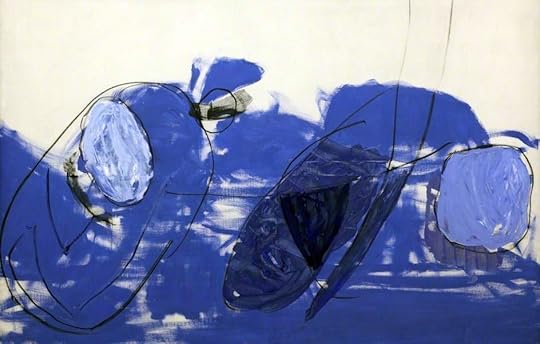
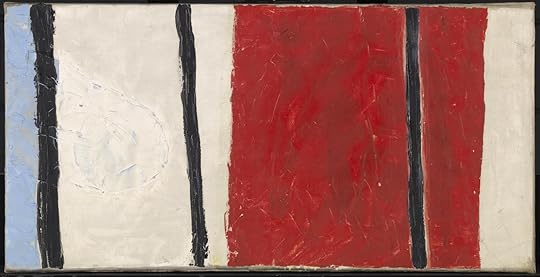
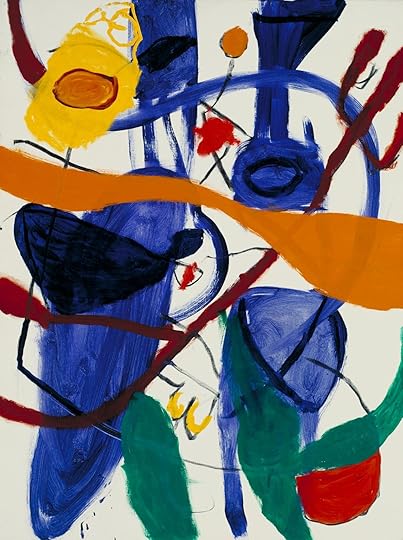
This was a painter who believed absolutely in the power of Abstract Painting. This was not the Neo Plasticism of Mondrian though there were connections to what Mondrian was doing. And this wasn’t the ‘abstracted landscape’ that Lanyon was producing, seated as it was in the power and affect of the Cornish sea and landscape particularly of the West Penwith peninsula. This was colour against colour, shape against shape with the addition of strongly graphic elements in scored charcoal drawing and scraped painted areas to produce what in the artist’s view was a harmonious whole to produce an effect in the mind of the viewer parallel to the drive that the artist had sought in producing the work.
Of course, you also get all the arty bollocks that goes with it, often from the mouths of the artists themselves. And Hilton was not immune to this. Some of his notes and writing within catalogues and to critics may shed light on his painting at one moment and be totally obfuscatory and opposite of what he might have said at a previous time. This we expect. Or at least have come to expect from someone who was such a showman as Hilton was. There is a sense that Hilton felt that he had to live up to what was circumscribed as ‘the artist’s behaviour’. And this was in a way amplified by his increasing use of alcohol and sense of self. Throughout his life Hilton managed to fall out with most of his friends and supporters, galleries and critics. His partners and children put up with his behaviour by and large with Rose Hilton only attaining her own space as an artist after Roger’s death in 1975.
His latter years were mainly bed-ridden due to peripheral neuritis caused by his alcoholism. This saw him move to working with drawn elements within gouaches. These came to define Roger Hilton and they stand as brilliantly as the large oils did earlier in his career.
Lewis has done a good job of an overview of Roger Hilton’s career with this book. He does fall into the troubled splendour that all art historians appear to fall into of describing or attributing something to the work which ain’t necessarily so. But if you come to this with your own views of Hilton’s painting and life, then the book is more than just a picture book of the works and there are interesting insights provided within the text. That really is about as much as you can expect from a book on an artist from an art historian.