The word "blurb", meaning a short description of a book, film, or other product written for promotional purposes, was coined by Burgess in 1907, in attributing the cover copy of his book, Are You a Bromide?, to a Miss Belinda Blurb. His definition of "blurb" is "a flamboyant advertisement; an inspired testimonial".In that book "Are You a Bromide?" and related essay "The Sulphitic Theory", Burgess is credited for coining the usage of the word "bromide" as a personification of a sedate, dull person who said boring things.[18] Bromide meant either the boring person himself or the trite statement of that person.-Wikipedia
Frank Gelett Burgess was an artist, art critic, poet, author and humorist. An important figure in the San Francisco Bay Area literary renaissance of the 1890s, particularly through his iconoclastic little magazine, The Lark, he is best known as a writer of nonsense verse, such as "The Purple Cow", and for introducing French modern art to the United States in an essay titled "The Wild Men of Paris." He was the author of the popular Goops books, and he coined the term "blurb."
Published in 1908, and still certainly relevant nowadays, this is the sort of essay that would in our contemporary age be part of a blog series or would be distilled in an article of the Onion or some other parody news source. This particular short essay was originally published in "The Smart Set" in 1906 and was then made into a standalone volume, presumably to be read and chortled over by those who fancied themselves to be "among the illuminati (9)." It is difficult for me at least to read this book and avoid seeing that it is written on at least two levels. On the one hand, this book is a lighthearted humorous piece that divides humanity into two types, conventional bromides who ape the trends of others and unpredictable sulphites capable of original thought. One can sense within the reader as well an understanding that the terms used by the author are capable of becoming cliches, so that people who read the book uncritically can adopt the language of the book without having the proper ironic mindset to apply them to themselves, such that what is original can become copied often enough so as to eventually be particularly trite and banal.
The essay itself is a short one of about sixty quarto pages, barely qualifying in length as a book, but for its small size, which makes sense because of its origins as a lead piece in a magazine, it is still a worthwhile book to read today because it demonstrates a particular t rend within contemporary culture that I write and reflect upon often. At the heart of this book is a polarity between what is striking and original and that which views itself to be original but is painfully unconventional, between those who come to their own thoughts even if those thoughts may not be particularly unusual and those who uncritically adopt the thinking of others and therefore think themselves to be more original on those grounds. We may think of this as the polarity between those who are thought leaders and thought followers, between those whose mind bubbles with originality and those who are continually surprised by what they see in others, between those who are able to take a critical and ironic look at themselves and their own lives and those for whom the artist and the progressive are merely a pose and whose self-seriousness makes all efforts to rebuke or correct or lightly and gently tease become fraught with all kinds of danger. The author himself is full of irony and paradox, and one reads this book the same way one would read satire [1], with a sense of its layers and its paradoxical enjoyment.
Yet even though this book is not by any means new, it is a very relevant work in explaining many trends in contemporary culture. For example, this book helpfully discusses the tension that exists between those who are originators and those who are copyists. Much of contemporary culture consists of fads and a tendency for what is shocking to become conventional within the course of a generation, something which can be connected to the tendency of many who fancy themselves to be originators and cultural innovators to be discontented about being lumped in with those who copy them, leading them to act in more unconventional and shocking ways and for those ways to be accepted and imitated by the larger culture around. Indeed, what the author titles as sulphitic would be the same as what the contemporary thinker would deem as hipster [2]. All that is original will, if it is of any worth or enjoyment at all, become cliche eventually. What never becomes cliche is the originality of the mindset. And here there is paradox as well. There are those whose lives may be restrained and circumscribed whose freedom of thought and capability for reflection and insight makes them unpredictable despite their dull and boring conventionality, and those who are so intent on shocking and surprising others (think of Madonna here, or Britney Spears or any number of imitators) that they end up being somewhat predictable in their desire to be unpredictable. Those who try to be cool will always find it irritating that others will wish to be just like them, and so they will periodically change how they act and how they present themselves so as to stay ahead of an ever-shifting tendency for others to mimic their example. How much better it would be for people to simply model the sort of behavior that could be copied, and to appreciate the role of being teachers and models of the right way to live. How daring and radical and original would that be?
This is one I started reading long ago and put aside. I'm glad I returned to it. Especially since some of the references led to me finding some brisk, refreshing reads similar to Burgess' own PURPLE COW! and GOOPS books.
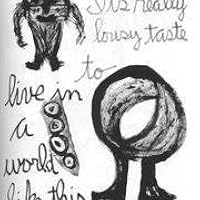
I read "Have You an Educated Heart?" before this one and think it is a stronger book. Even so, this title is worth the hour of reading. Beautiful border art and illustrations add a great touch to the prose.
Yes, I am a Bromide. I'm guilty on several occasions of uttering bromidioms such as "It's not so much the heat as the humidity".
Burgess in his 1906 essay (some references are a bit outdated but as long as the sarcasm stays fresh, who cares?) casts a gimlet eye on my predecessors in the art of boredom – that large part of the population, that live their lives from a script – and bemoans the dwindling numbers of Sulphites, the unpredictable sorts who are ready “to explode” without warning.
The essay is characterized by tongue in cheek humor, and observations (especially with regards to the various bromidioms), that more than a century later, are still as trenchant as when originally published. Recommended.
Is this satire? an attempt to deflate inflated, doctrinaire elites? just another whining and moaning malcontent? self-loathing and self-absorbed plaintiff? too long before the bar?
This book is the worst! I just read it because of the memorable use of the word "bromide" by Ayn Rand in her novels. I was surprised to find out out that popular culture could be just as mind-numbing in the 1920s as it is today. It is like reading an article on thoughtcatalog.com that someone has randomly linked to for some reason.
A short read. I find myself thinking about the central concept of this book from time to time. The Iowa State University library has a beautifully illustrated, and very old, copy of it.
It is a good read, providing the way to think that whether one is Bromide or the Sulphite.The basic difference between them is the being rational and irrational. Must read it is beautifully written.
This was good fun. I listened to this on Librivox & had a jolly old time. I reckon Michael Malice is one of those sulphites [people who are spontaneous and original in thought and conversation]. The "Barnum effect" [The tendency of individuals to give high accuracy ratings to descriptions of their personality that are in fact vague and general enough to apply to a wide range of people.] was top of mind whilst listening to this; howbeit, I don't know how relevant that really is. As a lexicographer, I love coming across new words and categorizations; despite, being aware of the dark side of categorizations i.e. over generalizations. I wouldn't say this is the best read but is great to have on in the background as you play games on mute or something.
Light satire on the innovative vs the imitative mind, the original vs the banal personality. A good half-hour´s entertainment that will help you to understand why you find most conversations with most people so boring.