Kubin was born in Bohemia in the town of Leitmeritz, Austro-Hungarian Empire (now Litoměřice). From 1892 to 1896, he was apprenticed to the landscape photographer Alois Beer, although he learned little. In 1896, he attempted suicide on his mother's grave, and his short stint in the Austrian army the following year ended with a nervous breakdown. In 1898, Kubin began a period of artistic study at a private academy run by the painter Ludwig Schmitt-Reutte, before enrolling at the Munich Academy in 1899, without finishing his studies there. In Munich, Kubin discovered the works of Odilon Redon, Edvard Munch, James Ensor, Henry de Groux, and Félicien Rops. He was profoundly affected by the prints of Max Klinger, and later recounted: "Here a new art was thrown open to me, which offered free play for the imaginative expression of every conceivable world of feeling. Before putting the engravings away I swore that I would dedicate my life to the creation of similar works". The aquatint technique used by Klinger and Goya influenced the style of his works of this period, which are mainly ink and wash drawings of fantastical, often macabre subjects. Kubin produced a small number of oil paintings in the years between 1902 and 1910, but thereafter his output consisted of pen and ink drawings, watercolors, and lithographs. In 1911, he became associated with the Blaue Reiter group, and exhibited with them in the Galerie Der Sturm in Berlin in 1913. After that time, he lost contact with the artistic avant-garde. (From Wikipedia)
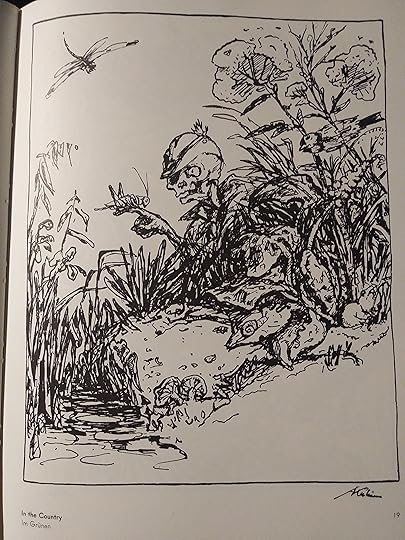
Kubin’s sketches are like the drawings of Goya updated for the 20th century, with a touch of Albrecht Dürer’s woodcuts, Bosch’s imaginative grotesques, and even Grünewald's more macabre visions ("The Temptation of Saint Anthony" comes to mind). Whereas Goya expressed the sufferings and horrors of poor pagan peasants under the oppressive thumb of wealthy landowners and hypocritical religious figures, Kubin focuses more on the ever-present reality of Death pursuing us all. The first section is largely a collection of the figure of Death hovering over (or even participating in) the demise of a wide-range of people. Some of the sketches are unforgettably disturbing, including one of Death clutched almost lustily to a partially-clad prostitute as she hangs from the rafters, assisting her in the act of suicide. The second section is a collection of sketches selected by Kubin of everyday scenes that range from the ordinary to the surreal, mostly devoid of the macabre imagery that pervaded the Death sketches, and sometimes even displaying light humor.
Despite the Introduction claiming that WWI was nowhere to be found in Kubin’s work. I thought the specter of the Great War haunted these sketches from the beginning, as one of the earliest images, “The Mask of Death,” shows a grinning, praying skeleton in what appears to be a Brodie helmet, the most identifiable symbol of the WWI soldier, with his face distorted into what might be a gas mask. In the age of mechanical warfare, the gas mask is the harbinger of Death, its symbol just as potent as that of the cloaked skeleton in medieval art. In any case, if Kubin does not directly address war, the sketches certainly embody the spirit of alienation, loss, and existential crisis experienced by his generation, as his friends and fellow Blue Rider artists Marc and Macke were both killed in the war. I don’t see how these illustrations, made during the height of the most brutal fighting, could possibly be devoid of connection.