What do you think?
Rate this book


124 pages, Hardcover
First published January 1, 2007
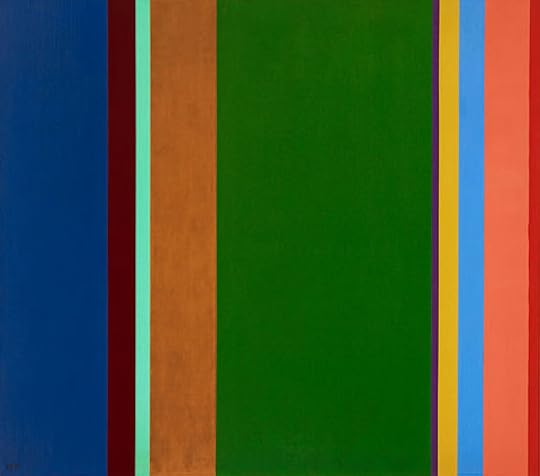
It’s also comforting to realize that Benjamin, Hammersley and McLaughlin, after their fifteen minutes of international fame as “Abstract Classicists,” in Los Angeles, San Francisco, New York and London, continued to flourish in the sunshine of absolute neglect, produced steadily, and created substantial bodies of work that we embrace now with amazement and a little twinge of shame for not having noticed
It embodies a very different conception of the artist’s vocation, which, unfortunately, for pigeonhole-art-historians, has nothing to do with Abstract Classicism---the term with which curator Jules Langsner saddled Karl Benjamin, John McLaughlin, Frederick Hammersley and Lorser Feitelson and to which they all objected
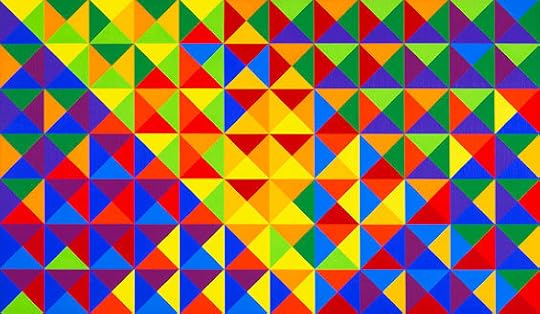
Benjamin, always, the sybaritic Hellenist, aghast at the infinity of options that his brand of oil painting promised... Even today, I can think of no other artist whose paintings exude the joy and pleasure of being an artist with more intensity than Karl Benjamin’s nor any other artist whose long teaching career has left no blemish of cynicism on his practice. He is always the kid in the candy store, the kid with the rock in his pocket drawing it out, showing it to you and exclaiming “Wow! Look at this.” As a consequence, the shape of Benjamin’s practice, driven by rigorous hedonistic curiosity, more closely resembles that of a younger generation of California artists than that of his peers. Like Edward Ruscha, Billy Al Bergsten and Peter Alexander, Benjamin doesn’t follow a path, deal with issues or aspire to a “look”. The narrative of Benjamin’s work spreads like a delta
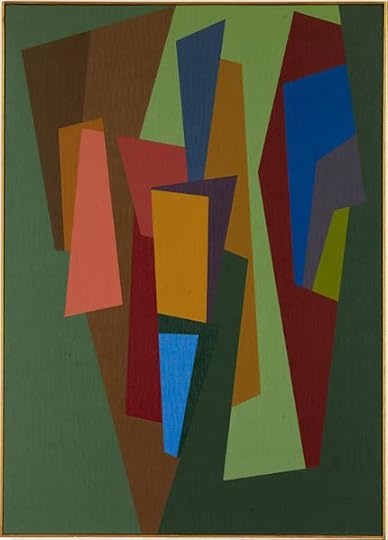
, chicken-egg arguments about the relative precedence of color and line, figure and ground dissolve into pleasurable confusion. If there is a rule at work in these Paintings it is, as Benjamin has remarked, to shun no color, and, as a result, there is no other painter with whom I am familiar, who can deploy and totally denaturalize colors
As a result, no green in Benjamin alludes to foliage; no brown alludes to the dirt in which the foliage grows. Benjamin takes these hues, burdened as they are with primal references, and makes them back into free colors, live presences
the physical consequences of his axiom to shun no color, speak directly to Gerhard Richter’s proposition that “all abstract painting is an allegory of social relations.” For Benjamin, the fact that no color is excluded and all colors are highly individualized, graded and nuanced by context is, in itself, a vision of the world and of society in its specificity
In the Post World War II period, Geometric Abstraction, or Op Art, or Hard Edge painting, or whatever you want to call it was, in fact, the dominant global idiom of that era, the true cosmopolitan language of post war art. During this era, Helio Oittica in Brazil, Raphael Soto in Venezuela, Max Bill in Germany, Jo Baer in New York, Bridget Riley in Britain, Victor Vasarely in Paris, Benjamin, McLaughlin and Hammersley in Los Angeles and hundreds of other artists created a massive body of work, which, if considered collectively, provides a much more rational precedent for the Puritanical Minimalism that followed in New York and the Hedonistic Minimalism that followed in Los Angeles