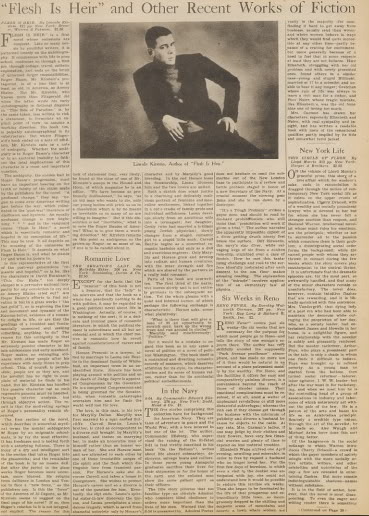
Lincoln Kirstein is well known as the founding director of the New York City Ballet, for his writings on dance, photography, painting, and sculpture. Known to few readers, however, is this early (1932)work, his only published novel, autobiographical in content but historical in scope and purpose.
In a revealing Afterword, Mr. Kirstein recalls his family background and education as well as the circumstances surrounding the writing of his novel. Family wealth and the “permissive generosity” of his parents gave him familiarity with “a fraction of literary London, the main European museums, plus Northern Italy, Spain, and North Africa” by the time he had completed his college education. He thus possessed a unique view, which inspired him “to write an ‘historical’ novel which would utilize what I knew and felt about my own times in as pictorial a fashion as I might muster.”
Flesh is Heir is the story of a boy who serves as the type of the first generation arising in the United States after World War I. At boarding school he experiences mortal fear of a crazy classmate: in a glass works he sees the ironical cruelties of manual labor; in London and Paris he encounters the decadence of one pattern of life, and in Venice, the death of another. He returns from abroad to find the triumph of a violent new force, and with that force he is absorbed.
To say Lincoln Kirstein was a man of many talents is a massive understatement, but it seems pretty clear from his single published novel that creative fiction cannot be counted as one of them. Written when Kirstein was in his mere twenties and drawn heavily from his own life experiences, it is primarily of interest for what it reveals about its author than as any kind of satisfying reading experience. Kirstein, gutted by the patronizingly lukewarm (at best) reaction he received upon publication, gave up his aspirations to be a novelist and decided instead to devote his considerable energies to a seemingly harebrained idea of establishing a ballet company in America to rival Europe and Russia's best.
The rest, as they say, is history. So maybe all good balletomanes, and fans of the vast amount of erudite scholarly writing on art Kirstein subsequently wrote, owe a debt of gratitude to this apparently "lost" and forgotten novel. Because without its failure, who knows what young Kirstein would have decided to do instead?
As for the novel itself: quite frankly, it is deathly dull (or at least what I managed to get through was). The prose is characteristically elegant but utterly lifeless—I dutifully plodded through the first chapter, an extended vignette set in an upper-class New England boarding school, and admitted defeat (afterwards I focused solely on several chapters pertinent to something I was researching). Really, the idea of this novel is more interesting than its actuality—it is fascinating to consider that its author, the brilliant upstart editor of Hound and Hornand considered to be at the forefront of literary modernism and all things new and avant-garde, would himself write a novel that could, at best, be charitably described as amiably antiquated. Really, it's essentially of the quality that would have been expected of a bright, artistic but relatively unexceptional young man of a certain means during the second half of the 19th century. But in the 1930's? This sad little book didn't have a chance.
But it is, ultimately, this dissonance that intrigues me, and it does serve as an early indicatation one of the great contradictions that would mark all of Kirstein's subsequent work: a man whose taste in art and aesthetics was essentially neoclassic, and yet who defended adamantly and often brilliantly to a generally skeptical American public all that was modern and experimental and new. As Flesh is Heir makes abundantly clear, this seemingly incongruous dynamic was there right from the very beginning.
And, truth be told, I do expect to return and read the whole thing someday. Only this time with properly adjusted expectations and a bountiful reserve of patience, of course.