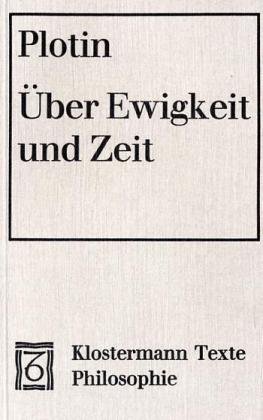
Plotinus’ treatise on time in book III, chapter 7 of the Enneads forms the most important document on the topic between Aristotle and book XI of Augustine’s Confessions. Werner Beierwaltes provides a translation (bilingual Greek-German), an 88-page introduction and 155 pages of commentary, mostly devoted to philological matters. As one could expect, the introduction situates the text in the context of the overall themes of eternity versus time, the inner structure of the intellect and of the soul and the process by which the soul detaches itself from immersion in time and reenters the timeless intelligible realm. Beierwaltes’ careful delineation of all aspects of these things serves as an ideal setting in which to approach Plotinus’ original text. The text itself is concise and compressed, at just 23 pages in either language, as is Plotinus’ habit. First of all, it defines the nature of eternity as life that remains in itself and simultaneously comprehends everything in a single overarching present (one is reminded of Boethius’ formulation in the Consolation of Philosophy: Aeternitas est interminabilis vitae tota simul et perfecta possessio). Plotinus then discusses the nature of time and its relation to motion and to number. His main argument is to contest Aristotle’s definition of time in the Metaphysics as the ‘number of motion’. The crux seems to be that time cannot be a number, just as, by analogy, we distinguish between a function and the numerical value of the function at a given point (where we invoke, anachronistically, the concept of a function as it was developed during the course of the nineteenth century). Rather, as Beierwaltes discusses, time is the life of the soul as it proceeds from and returns to its origins in the timeless intellect, what shows the mystical tendency of Neoplatonism, in which philosophy has not yet separated from religion as the two have become nowadays. Beierwaltes’ introduction and Plotinus’ text itself are excellent and thought-provoking; the extensive commentary, on the other hand, descends into too much minute philological detail to be of much use to the typical reader.