Sophia Andreyevna Tolstaya (née Behrs) (Russian: Со́фья Андре́евна Толста́я, sometimes Anglicised as Sophia Tolstoy), was the wife of Russian novelist and thinker Leo Tolstoy. Sophia was one of 3 daughters of physician Andrey Behrs, and Liubov Alexandrovna Behrs.
Sophia was first introduced to Leo Tolstoy in 1862, when she was 18 years old. At 34, Tolstoy was 16 years her senior. On 17 September, 1862 the couple became formally engaged, marrying a week later in Moscow. At the time of their marriage, Leo Tolstoy was already well-known as a novelist after the publication of The Cossacks.
On the eve of their marriage, Tolstoy gave Sophia his diaries detailing his sexual relations with female serfs. In Anna Karenina, 34 year old Constantine Levin, a semi-autobiographical character behaves similarly, asking his 19 year old fiancée Kitty to read his diaries and learn of his past transgressions.
The Tolstoys had 13 children, only 8 of which survived childhood. Tolstaya tried to convince her husband to use birth control but he refused. Fortunately, the family was prosperous, owing to Tolstoy's efficient management of his estates and to the sales of his works, making it possible to provide adequately for the increasing family.
Tolstoya was a devoted help to her husband in his literary work. She acted as copyist of War and Peace, copying the manuscript seven times from beginning to end.
In 1887, Tolstoya took up the relatively new art of photography. She took over a thousand photographs that documented her life, including with Tolstoy, and the decline of pre-Soviet Tsarist Russia.
She was also a diarist and documented her life with Leo Tolstoy in a series of diaries which have been published in English translation.
After many years of an increasingly troubled marriage - the couple argued over Tolstoy's desire to give away all his private property - Leo left Sophia abruptly in 1910, aged 81, with his doctor, Duchan Makovicki, and daughter Alexandra Tolstaya. Tolstoy died 10 days later in a railway station, whilst Sophia was kept away from him.
Following the death of her husband, Sophia continued to live in Yasnaya Polyana and survived the Russian Revolution in relative peace. She died in 1919.
What if some 30 or 40 years after the events described in "War and Peace" Natasha Rostova were to write her own version of the story of her life?
As I was reading "My Husband Leo Tolstoy" written by Leo Tolstoy's wife, I felt as if it were a memoir of a middle-aged Natasha Rostova or Kitty from "Anna Karenina".
"Behind every great man there's a great woman."
Well, if the great man is lucky it's a woman like Sofia Tolstaya -- strong, energetic, impressionable, passionate, but also thoughtful, clever and knowledgeable, the woman who comes to fully acknowledge and appreciate her husband's genius, both his immense talent and the shortcomings and sufferings that come with it. And first and foremost, the woman who is endlessly devoted to her husband and family, and thus inevitably turn by the contradictions between what she considers as her duty towards her children and the ever-growing self-searching altruistic philosophical pursuits of her husband, which she fully understands but cannot fully share.
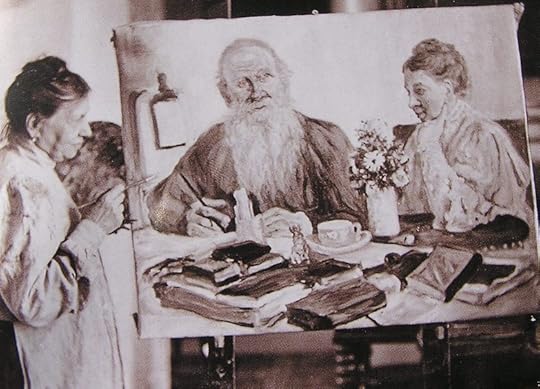
Sofia Tolstaya paints a copy of the portrait done by Ilya Repin (Wikimedia Commons, public domain)
I'm giving this audiobook version 4 stars instead of 5, just because it seems too short and sometimes disjointed. I'm not sure yet if this is the problem of the audiobook (it claims to be unabridged, but who knows), or if this is due to some circumstances that prevented Sofia Tolstaya from writing more, or if this is how she really meant the book to be. Anyway, I found this short memoir immensely interesting and full of unexpected details, and the personality of Sofia Tolstaya made me wish to travel in time to meet her. I'm looking forward to reading her diaries in the foreseeable future and hope she will forgive me for prying.;)