This work has been selected by scholars as being culturally important and is part of the knowledge base of civilization as we know it. This work is in the public domain in the United States of America, and possibly other nations. Within the United States, you may freely copy and distribute this work, as no entity (individual or corporate) has a copyright on the body of the work. Scholars believe, and we concur, that this work is important enough to be preserved, reproduced, and made generally available to the public. To ensure a quality reading experience, this work has been proofread and republished using a format that seamlessly blends the original graphical elements with text in an easy-to-read typeface. We appreciate your support of the preservation process, and thank you for being an important part of keeping this knowledge alive and relevant.
François-André Danican Philidor, born on September 7th, 1726, in Dreux France, often referred to as André Danican Philidor during his lifetime. He was both a French chess player and musical prodigy - his first musical composition was played before King Louis XV when he was only 11 years old. He contributed to the early development of the opéra comique. He was also regarded as the best chess player of his age. He was taught chess by Kermur Sire De Legal, who initially gave him rook odds, until the young Philidor became too strong for his teacher. In 1744 Philidor played two chess games blindfolded simultaneously in public in Paris, a feat never before known to have been accomplished.
His book "Analyse du jeu des Échecs", was published in London in 1749 and was considered a standard chess manual for at least a century. It was the first chess book to explain the openings, the middlegame, and the general strategy of chess. The book claimed that "les pions sont l'âme du jeu", a phrase that became widely known as 'the pawns are the soul of chess', a maxim known to chessplayers ever since.
His name is associated with the endgame commonly called the Philidor position, which is among the most important fundamental endgame positions. Philidor's name is also associated with a fundamental chess tactic commonly known as Philidor's Legacy, a smothered mating pattern involving a queen and knight. However this is only a traditional name, as the tactic first appeared in print by a book by Luis Ramirez de Lucena.
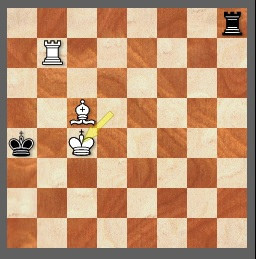
In this position from yesterday's key encounter in the Candidates Tournament, GM Fabiano Caruana, current world #3, has just played 103. Kc4! to reach a winning position against GM Peter Svidler. Unfortunately he was not on top of the latest theory, having failed to study Philidor's 1749 book, and only drew the game.
Well, that's the 21st century for you. It's just too hard to keep up with everything. _______________________
[Update, Mar 28 2019]
Whadaya know. Exactly three years later, Caruana got the same ending yesterday as black against Gareyev in round 7 of the US Championship. After 121 moves, Gareyev made a slip, and this time Caruana knew his Philidor. He pounced and took the full point.