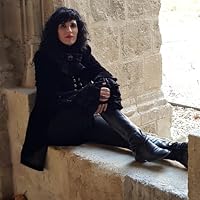
Bett must overcome these, and she must keep moving. If she reaches the coast, crossing half of Canada, then she must decide-
To the north, survivors of Blight will hole up as long as possible. A generation or two is all the Earth's got left, but maybe they can make the best of it?
To the south, a King is offering everyday people a one-way ticket off Earth-he's the only trillionaire who doesn't seem anxious to leave the poor behind.
North?
Or south?
In the crux of her decision, Bettina encounters a bewildering, witchy woman who speaks with animals and who listens to whispers on the wind. Mystifying things walk the enduring forests, and rumours of Old Gods spread terror.
Old Gods who want Bett on their side.
Join Bett on her journey. Read When the World Ends today.
When the World Ends is a novella of science fiction and dark fantasy by award-winning author J.L. Forrest, Active member of the Science Fiction and Fantasy Writers of America.
Forrest has been published by Crossed Genres, Analog Science Fiction and Fact, the Robot Cowgirl Press, Third Flatiron, and others. He is an Active member of the Science Fiction and Fantasy Writers of America (SFWA), and a writing fiend.
When the World Ends is a somber tale set in a dark, haunting, and plausible post-apocalyptic future of our own world. A world ravaged to its core, where mysterious dangers lurk in the shadows. Humankind has been defeated and decimated through a series of cataclysmic events and those remaining struggle to survive. Their worries not only include a broken Earth, but cruel cults, fanatical extremist groups and enigmatic folk magic. We embark on a harrowing trip across North America, witnessing hardships through a series of journal entries as a woman journeys to find some semblance of a safe future.
This novella is a terse and staggering assessment of human behavior and its effects on society and the planet, with an underlying focus on the famous philosophical question of “what if”. It also highlights the socioeconomic injustices that currently exist in our own world that many choose to turn a blind eye to. Of all the dark fantasy stories I’ve drowned myself in over the past few years, this has to be the most terrifying of them all, because it hits so close to home.
I really appreciate the unusual writing style and format as it only adds to the trepidation of a seemingly hopeless quest. You can truly feel the narrator’s desperation and numbness to her surroundings in a very dismal way:
Wish I could say this guy was our first kill…Wish I could say it was exhausting, that I was sad, that I cared.
The thought of living in a world where we’re forced to think this way is horrific.
The seamless blend of fantasy and science fiction made this a really unique and enjoyable read, revealing just enough to leave you wanting more. While it uses the building blocks of many post-apocalyptic tales, it has a fresh voice that makes it feel new. I’m really looking forward to diving deeper into this world Forrest has created - I need answers!
When the World Ends is an intense trip to madness that has to be read while listening to the song with the same name and on which the story is based. In a few pages the reader is taken to this, not so impossible apocalyptic world that humanity as we know it, has given birth to. Blight has wiped out most of the life on Earth in an attempt to clean the plague that inhabits it: humans.
Set up in a futuristic context, the author portrays the essence of human kind above all, an essence that is pushed to its deepest and purest form in extreme situations. It becomes the perfect ground for a perfect harvest of the unexplainable. Magic, premonitory dreams and creation of new Gods are all primitive responses towards social stability. The characters have no choice but to move in the realms of an irrational hierarchy within the anarchy of extinction.
Mostly in diary form, the reader is driven and guided to the different American Estates that have undergone the impact of the survival of the fittest: kill or be killed. And as barbaric as some of the descriptions can be, the story serves as a warning to Homo Sapiens’ old ways of reacting to life threats over the centuries.
There is a poetic layout of the dialogues and the narrative that contribute to move you quickly through the novella’s pages. While reading, you can't help but think of Sam and Dean Winchester from the series Supernatural in their quest to clean the world of demons. In a similar way, When the World Ends explores what happens to human beings when removed from their humanity. In this sense some passages can also remind you of The Lord of the Flies by William Golding where the lack of status quo confirms Thomas Hobbes' phrase “the man is a wolf for the man”, represented by cannibals, and horned lords. Many are the references and parallelisms to other works cleverly dressed under modern and unique 21st century global concerns.
Although it can take some time to get into the whys and wherefores of the story because of its ipso facto scenes and short but conceptual sentence formation and rich lexicon, once familiarised with its surroundings, the reader suddenly gets fully engaged in the narrative and to its main characters’ destinies, who bring death in self-defence. Within death there's hope, an almost forgotten feeling that little by little and mainly Bettina, starts to acknowledge.
This first novella is just the preparation of what is still to come, and I'm already excited about what the author has lined up for us readers.
When the World Ends is an intense trip to madness. In a few pages the reader is taken to this, not so impossible apocalyptic world that humanity as we know it, has given birth to. Blight has wiped out most of the life on Earth in an attempt to clean the plague that inhabits it: humans.
Magic, premonitory dreams and creation of new Gods are all primitive responses towards social stability. The characters have no choice but to move in the realms of an irrational hierarchy within the anarchy of extinction.
There is a poetic layout of the dialogues and the narrative that contribute to move you quickly through the novella’s pages. When the World Ends explores what happens to human beings when removed from their humanity and the lack of status quo confirms Thomas Hobbes' phrase “the man is a wolf for the man.
This first novella is just the preparation of what is still to come, and I'm already excited about what the author has lined up for us readers.
A promising start to what will no doubt be an enthralling series, When the World Ends is clever, impactful, and brimming with some very eclectic world-building. The combination of futuristic-dystopian and mythic dark fantasy is such an imaginative blend, and one Mr. Forrest does exceptional well.
The character of Bettina proved to be engaging in her first-person narrative (well, journal entries), and painted a vivid picture of every occurrence, every person and every environmental detail that it was all too easy for me to get sucked into the story, finishing it in only a few sittings.
I'll gladly be reading more of this series in the foreseeable future.
Absolutely brilliant. Well crafted, gave me a good sense of the characters and the world. Everything was so clear in my mind, especially the launching areas for everyone trying to leave earth. I could see the ships so easily.
The author did an amazing job fleshing everything out. Cant wait to read the next one!
I've been following J.L. Forrest's writing for several years now, and if there is anything that he does with absolute consistency, it's producing surprises ensconced in some the tightest, sharpest writing in SF/F field. This story is no exception. Super-tight writing allows one's imagination to do a lunatic rumba in the story's negative spaces. The words are like the zen bowl; the empty space they hold is where the magic happens. It's a strange mix of dark fantasy and hard SF, a difficult combination, but Forrest pulls it off with punch and verve. WHEN THE WORLD ENDS tells a story of rampant climate change and vastly accelerated disparity between the haves and the have-nots. After a world-wide plague, a la The Stand, coupled with rising sea levels that have redrawn all the world's coastlines, the human race has been brought to its knees, forced to retreat toward the poles, as higher latitudes are the only areas still capable of supporting life as we know it. Into this chaos comes the rebirth of Old Gods, strange entities said to lurk beyond the fringes of habitated zones. And in the big cities, such as the island of San Francisco, the ultra-rich build space elevators to the stars in a desperate attempt to escape a planet that can no longer sustain them. The story bears the footprints of many post-apocalyptic novels that have gone before, but Forrest takes those, shakes them up, and cooks up something new and tasty. Highly recommended.
J. L. Forrest is an old friend of mine, and we occasionally beta-read manuscripts for each other. When he sent me this slim little novella with its haunting cover, I knew I was in for a hell of a read.
Post-apocalyptic fiction is something of a love-hate thing for me. It can feel like disaster porn at worst, or generally a tiresome rehash of prophetic warnings about humanity's progressively darker futures. At best, the genre offers transcendent catharsis: things have changed, they may be bad, but new glories can evolve from the ruins.
Forrest's 'When The World Ends' is firmly in that latter category. It's a dreamlike, blood-soaked trek from scorched prairies to carbon and diamond skyscrapers, a Twenty-Second Century world where Moribund Christian Fundamentalists and kindly techno-despots offer different versions of hope. Their equally-blind ambitions leave the bisexual narrator and her mysterious new wife no choice but a third, ambiguous path back into the natural realms of a damaged but healing Earth.
A few minor errata aside, I'd expect to see fiction of this quality at Tor.com or The Magazine of Science Fiction & Fantasy. Kudos to Forrest and Robot Cowgirl Press!
Oh, and the song that inspired the story is worth a listen or three.
J.L. Forrest's WHEN THE WORLD ENDS offers a horrifying glimpse into a ravaged world which is much too plausible for comfort. Told through the journal recollections of a survivor, the tale is part fever dream and part pseudo-prescient science fiction, where the Earth herself fights back against her most abusive foe, humankind. Despite surviving natural disasters brought about through rampant climate change, humanity has been brought low through a virulent disease known as Blight. To compound the existing problems, hordes of religious zealots, some worshipping resurgent ancient gods, plague the survivors with fresh horrors. J.L. Forrest paints a fascinating, but bleak, landscape that had me researching if apocalypse had a plural. And yet the light of hope and the human spirit still shines through. My only regret was that the story wasn't longer. This is a thoroughly enjoyable read for any fans of the post-apocalyptic genre.
I always glance through other reviews before adding my own and was surprised by the adjectives used. I don't normally pick scifi fantasy as a go-to book genre, but I do enjoy a good "end of the world" scenario. I tend to be a realistic optimist, but do see us heading down a slipper slope in society. Which brings me back to adjectives...
I liked J.L. Forrest's story and his writing style. I didn't find it so very dark or so very horrifying. Post-apocalyptic, yes. Grim, yes. Violent, yes. Sexual, yes. But not cringe-worthy or overly graphic. His future world was well-conceived, although I do take exception to making Salem a hub in this story (since Oregon is my home turf) and I believe it would be long washed away in Forrest's imagined world.
I will read on with the next in the series and am looking forward to following how Bettina and Cailin stay alive.