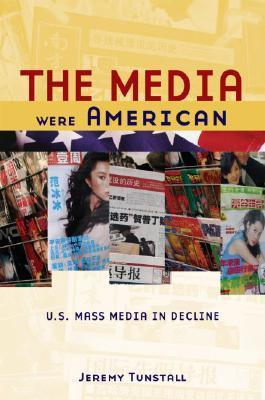
In 1977, Jeremy Tunstall published the landmark The Media Are American . In it, he argued that while much of the mass media originated in Europe and elsewhere, the United States dominated global media because nearly every mass medium became industrialized within the United States. With this provocative follow-up, Tunstall chronicles the massive changes that have taken place in the media over the past forty years--changes that have significantly altered the "balance of power" within the global media landscape. The Media Were American demonstrates that both the United States and its mass media have lost their previous moral leadership. Instead of sole American control of the world news flow, we now see a world media structure comprised of interlocking national, regional, and cultural systems. From a relentlessly global point of view, Tunstall looks closely at China and India--and at their rapidly burgeoning populations--and also at the rise of the mass media in the Muslim world. He considers the role of the media in the collapse of the Soviet Union, the ascendance of the Brazilian and Mexican soap opera, the increasing strength of "Bollywood"--the national cinema output of India--and the relative decline in influence of U.S. media. Reconsidering the very notion of "global media," the book posits a reemergence of stronger national cultures and national media systems.
"The Devil doesn't carry a gun. He comes at you with cheap appliances and bad television".---Judy Davis, CHILDREN OF THE REVOLUTION The nightmare is always the same. You are stuck in a hotel room somewhere other than the United States. Your only companion is the television set. Suddenly, without warning, you are listening to KNIGHT RIDER in Spanish ("por eso nos pagan tanto para manejar, amigo") or Dutch or Hindi. (This actually happened to me once just outside Santa Cruz, Bolivia, and again in Lisbon, Portugal.) You are being beamed "be American, buy American" not by commercials but through reruns of really bad US TV. Back in 1977 that punk and enfant terrible of British media studies, Jeremy Tunstall, published THE MEDIA ARE AMERICAN; a pathbreaking study illustrating how American corporate media had achieved a near monopoly on global television broadcasts. (Did you know ALL IN THE FAMILY once went to Number One in Italy?) Nor did cinema offer any more media democracy. Think back to the universal success of JAWS in 1975 (Tt even played well in Cuba, where Fidel Castro was a fan!) and STAR WARS coming out the same year as Tunstall's opus. Forty years later an older but wiser Jeremy decided neoliberalism in media wasn't such a bad thing after all and revised both his thesis and title. The high ratings enjoyed by Chinese and Korean soap operas, the success of "Bollywood" in reaching hundreds of millions at home and exporting its product, and the crossbreeding of these medias, e.g. Miami television carries Turkish soaps translated into Spanish for a Hispanic-American audience lead him to believe the U.S. is in decline in the media world as much as in economic or military power, assuming these three items can be disentangled. I am intrigued but not sold on his conversion story. In Latin America, as I can attest personally, the number of home made films has declined precipitously since the 1980s and shows no sign of resurgence. Chinese films can compete with Hollywood, and Hollywood needs the China market, but production and distribution still goes mostly in one direction in the Pacific. If you are watching global news in any part of the Third World there's a high chance it is CNN translated into your native language. At the end of the day the media world is not the level playing field Jeremy wants it to be. One more thing: When I enter hell I'll be forced to watch loops of Spanish-language TV from Miami; from endless discussions of what went wrong at the Bay of Pigs to Latina T & A contests.