

What do you think?

Gobolinks: or, Shadow Pictures for Young and Old
This special edition of 'Gobolinks: or, Shadow Pictures for Young and Old' was written by Ruth McEnery Stuart & Albert Bigelow Paine, and first published in 1896, making it over 120 years old. This rare find is filled creepy, fantastical and wondrous beasts - what are they, exactly? Are they goblins or demons? Maybe imps or fairies? Or maybe something else entirely, like bugs, or butterflies, or even a mermaid or two. Some are whimsical or funny, some are sinister and dark.
Herein lies the 'Gobolinks' - more commonly know as Ink-Blots, created by the same method as the 'Rorschach Test' images. These are used by psychoanalysts and psychiatrists who interpret their patient's answers on what they see in the pictures, and subsequently determine their mental state.
But Gobolinks is also a game - one where you make the Ink-Blot image, then tell a story about what you see, in the form of a poem.
This is a fabulous rare find and a must-have addition the libraries of all collectors of the weird, the curious and the strange.
IMPORTANT NOTE - Please read BEFORE buying!
THIS BOOK IS A REPRINT. IT IS NOT AN ORIGINAL COPY.
This book is a reprint edition and is a perfect facsimile of the original book. It is not set in a modern typeface and has not been digitally enhanced. As a result, some characters and images might suffer from slight imperfections, blurring, or minor shadows in the page background. This book appears exactly as it did when it was first printed.
DISCLAIMER: Due to the age of this book, some methods, beliefs, or practices may have been deemed unsafe, undesirable, or unacceptable in the interim years. In utilizing the information herein, you do so at your own risk. We republish antiquarian books without judgment, solely for their historical and cultural importance, and for educational purposes. If purchasing a book more than 50 years old, especially for a minor, please use due diligence and vet the text before gifting.
Herein lies the 'Gobolinks' - more commonly know as Ink-Blots, created by the same method as the 'Rorschach Test' images. These are used by psychoanalysts and psychiatrists who interpret their patient's answers on what they see in the pictures, and subsequently determine their mental state.
But Gobolinks is also a game - one where you make the Ink-Blot image, then tell a story about what you see, in the form of a poem.
This is a fabulous rare find and a must-have addition the libraries of all collectors of the weird, the curious and the strange.
IMPORTANT NOTE - Please read BEFORE buying!
THIS BOOK IS A REPRINT. IT IS NOT AN ORIGINAL COPY.
This book is a reprint edition and is a perfect facsimile of the original book. It is not set in a modern typeface and has not been digitally enhanced. As a result, some characters and images might suffer from slight imperfections, blurring, or minor shadows in the page background. This book appears exactly as it did when it was first printed.
DISCLAIMER: Due to the age of this book, some methods, beliefs, or practices may have been deemed unsafe, undesirable, or unacceptable in the interim years. In utilizing the information herein, you do so at your own risk. We republish antiquarian books without judgment, solely for their historical and cultural importance, and for educational purposes. If purchasing a book more than 50 years old, especially for a minor, please use due diligence and vet the text before gifting.
90 pages, Paperback
First published January 1, 1896
About the author
Ruth McEnery Stuart
121 books2 followersShe was born Mary Routh McEnery Stuart, child of James and Mary Routh (Stirling) McEnery in Marksville, Louisiana. (She changed the spelling of her name to "Ruth" after she began her career in literature.) Stuart's true date of birth is not known with certainty.
Stuart first published in February 1888 in the New Princeton Review. She sold a second story to Harpers New Monthly Magazine shortly thereafter; in the early 1890s she moved to New York City. Stuart was active in her literary career from 1888 until 1917, producing some 75 works.Between 1891 and 1897 she produced "20 books, short stories, sketches, and reprinted verses she had originally published in magazines". She was known not just for her writing, but also for oral performances of her work. Her most famous work is said to be Sonny (1896). She was also occasionally a sub-editor at Harpers.
Stuart has been characterized as belonging to the school of "American local color writing that emphasizes regional characteristics in landscape, way of life, and language." Stuart's treatment of blacks forms a significant portion of her corpus and, if potentially troublesome today, "contemporary critics acclaimed her as providing an authentic representation of African Americans." Her work is said to be of the same school as Kate Chopin
Stuart's work was appreciated in England. She became a member of the Lyceum Club there in 1904. In 1915 she was granted an honorary Litt.D. in 1915 by Tulane University. Also in 1915 a literary club, Ruth McEnery Stuart Clan, was founded and named in her honor.
Stuart died in New York City in 1917 and was buried in New Orleans.
Stuart first published in February 1888 in the New Princeton Review. She sold a second story to Harpers New Monthly Magazine shortly thereafter; in the early 1890s she moved to New York City. Stuart was active in her literary career from 1888 until 1917, producing some 75 works.Between 1891 and 1897 she produced "20 books, short stories, sketches, and reprinted verses she had originally published in magazines". She was known not just for her writing, but also for oral performances of her work. Her most famous work is said to be Sonny (1896). She was also occasionally a sub-editor at Harpers.
Stuart has been characterized as belonging to the school of "American local color writing that emphasizes regional characteristics in landscape, way of life, and language." Stuart's treatment of blacks forms a significant portion of her corpus and, if potentially troublesome today, "contemporary critics acclaimed her as providing an authentic representation of African Americans." Her work is said to be of the same school as Kate Chopin
Stuart's work was appreciated in England. She became a member of the Lyceum Club there in 1904. In 1915 she was granted an honorary Litt.D. in 1915 by Tulane University. Also in 1915 a literary club, Ruth McEnery Stuart Clan, was founded and named in her honor.
Stuart died in New York City in 1917 and was buried in New Orleans.
Ratings & Reviews
Friends & Following
Create a free account to discover what your friends think of this book!
Community Reviews
Displaying 1 - 6 of 6 reviews

May 17, 2016
It's merely a series of Rorschach ink blots with the author trailing off on a whim of fancy about what she sees in them.
April 25, 2025
What a positively delightful little book! I adored the poetic verses that accompanied the pictures, as well as the insight into what life must have been like in the world when klecksography was a popular past time. At least popular enough that a book was dedicated to the subject anyways.
I'm now filled with the desire to procure myself some ink and droppers and host a game of Gobolink with my friends. I especially loved this part in the instructions:
"For a specially invited Gobolink party the company may dress in any grotesque fashion, remembering only that both sides of their costumes shall be the same, this being a feature peculiar to Gobolink attire."
If you're looking at this book thinking "Wow, those look an awful lot like Rorschach ink blots" you my friend, are not far off! As a child Hermann Rorschach loved klecksography so much that he was nicknamed "Klex" by his friends. Then as an adult studying psychology he was reminded of his ink-blot filled youth and wondered if the images couldn't also be applied to psychology! At least that's what Wikipedia tells me anyways :)
Rorschach was born in Switzerland in 1884 and this book was published in the States in 1896 so I'm assuming that his childhood fascination with ink blots didn't come from this book in particular, but I wonder if maybe as an adult in his later years he may have happened upon it? Who's to say?
All in all though if you're a fan of fun poetic verses and obscure semi-strange pastimes, I imagine you'll love this book.
I'm now filled with the desire to procure myself some ink and droppers and host a game of Gobolink with my friends. I especially loved this part in the instructions:
"For a specially invited Gobolink party the company may dress in any grotesque fashion, remembering only that both sides of their costumes shall be the same, this being a feature peculiar to Gobolink attire."
If you're looking at this book thinking "Wow, those look an awful lot like Rorschach ink blots" you my friend, are not far off! As a child Hermann Rorschach loved klecksography so much that he was nicknamed "Klex" by his friends. Then as an adult studying psychology he was reminded of his ink-blot filled youth and wondered if the images couldn't also be applied to psychology! At least that's what Wikipedia tells me anyways :)
Rorschach was born in Switzerland in 1884 and this book was published in the States in 1896 so I'm assuming that his childhood fascination with ink blots didn't come from this book in particular, but I wonder if maybe as an adult in his later years he may have happened upon it? Who's to say?
All in all though if you're a fan of fun poetic verses and obscure semi-strange pastimes, I imagine you'll love this book.
October 14, 2017
I found this late nineteenth century book intriguing, as it consists of poetry that has been inspired by random inkblots. This attests to the idea that poetry is truly universal and can arise at any time, under any circumstance, if one lets his or her imagination flow freely. The spirit of poetry is, indeed, alive.
I plan to use this work,or at least part of it, as a teaching tool for my introduction to literature class.
I plan to use this work,or at least part of it, as a teaching tool for my introduction to literature class.

September 23, 2017
Stuart use ink-blot pictures /Rorschach with poetry to describe the images formed. Her interdisciplinary as well as relating to daily event of her time make the reading of this book quick and accessible. As intended, the book is suitable for the young and old.

April 3, 2016
Rather sweet collection of ink-blot pictures (think Rorschach) paired with light verse.
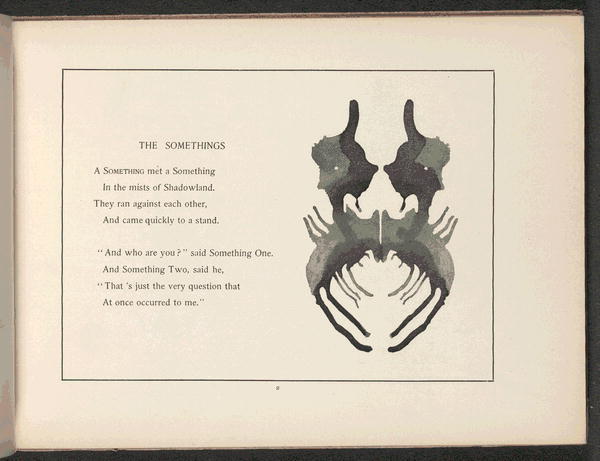
Instructions provided as to how to make them, as well as rules for a party game that one might play with the rest of one's friends, should one find oneself at a party in 1910.
Available as high quality scans or a somewhat lower quality PDF from the Library of Congress https://lccn.loc.gov/16017793 as well as on Project Gutenberg in the usual formats.
Instructions provided as to how to make them, as well as rules for a party game that one might play with the rest of one's friends, should one find oneself at a party in 1910.
Available as high quality scans or a somewhat lower quality PDF from the Library of Congress https://lccn.loc.gov/16017793 as well as on Project Gutenberg in the usual formats.

September 13, 2016
A groundbreaking book at the time and still relevant today. A lovely recreation for Kindle.
Displaying 1 - 6 of 6 reviews