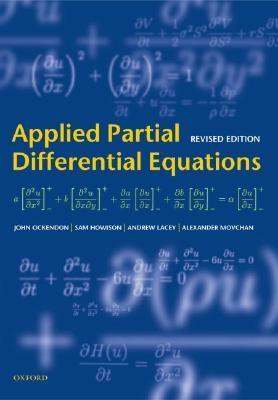
Partial differential equations are used in mathematical models of a huge range of real-world phenomena, from electromagnetism to financial markets. This new edition of Applied PDEs contains many new sections and exercises Including, American options, transform methods, free surface flows, linear elasticity and complex characteristics.
Applied Partial Differential Equations, written by John Ockendon, Sam Howison, Andrew Lacey and Alistair Movchan, is a distinctive and engaging textbook that presents partial differential equations (PDEs) from the perspective of applied mathematics. Published by Oxford University Press, the book is intended primarily for advanced undergraduate and postgraduate students in applied mathematics, engineering and related disciplines. Rather than treating PDEs solely as abstract mathematical objects, the authors emphasise their role in modelling and understanding real-world physical phenomena. The result is a text that combines mathematical rigour with physical intuition, practical insight and an unusually conversational writing style.
What distinguishes this book from many conventional mathematical textbooks is its underlying philosophy: understanding a differential equation involves more than learning how to solve it. It also requires recognising the physical problem being modelled, understanding the assumptions behind the model, and determining whether the resulting mathematical problem is well posed.
Content and Organisation
The book develops its subject systematically, beginning with first-order scalar quasilinear equations before progressing through first-order systems and second-order scalar equations. Subsequent chapters address hyperbolic, elliptic and parabolic equations, followed by free-boundary problems, non-quasilinear equations and a selection of more specialised topics. This organisation provides a broad introduction to the principal classes of PDEs and the analytical techniques used to study them.
A particular strength is the connection between mathematical theory and practical applications. The discussion of first-order equations, for example, includes characteristics, discontinuous solutions and weak solutions, illustrating how apparently straightforward equations can lead to subtle mathematical difficulties. Physical examples, such as the flow of a thin layer of paint down a wall, help demonstrate how simplified mathematical models emerge from real situations.
The treatment of different equation types also encourages readers to understand why particular methods are appropriate in particular circumstances. Rather than presenting solution techniques as isolated procedures, the authors place them within a broader framework of mathematical modelling and analysis. This makes the text valuable not only for learning established methods but also for developing the judgement needed to approach unfamiliar problems.
Mathematical Insight and the Importance of Well-Posedness
One of the book's most important themes is the concept of well-posedness. A mathematical problem is classically regarded as well posed when a solution exists, is unique, and depends continuously on the prescribed data. These conditions are fundamental to understanding whether a model is mathematically meaningful and whether small errors in its input can lead to disproportionately large changes in its output.
The authors' emphasis on well-posedness is especially relevant to numerical computation. Obtaining a numerical solution is not, by itself, sufficient to establish that the underlying problem has been solved reliably. The mathematical structure of the problem must first be understood, including the behaviour of solutions and their sensitivity to initial or boundary conditions. By highlighting these issues, the book helps readers appreciate the relationship between analytical theory, numerical approximation and the practical reliability of mathematical models.
This perspective is one of the text's greatest strengths. It encourages students to ask not merely whether a solution can be calculated, but whether the problem has been formulated appropriately and whether the answer can be trusted.
Writing Style and Approach
Perhaps the book's most memorable feature is its informal, conversational and occasionally humorous narrative. The authors write with the confidence of experienced applied mathematicians who understand that mathematical progress involves intuition, experimentation and the recognition of potential difficulties, as well as formal derivations. The Journal of Fluid Mechanics review by J. R. Lister particularly appreciates this personal style, noting the authors' willingness to describe analyses as “trivial, tedious, delicate or hair-raising”. This language gives the book a distinctive personality and makes the mathematical discussion feel more approachable.
The informal tone does not come at the expense of intellectual depth. Instead, it helps communicate the authors' experience of working with difficult mathematical problems. Their explanations convey a sense of how applied mathematicians think: which details deserve attention, where an argument may become delicate, and why a particular analytical approach might succeed or fail.
The book also benefits from its extensive footnotes, which provide additional physical explanations and contextual information without interrupting the main discussion. These details are particularly useful for readers who want to understand the scientific motivation behind a mathematical result rather than simply reproduce its derivation.
Exercises and Learning Value
The end-of-chapter exercises are another significant strength. They encourage readers to apply the techniques introduced in the text, test their understanding and explore problems that require more than routine calculation. Their challenging nature makes the book suitable for serious university-level study, whether as a course textbook or as a resource for independent learning.
The authors assume a relatively modest mathematical background, including knowledge of ordinary differential equations, multivariable calculus and elementary complex-variable theory. Nevertheless, the material becomes increasingly sophisticated as the book progresses. Readers benefit from a willingness to work through derivations carefully and to engage actively with the exercises.
For instructors, the combination of systematic coverage, physical examples and substantial exercises provides a useful foundation for an advanced course in PDEs. For independent learners, the informal explanations and supplementary notes help make difficult ideas more accessible, although some sections may require repeated reading.
Critical Evaluation
Despite its many strengths, Applied Partial Differential Equations is not without limitations. Its breadth and mathematical depth mean that it is unlikely to be an effortless introduction for readers encountering PDEs for the first time. Although the prerequisites are not especially extensive, the book expects readers to develop mathematical maturity and to engage with abstract reasoning alongside physical interpretation.
Furthermore, its conversational style may not appeal equally to all readers. Those who prefer concise definitions, highly structured theorem-proof presentations and a more formal exposition may find the authors' personal asides and informal commentary distracting. Similarly, the book's emphasis on analytical understanding means that readers seeking a primarily computational guide, with extensive software demonstrations or step-by-step numerical implementation, may need to supplement it with other resources.
Its publication history is also worth considering. The revised edition appeared in 2003, and its core mathematical methods remain valuable, but readers interested in contemporary computational techniques, modern numerical PDE software or recent developments in scientific computing will benefit from consulting more recent specialist literature.
These limitations, however, largely reflect the book's priorities rather than fundamental weaknesses. Its principal purpose is to develop an applied mathematician's understanding of PDEs, not to serve as an exhaustive manual of numerical algorithms or a reference to every modern development in the field.
Conclusion
Overall, Applied Partial Differential Equations is a highly worthwhile textbook that successfully bridges mathematical theory and physical application. Its comprehensive treatment of the major classes of PDEs, emphasis on well-posedness, illuminating examples and challenging exercises make it a valuable resource for advanced students of applied mathematics and engineering.
Above all, the book's greatest contribution lies in its approach to mathematical thinking. By combining technical analysis with physical intuition and the accumulated experience of practising applied mathematicians, the authors demonstrate that solving PDEs requires judgement as well as technique. The informal narrative makes this perspective unusually engaging, while the mathematical content ensures that the text remains intellectually demanding.
The book is therefore particularly recommended for students who wish to move beyond memorising solution methods and develop a deeper understanding of how PDEs describe physical systems. It is equally useful for readers seeking to strengthen their analytical foundations before progressing to more specialised research. Despite the availability of newer computational resources, its central message remains relevant: effective applied mathematics depends on understanding not only how equations are solved, but also what those equations mean and when their solutions can be trusted.