
What do you think?
Rate this book


Hardcover
First published January 1, 1972


Most sombre variations on the bird theme are The Elect of Evil and Bonjour Satanas. Glorification has given place to the manifestation of evil desires. Iconographical references to Christian mythology are often present, according to Werner Hofmann: thus, in the emblamatic system of the Baroque period, the pelican stands for Christ. (p.91)
Do these pictures still bear any relationship to surrealism? Surrealism is more than an attitude of mind than a stylistic tendency. Surrealism is the sum of Breton's doctrine, Dali's paranoiac-critical method, Magritte's intellectual semantics, Miro's automatism and Max Ernst's combination of guided chance and imaginative power. Each of the Surrealist painters goes his own way. In the last analysis there is remarkably little to hold them together. (p.99)
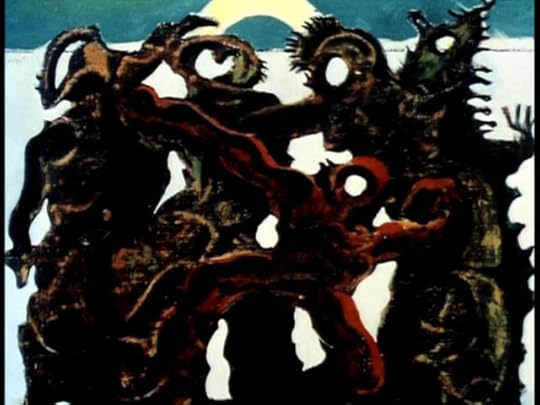
John Russell has drawn attention to the fact that the Barbarians Marching Westwards call to mind 'the fantasies of Denos, in which idealized barbarians from the East would come marching in to save the western world from itself'. There is no denying that an element of discontent with civilisation, inspired by Surrealism, does have a part to play in these pictures, especially as the dogmatic Parisian leading lights of the movement did occasionally incline towards the idealization of anti-cultural impulses. Equally not to be denied is the fact that the Barbarians are conclusions drawn from political events, and thus point forward to the Nazi invasion of France. (p.134)
The title of The Breakfast on the Grass is a borrowing from Manet; and Hunger Feast is taken from Rimbaud. Max Ernst likes to play around with more or less current concepts. On his own admission the titles only come in the final stages. As plays on words and ideas, that is, as independent entities, they exist alongside, or even run counter to, the visual work. There are direct references to Rembrandt (Polish Horsemen), Gericault (Raft of the Medusa), and the German Novelist Theodor Storm (Aquis Submersus); and paraphrases of Nietzsche (The Birth of Comedy), Baudelaire (The Elect of Evil) and Matisse (Lust For Life). So in the world of language, too, Max Ernst modifies found objects (p. 151)
