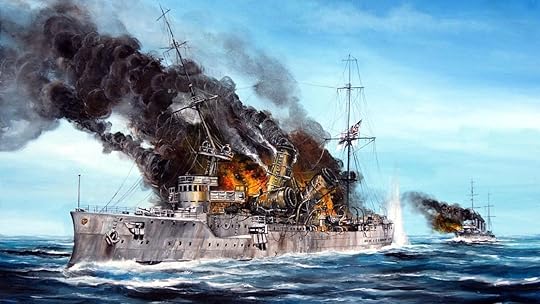
Olson has pieced together a comprehensive account of the action and events before and afterEmden's loss on the Cocos Islands. Employing a wealth of archival and photographic material, as well as numerous first-hand accounts of the German, British and Australian participants, he has written a work that takes the reader right to the center of the action and brings alive the immediacy and horror of naval warfare for those who took part.
Join The Navy and see the world (and get drowned or blown into little bits for the fishies.)
Wes Olson has written a brilliant recount of The Emden's last voyage. His research is detailed and very well referenced.
When you think of WW1, bloody battle scenes on the fields of France would come to mind. Very few would realise that the navies of the world were involved in bloody battles of their own. This book expertly documents one of the smaller naval brawls of WW1 that occurred on November 9th, 1914 just off the coast of the Cocos Islands. In one corner was The Menace of the Indian Ocean, the German raider SMS Emden - a light cruiser with a well-trained crew and deadly 4" guns. In the other corner was the HMAS Sydney, another (Australian) light cruiser. The difference was - Sydney was a "bruiser cruiser" fitted with 6" guns that could lob a 100 pound HE shell 12 Kms. Despite being outclassed in both guns and speed, Emden put up a good fight and if not for the fact that 6 of the 18 shells she hit Sydney with failed to detonate - the results could have been very different.
Things that stood out for me:
>Emden's captain, Karl Von Mueller, was a gentleman. He would always save a crew of any ships he attacked, mostly before the attack. He made sure they made it safely back to land. Warships were another matter - he just attacked them before they had a chance to hit back.
>The British captain of the Sydney was not very bright. Despite having had two hours to prepare for battle, he was more concerned with stupid preliminary religious blessings than actually getting his sailors ready for action. Von Mueller wasn't so tardy.
>The idea of being trapped on board a ship under attack with shells exploding around you at the rate of 10 per minute is horrifying -with graphic accounts of men getting burned, and having bits blown off their bodies, their guts hanging out....Brrrrr!
>The bravery of these men is beyond belief. I'd be a quivering mess. I admire them greatly.
>How did they manage to aim their guns, let alone hear orders/instructions when loud explosions are happening right next to them, and their shipmates are falling injured or dead?
I feel it does everyone good to read accounts like this, just as a reminder of what our forefathers went through for us. This book takes the reader right to the center of the action and describes the horror of naval warfare in graphic detail. This is a great read that I shall never forget.
Wes Olson's book, THE LAST CRUISE of a GERMAN RAIDER: THE DESTRUCTION of SMS EMDEN, is a fascinating read, not only about the career of Emden, but it also provides a window into the warfare of the early 20th century. Also, I do love a good solid book, and this is one is very well-made, with thick paper, and solidly constructed, so much so that it really jumped out at me how well made the physical book is. Besides that, the book covers everything from ship design, operational logistics, area of operation, operational requirements, and the final battle between Emden and Sydney, making this an informative and satisfying read.