

What do you think?

Angelica Kauffman: A Continental Artist in Georgian England
Shipped from UK, please allow 10 to 21 business days for arrival. 216pp. Good clean copy. No marking of text. Fold back on top front cover. Catalogue to 1993 exhibition, with list of works insert from York City Art Gallery. Good number of colour plates with four essays on aspects of Kauffman's work.
216 pages, Paperback
First published January 1, 1992
Ratings & Reviews
Friends & Following
Create a free account to discover what your friends think of this book!
Community Reviews
Displaying 1 - 1 of 1 review

July 27, 2020
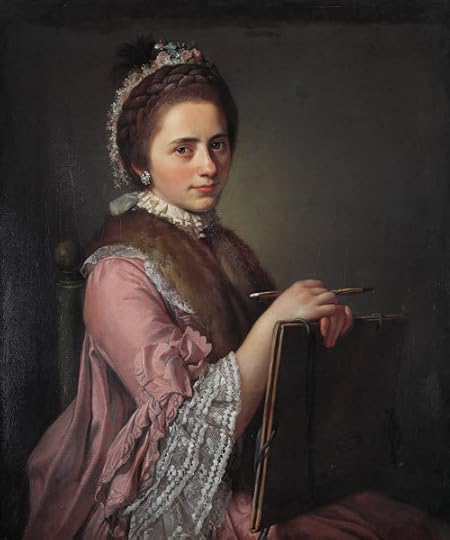
Nathaniel Dance, Angelica Kauffman, c. 1765
It's curious how prominent Swiss artists were in the formation of Britain's Royal Academy of Arts. Two of the founder members were from Switzerland, one other was from a Swiss family – and then there was Henry Fuseli, who joined a little later but went on to become the RA's Keeper and Professor of Painting. I suppose London at the time was the world city that drew aspiring up-and-comers from all trades.
One of those Swiss founder-members was Angelica Kauffman, who was born in the misty Alpine city of Chur in 1741. Chur in those days was the capital of the Three Leagues, a strange and fascinating early-modern polity that didn't get fully assimilated into Switzerland until Napoleon invaded – but that's another story. Kauffman was a child prodigy in music as well as painting, did a stint of training in Italy, and then, finding that most of her best customers/patrons were English, moved to London when she was twenty. She was hugely successful and built up a pan-European reputation.
Kauffman was most famously a history painter – that is, she painted epic scenes from history and literature – which was seen as the highest form of painting and was extremely unusual for a female artist. (The only other female member of the Academy, Mary Moser (whose father was Swiss btw), painted flowers.) History painting was traditionally seen as men's business – a lot of contemporary critics talked ambiguously about Kauffman's ‘manly energy’. Her skills, though, could not be dismissed, and the fact that she was young, foreign and good-looking probably helped as well. She was in high demand as a portraitist – probably, for a lot of women, sitting to a female painter was an appealing option compared to being plonked in front of Joshua Reynolds again for a week.
It is really refreshing to see the field of portraiture and history painting through female mediation for a change. She initiated a number of artistic scenes that had never been painted before, especially involving female protagonists – a whole series, for instance, on Penelope, as well as a number of female-centric events from English history.
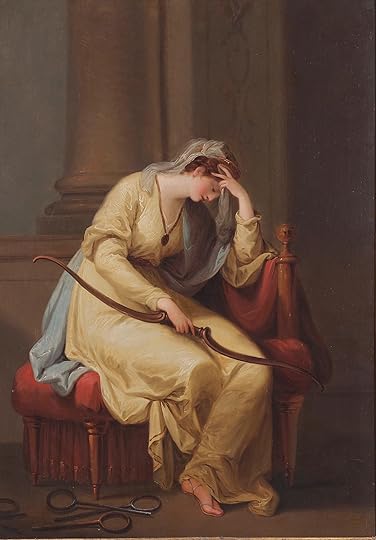
Penelope Weeping over the Bow of Ulysses, 1779
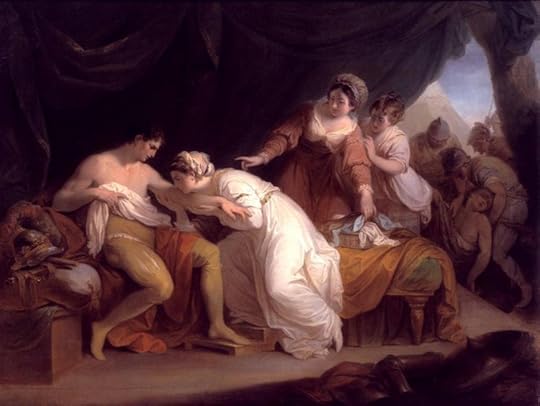
The Tender Eleanora Sucking the Venom out of the Wound which Edward I, her Royal Consort, Received with a Poisoned Dagger from an Assassin in Palestine, 1776
I read somewhere else, although I can't remember where, that she was sometimes considered a bit prudish for avoiding the usual bare-breasted female subjects; it is probably more likely that she made a point of devising scenes that did not depend for their effect on Classical women with their tops off. In fact she handles the erotic mode quite well, but usually brings to it some awareness of the practicalities involved – as in her charming scene of Zeuxis's studio:
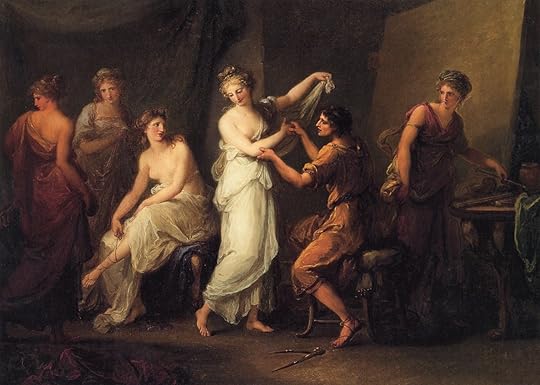
Zeuxis Selecting Models for his Painting of Helen of Troy, c. 1778
Her men – as with Zeuxis there – are often a bit droopy and effeminate. This may have been because, as a woman, she could not attend the Academy's life drawing classes; a lot of her studies of human form are from Classical statues, and many of her men seem to owe something to Antinous or the Apollo Belvedere.
This book makes a point of noting that Kauffman's reputation in subsequent generations got a bit waylaid by gossip over her private life, and the essays here are careful to avoid that. This was unfortunate, since I am all about the gossip. But there is nevertheless a wealth of information about how Kauffman worked and how her work was taken up by European society, and it's lavishly illustrated throughout. I see that the Royal Academy was supposed to be holding a long-overdue exhibition of her work right now in London, but, thanks to coronavirus, it's been cancelled, so books like this are the best you're going to get right now.
Displaying 1 - 1 of 1 review