
Jump to ratings and reviews
Rate this book

A Crash Course in Mathematica

Rate this book
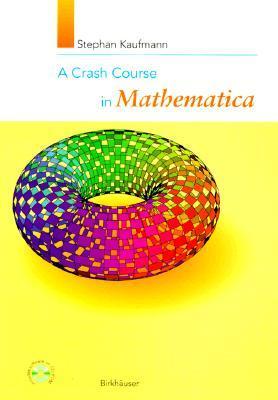
This compact introduction to Mathematicaaccessible to beginners at all levelspresents the basic elements of the latest version 3 (front § kernel, standard packages). Using examples and exercises not specific to a scientific area, it teaches readers how to effectively solve problems in their own field. The cross-platform CD-ROM contains the entire book in the form of Mathematica notebooks, including color graphics, animations, and hyperlinks, plus the program MathReader.

200 pages, Paperback

First published July 30, 1999

Loading...
Loading...

About the author

Ratings & Reviews

What do you think?
Rate this book

Friends & Following

Create a free account to discover what your friends think of this book!

Community Reviews

5 stars
0 (0%)
4 stars
2 (66%)
3 stars
1 (33%)
2 stars
0 (0%)
1 star
0 (0%)
Displaying 1 - 2 of 2 reviews
Profile Image for Thomas Ray.
1,596 reviews545 followers
February 15, 2022
A Crash Course in Mathematica, Stephan Kaufman, 1999, 200 pages, for Mathematica version 3, ISBN 3764361271, Library-of-Congress QA 76.95 K3913 1999 Steenbock Library. Translated from German by Katrin Gygax. Originally /Mathematica--kurz und bündig/, 1998.

This is a good primer. The basics this book covers are still current.

As of 2022, Mathematica Version 13 is current.

Current Wolfram books:
https://www.wolfram.com/books/search....

There is no comprehensive guide to Mathematica since the 2005 Mathematica Book for version 5. There is online documentation.

Plot spiral:
ParametricPlot [{Theta Cos[Theta], Theta Sin[Theta]}, {Theta, 0, 2 Pi}]
https://www.wolframalpha.com/input?i=...
p. 20
(A different spiral: https://www.goodreads.com/review/show... )

To evaluate all cells in a notebook file in sequence:
From the menu:
Kernel > Evaluation > Evaluate Notebook
p. 30.

Simplify
Sum[x^n, {n, 0, 10}] - (1 - x^(11))/(1 - x)
https://www.wolframalpha.com/input?i=...
p. 45

Clear all definitions:
Clear[Global`*]
p. 50

Stirling's formula
Plot Log[n!] and (n + 1/2)Log[n] - n + Log[Sqrt[2 Pi]], n = 1 to 3
https://www.wolframalpha.com/input?i=...
p. 51

Second derivative:
D[Sin[x], {x, 2}]
denotes
d^2/dx^2(sin(x)) = -sin(x)
https://www.wolframalpha.com/input?i=...
p. 60

Differential equations
DSolve[x''[t] + x[t] == 0, x[t], t]
x(t) = c_2 sin(t) + c_1 cos(t)
https://www.wolframalpha.com/input?i=...
p. 62

Procedural Programming
"
Do
and
While
can be useful. The
For
loop is a concession to C programmers; it often leads to badly structured programs."
p. 179
10 reviews1 follower
October 10, 2020
This is an old book about Mathematica. It covers Mathematica 4 while newest version in 2020 is Mathematica 12.
Nonetheless, it is a good introduction book for Mathematica.
Displaying 1 - 2 of 2 reviews