Tout au long de l’époque baroque, Venise, Naples et Rome jouent un rôle essentiel sur le plan musical, tout en poussant l’art de la fête à des sommets inégalés. Dans cet essai vagabond, coloré et joyeux, Patrick Barbier nous plonge dans la vie quotidienne de cette Rome pontificale des XVII e et XVIII e siècles, théâtre d’un gigantesque bouleversement artistique. Le lecteur voyage, guidé par Patrick Barbier, au cœur des chefs-d’œuvre musicaux de la Rome baroque. Entre anecdotes historiques et documents inédits, nous découvrons l’aristocratie romaine et ses plaisirs, les courses de chevaux et les carnavals, les palais privés et les soirées à l'opéra, mais aussi l'étonnante vie culturelle et les cérémonies somptueuses du Vatican.
This is the third of Barbier’s books on the musical life and production in a particular Italian city. These are Vivaldi's Venice published in 2002, Naples en fête : Théâtre, opéras et castrats au XVIIIème siècle from 2012 and then this one from 2016. He has also written extensively on the Castrati. The three cities were during the Baroque and the Enlightenment periods great rivals in music production. I am so glad I have found this mine of music history.
Barbier starts this volume by conjuring the city as it was rebuilt from the Renaissance period and gradually became a large and magnificent stage: for its population, its visitors, its arts and music and for the narration of the book. What seemed a protracted beginning gradually acquired its significance as the extensive theatre emerges. It served as a sort of prelude in which the various themes were introduced to be later developed, like in grand opera.
The city had gone down the drains during the Middle Ages when the papacy transferred to Avignon in 1309 and the Black Death struck it. When Martin V (a Colonna) brought back the papacy in 1420 reconstruction began. But when it was sacked in 1527 all plans, and stones were turned upside down. Rebuilding in earnest began from the 16th century but the desired glory was attained, particularly in music, during the following century. The Baroque style which promulgated an early form of ‘Gesamtkunstwerk’ in a grandiose idiom suited Rome splendidly.
Rome was a city of clerics and of visitors – there had always been pilgrims but soon also travellers in their Grand Tour. Unsurprisingly Rome conceived itself for display – as an extended theatre in which masquerades, carnivals and horse races (hence via del Corso) were rabidly celebrated. The famous architects--Maderno, Bernini, Borromini, Fontana--built and decorated specific buildings but also designed fountains and gates and the complex decors for all the festivities and celebrations.
Of the long list of popes that reigned during these long years, Barbier selects five who mattered particularly for the music scene: Paul V Borguese (1605-1621); Urban VIII (1623-1644); Alexander VII Chigi (1655-1667); Clemente IX (1667-1669); and Alexander VIII Ottoboni (1689-1691). This last one may not strike as one of the notable popes except for the fact that he was a musician himself.
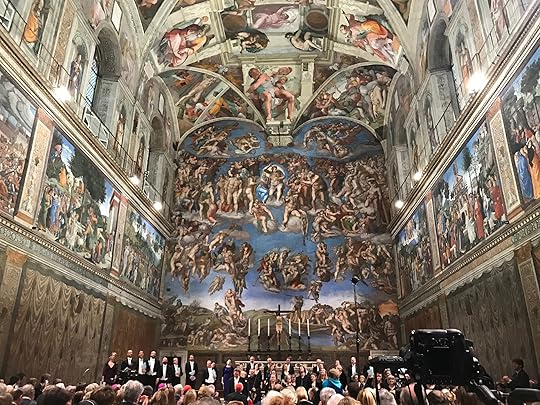
In Rome the popes organized two music groups or cappelle (singular cappella). One, the Papal Sistine Cappella, was attached to the papacy (not to a domicile), while the other, the Cappella Giulia (set up by Julius II, the pope of Michelangelo and Raphael) functioned in a freer way. The former had no instrumentalists, just singers (singing 'a cappella'), and continued to perform polyphonic music well after this style was part of history. The Giulia, in contrast, kept well abreast of the melodic and spatial conceptions offering newer repertoire.
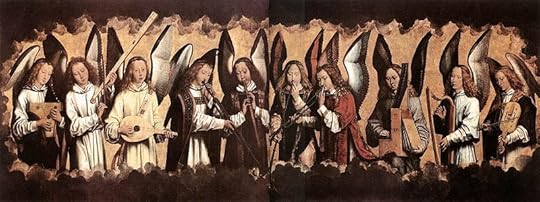
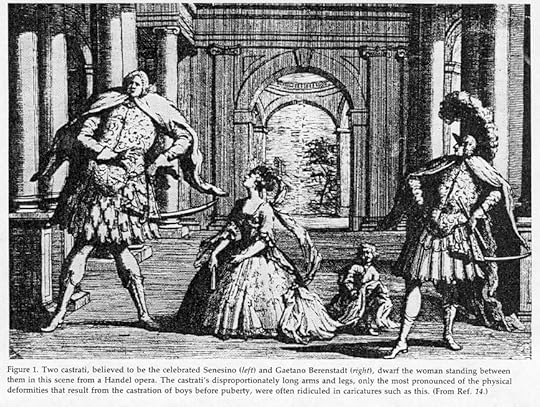
In spite of its conservatism, the Papal Cappella incorporate the voices of the castrati when these became part of the desired musicality--that is, from the end of the 16th century. These singers provided a celestial effect: as they stood surrounding the papal throne, the androgynous voices created the illusion of being a choir of angels. To note also, is that as the Papal Capella run through an extensive repertoire, these singers acquired the reputation of fabulous sight-readers; most often they performed a new score directly.
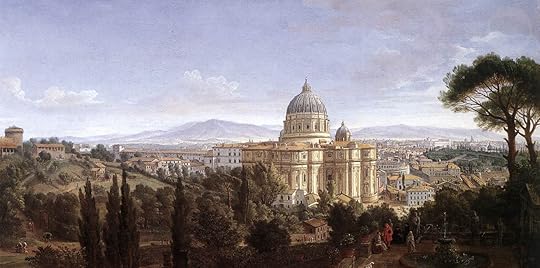
The Giulia Cappella was launched a few years after laying the first stone for the new St Peter basilica and just a couple of months before their sponsor Julius II died. Due to various difficulties it was not really until more than a century later, when the church was finished, that this musical group really took off. Amongst other innovations, they explored a great deal further the expressive possibilities that fragmented spaces offered when arranging different instrumental groupings -- searching echoes, dialogues and counter melodies. With them, the choir of castrati who sang like angels moved up to the cupola – as if singing from heaven.
The impetus of these cappelle led to the formation of an institution of musicians, the first of its kind. Originally set up as a Congregation by the end of the 16th century, it was transformed into a fully-fledged Accademy, that of Santa Cecilia. It was there that Arcangelo Corelli (1653-1713) experimented with instrumentation and where, in succeeding years, composers such as Berlioz, Liszt, Mendelssohn and others spent some time. And it was in the Sistine Cappella, where that precocious child from Salzburg listened to Allegri’s Miserere a couple of times. This piece was considered so very special that it was forbidden to play it outside the Sistine chapel and no copying of the score was allowed. The child once home managed to transcribe it from memory.
Rome was also the scenario where two new musical genres were born. One was the ‘oratorio’ which is the only genre that was born out of a particular place, the Chiesa Nuova of Filippo Neri. It was based on the concept of wanting to educate while entertaining: sacred texts would be read in group with accompanying singing. The other genre was the ‘concerto grosso’ construed by Corelli in which a smaller group of instrumentalists, the ‘concertino’, played separately from the rest, the ‘tutti’. This later developed in the concertos with one instrument as ‘solo’.
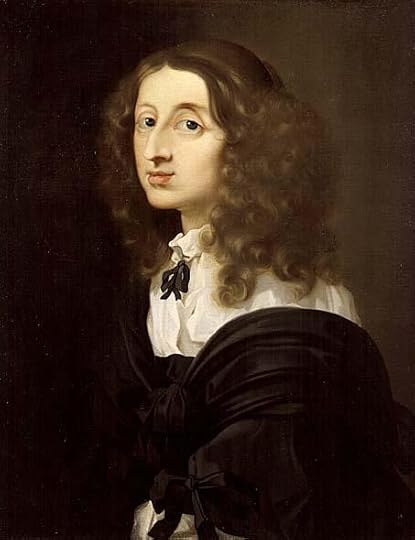
Queen Christina.
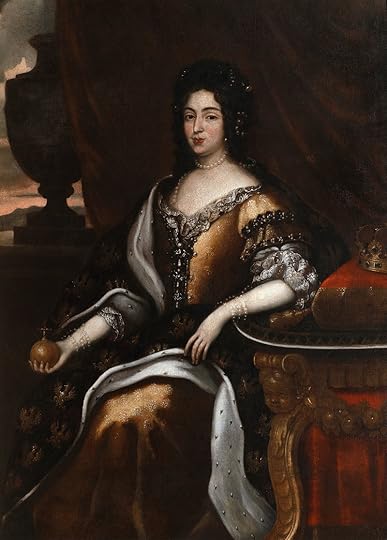
But this city of popes and clerics (about a third of the population) was also the destiny of other eminent personalities. Two queens, Christine of Sweden (1626-1689), after she abdicated, and Marie Casimire of Poland (1641-1716), once she was a widow of king Jean III Sobieski, established themselves in the eternal city and became major patronesses of music.
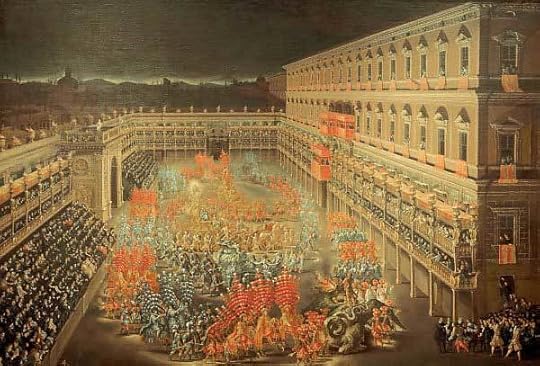
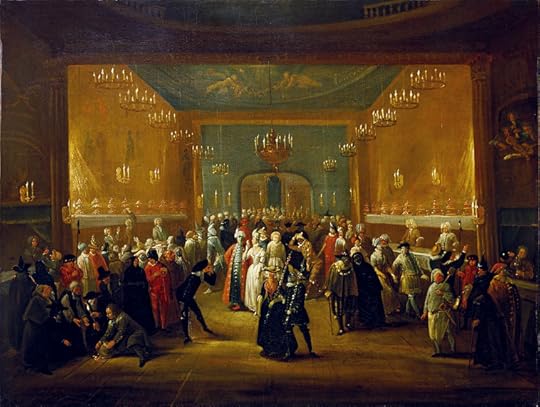
Celebrations for Queen Christina at Palazzo Barberini. February 1656, by Gagliardi and Lauri.
Christina’s official entry into Rome became legendary. The gate, the Porta Flaminia (now Porta del Popolo) was redesigned especially for her arrival, and Bernini constructed her carriage. She resided in a couple of palaces, first in the Farnese and then in the Corsini. From those abodes she ruled her court of admirers and managed the musicians. She played a role in the foundation of the Accademia dell’Arcadia, a literary institution but which also had an impact in the musical circles. Scarlatti and Handel count among its visitors.
Queen Marie Casimire.
Marie-Casimire’s impact had less panache, but she also supported the musical activities employing Domenico Scarlatti among others. During the fifteen years she was there she settled in palazzo Chigi-Odescalchi (later Zuccari) which became another centre of music. Her son would later set up a distinguished public theatre, the Teatro Alibiert.
Benedetto Pamphilj.
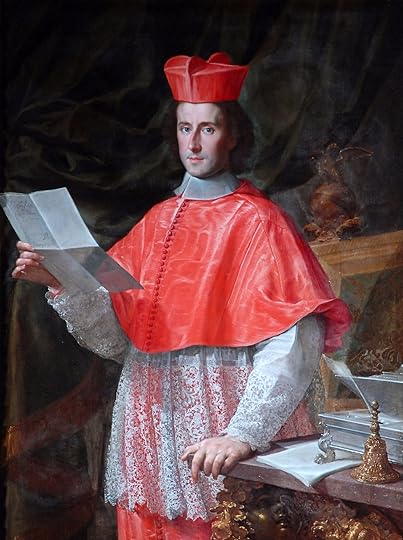
To these two splendorous women two cardinals, who were friends, succeeded in being the motor for the musical scene in Rome thus complementing the continuing activities of the papal cappelle. One was Benedetto Pamphilj (1653-1730), a nipote of pope Innocent XI (1676-1689) and son of the astoundingly wealthy Olimpia Aldobrandini. Benedetto’s palace became a temple of music for about fifty years. Corelli lived there and Handel hang around the place. Barbier’s descriptions of one of hismusical festivities implores the attention of a Hollywood producer. Benedetto was also an art collector with a particularly good selection of Dutch masters. He became the heir of his mother’s extraordinary art gallery
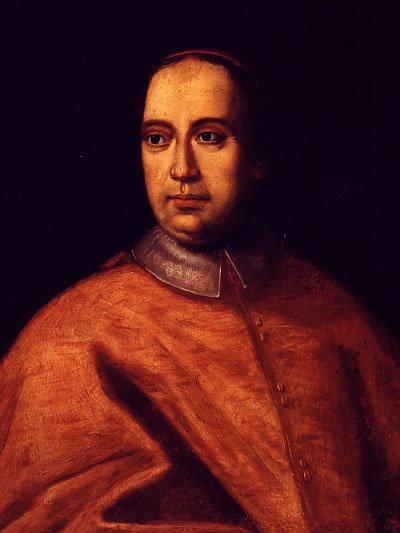
Pietro Ottoboni.
The other cardinal was Pietro Ottoboni (1667-1740), a nipote of Alexander VIII (1689-1691). He was noteworthy because he was the last ‘Cardinal-Nipote’ (a curial office), as this practice was abolished by the following pope, but he enters into Barbier’s account because his theatre in the Palazzo della Cancelleria became a major centre for the advancement of music. He was also the inventor of the ‘season-tickets’. As protector of Corelli also, he ensured that this musician would be buried in the Pantheon. He also had in his orbit Alessandro Scarlatti, and the Venetian Antonios: Caldara & Vivaldi (the Ottobonis were Venetian in origin). The castrato Senesino, before he moved to London to become Handel’s favourite singer, also belonged to Ottoboni’s circles. This palace belongs to the Vatican still but, as it holds some of their offices, it cannot be visited.
Discussing Ottoboni means discussing Handel’s visit to Italy. In just about four years the vey young German musician made an impact in Rome, Naples and Venice. And these cities also had an impact on him. He gathered and concocted a great deal of material during his Italian stay that would crop up in his later works. We can count his "Delirio Amoroso", his "Resurrezzione", his "Acis, Galatea and Polifemo" (composed for a wedding in Naples), "Il Triungo del Tempo", and most spectacular of all his "Agrippina" as significant Italian productions. To close his stay, Handel entered into a competition with Domenico Scarlatti. It seems the latter showed greater abilities with the clavichord while Handel was unbeatable with the organ.
The musical scene that these queens and cardinals established, separate from the Vatican from where the Roman musical activity had began in the modern times, prepared the ground for the arrival of opera. This genre had been born in the private palaces of the aristocrats in Florence and Mantua, and as Barbier describes, it soon spread like an oil stain throughout Italy. After reaching Venice in the very beginning of the 16th century, it soon appeared in Rome and a couple of decades later in Naples. The competitive spirit that had blossomed during the Renaissance added fuel to the rivalries between the great families in their organisations of glittering festivities in which music and soon opera were a major element.
The first Roman operas were "La Morte d’Orfeo" by Landi and "L’Aretusa" by Vitali; these were born in the Barberini premises. This family originally from Florence but came to its splendour in Rome. The Barberini pope, Urban VIII (1623-1644), had a considerable family. His three nipoti: Francesco, Taddeo (married to Anna Colonna) and Antonio (Ambassador to France) were the promoters of the renovation of the family palace employing the top architects in town: Fontana, Bernini and Borromini. This palace was near that of the Medici, and it was there where the Barberini first heard this new way of singing and performing. The three nephews soon transformed one of their rooms so as to hold opera performances and sponsor new creations. Amongst these we have the striking "Il Sant’Alessio" by Stefano Landi with a libretto by Giulio Rospigliosi, later pope Clemente IX.
Opera became a craze in Rome. During the Carnival season in 1678 one hundred and thirty works were performed in private rooms. Soon therefore other families such as the Colonna, the Chigi, the Pamphilj joined the Barberini in organizing their own theatres. Eventually the first public theatre was set up, the Tordinona, built by Carlo Fontana. It was the first to have a horse-shoe shape. This was followed, in the early eighteenth century by the Teatro Alibert, also with a horse-shoe layout, founded by Marie-Casimire’s son, as. mentioned above. In the Alibiert Leonardo Vinci’s "L’Ataserse" was premiered ; this was also the venue where the exiled James II of Britain came to lighten his evenings during the time he lived in Rome. Other theatres for the blossoming of opera followed; one such was the Teatro Valle where castrati of the calibre of Carestini, Caffarelli as well as Manzuoli sang to a more and more demanding audience.
After reading Barbier’s account, any other look at Rome during the Baroque period will seem deaf to me. All those palazzi, all those art galleries were not mute. Music sounded within and without their walls and even if a great deal is lost (both in music and in physical venues) one has to try and keep one’s imagination and one’s inner ear tuned to the extraordinary music composed in this city during that time.
This was a wonderful read and it is a book I will come back for future reference. The missing half star is for the relative lack of clarity regarding the chronology of events.