Bertha Muzzy Sinclair or Sinclair-Cowan, née Muzzy, best known by her pseudonym B. M. Bower, was an American author who wrote novels, fictional short stories, and screenplays about the American Old West. Her works, featuring cowboys and cows of the Flying R Ranch in Montana, reflected "an interest in ranch life, the use of working cowboys as main characters (even in romantic plots), the occasional appearance of eastern types for the sake of contrast, a sense of western geography as simultaneously harsh and grand, and a good deal of factual attention to such matters as cattle branding and bronc busting.
Born Bertha Muzzy in Otter Tail County, MN and living her early years in Big Sandy, Montana, she was married three times: to Clayton Bower, in 1890; to Bertrand William Sinclair,(also a Western author) in 1912; and to Robert Elsworth Cowan, in 1921. Bower's 1912 novel Lonesome Land was praised in The Bookman magazine for its characterization. She wrote 57 Western novels, several of which were turned into films.
Another lap in my mini-marathon of B. M. Bower titles, The Whoop-Up Trail was written in 1933 but returns us once again to the Happy Family gang of cowboys written about with such joy in Bower's earliest books.
In this story, we meet the famous Chip Of The Flying U (hero of a book by that name that was published in 1906) before he becomes who he was in that story. I don't remember many of the first Bower books revealing too much about the personal histories of her cowboys before they arrived at the home ranch. I remember hints about such things, but unless I have completely forgotten everything from those books, I just don't recall any time Bower sat down and told her readers exactly what this or that person was doing before he joined the Happy Family.
Maybe in her last years (Bower passed away in 1940 at the age of 68) she simply wanted to go back and hang out with her most famous characters again. Whatever the reason, we get to travel a bit with Chip and some fine horses he has. He left Colorado to follow what is known as the Whoop-Up trail north to Montana, looking for his older brother Wane. What he finds is plenty of trouble, a fickle gal with pretty blonde hair, and a whole new family.
Weary was the name of another of the Bower cowboys. We meet him in his early years here too, and learn why he is called Weary. And we see the first time the Happy Family is given that name. It was meant to be a put-down but our boys (including Slim, Happy, Patsy, and J.D. the boss) adopted it with pride.
I loved these guys in the earlier books and I loved them here. Were cowboys ever really this way or did Bower create an ideal version of the breed? She knew ranch life, maybe she knew men just like this, or maybe she saw them that way by choice. Doesn't matter. What matters is that she created some great stories about her Happy Family bunch, and I will never get tired of reading about them.
And wishing that more men these days could be like them.
The historic Whoop-Up Trail came about with the building of Fort Whoop-Up (“Fort Hamilton”) in 1869. This started the important transit route between Canada and the United States, culminating in 240 miles of trail all the way to Fort Benton in Montana. Cattle and trade goods flowed along the trail until the coming of the railroad made the trail obsolete. It’s now plowed over, although some vestiges can still be found. In this novel, the trail is used as the backdrop for a Western about the impetuousness of youth and the greed of thieves.
Chip Bennett is a young cowboy, younger in fact than he looks. His youth has hardened after the passing of his mother and miles of trailing with all that he has left, a group of cherished horses. He has come along the Whoop-Up Trail to find his older brother who has vanished with no word as to his whereabouts. But Chip is in for immediate trouble when he enters Cow Island, a rough frontier town ruled by vigilantes. He is falsely accused of being a horse thief and suddenly he must find a way to escape the noose. He will find firm allies at the Flying U Ranch, where a motley assembly of fellow cowboys will become his new family. Can he save his horses and discover what happened to his beloved brother?
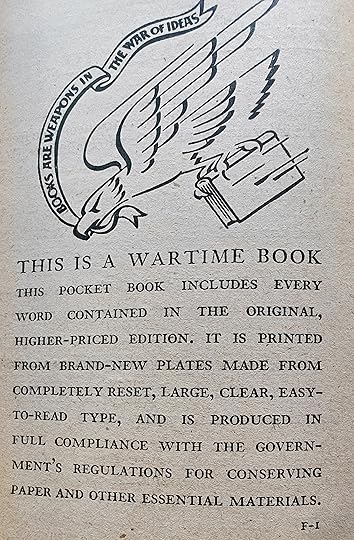
This pulp Western was first published in 1933 and proved popular enough to have continuous printings through WWII. I can see why, as the hero of the story is young and has been through much in his short life. At a time when the United States was going through the Depression and previously bountiful farmland was turning into Dust Bowls, this tale would appeal to young boys who would go on to prove themselves, not on long-gone cowboy trails, but in the real wartime conflicts in Europe and the Pacific. The action moves along quickly, and the reader has to worry about which characters are really trustworthy. The paperback itself is history itself, reflecting the second World War with its request to remind the reader that Books Are Weapons In The War Of Ideas. I wonder if this very book was carried with a long-gone soldier during that war.
Book Season = Year Round (where the buffalo point the way)
2.5 stars - I challenged myself to read this book because I tend to avoid the genre of Western fiction. By the end however, I wanted to plug the 'heroic' protagonist, Chip Bennett, with a six shooter myself. Absolutely juvenile side story of perplexing and poorly written romantic hopes, surrounded by the general idiotic behaviour of the main character throughout, this is a tale that leaves the reader unsatisfied.
The author Bower - a pseudonym for Bertha Muzzy Sinclair - was prolific and churned out 57 Westerns, selling an impressive number of books over the course of her career.
In this 1933 example of her writing she does a decent job of describing the physical surroundings of the Flying U ranch located in present day Montana as well as the small town of Cow Island. As a real wagon trail leading from Montana to what is now southern Alberta, the Whoop-Up Trail was no doubt an irresistible draw for an author looking for subject matter, giving full room for a folkloric tale of good and evil, horses, hard-bitten men and unbroken prairie. Unfortunately the author's inability to handle her characters and create realistic motivations and behaviours for them dragged the story down.