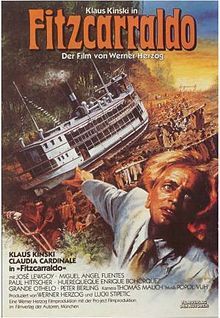
Fitzcarraldo (diventato per mano del suo stesso autore un film leggendario), è l'emozionante vagabondaggio di una fantasia ben decisa a rifiutare la frustrazione quotidiana dell'homo sapiens, e di continuo stimolata, con scarti non controllabili, verso l'evasione. Inconfondibilmente il protagonista vi riprende i tratti di un altro eroe di Herzog, quel fantasma corrusco che dal buio dello schermo subito ci ha penetrati e invasi: Aguirre. Come lui, vive, senza ostacoli interiori, un delirio di grandezza; come lui, contrappone allo squallore di una società dai ruoli predeterminati l'ipotesi della conquista di un lontano, di un inconoscibile. A differenza di lui, non sigilla la sconfitta con la nota lacerante del dramma; accetta invece la realtà, quando apparentemente il gioco è chiuso, per sabotarla, per minarla, per corromperla con lo strumento sottile dell'ironia. Questo estremo conquistador, arrivalo con tre secoli di ritardo in un'Amazzonia stuprata dagli speculatori del caucciù, affronta 'il paese sognante', come gli indigeni chiamano la foresta solcata dal fiume immenso, non per arricchirsi, ma per fissare se stesso in uno spazio e in un tempo che sa già improbabili, per fondare, tracciando confini che la prima pioggia dissolverà, una città, ma d'aria, di nuvole, che porti il suo nome. Parte, su un battello sconnesso, al suono di melodie verdiane, diffuse, per il gran mare verde, da un vecchio grammofono, cantate dalla voce di Caruso; e ritorna nel clangore della Valchiria wagneriana. In questa sostituzione, amara e spiritosa, sta la risposta di Fitzcarraldo al mondo: spenta la fiamma patetica del cuore, il suo viaggio continuerà, nei meandri della foresta di cemento, come freddo, astuto artifizio della ragione. (Giorgio Cusatelli)
Werner Herzog (born Werner Stipetić) is a German film director, screenwriter, actor, and opera director.
He is often associated with the German New Wave movement (also called New German Cinema), along with Rainer Werner Fassbinder, Margarethe von Trotta, Volker Schlöndorff, Wim Wenders and others. His films often feature heroes with impossible dreams, or people with unique talents in obscure fields.
This is like nothing I've ever read before, just as Werner Herzog films are like nothing I've ever seen elsewhere. I like that there's a still photo included from each of the four filmed scenarios. Herzog's descriptions are so vivid they are manic, and I just have to say these stories are all weird. I don't know what Herzog's motivation is besides his obvious love of words, music and describing misery and violence, but I'd love to know where his head is at when he has a male character ask what women were made for, "they really don't seem to be useful for anything more than sitting around". I'm glad Land of Silence and Darkness has female main characters to balance out the overwhelming macho-manliness of all the other leads presented here. At one point I wondered if it was a typo when Herzog himself had a word of dialog in Land of Silence and Darkness, but after searching online I see that breaking the 4th wall is a technique he used fairly often.
It's remarkable how closely this text mirrors the film. It's rich with detail, full of fantastic scenarios and enveloping moods. Fitzcarraldo, the man of opera, shoulders the burden of his dreams and brings them into existence. Highly recommended for all who admire Herzog's work.
From wiki - Fitzcarraldo is a 1982 film written and directed by Werner Herzog and starring Klaus Kinski as the title character. It portrays would-be rubber baron Brian Sweeney Fitzgerald, an Irishman known as Fitzcarraldo in Peru, who has to pull a steamship over a steep hill in order to access a rich rubber territory. The film is derived from the real-life story of Peruvian rubber baron Carlos Fitzcarrald.
Some handsome trees were felled during the making of this film.
This entire review has been hidden because of spoilers.
Five stars only because not only is the film brilliant but the book about the backstory is completely enthralling.
I admire Herzog and I have always been a big fan of Kinski, although, I cannot give you any hard fast reasons except he is a fascinating madman on screen and this film plunged him over the edge...but that's enough of a teaser for you.
“Fitzcarraldo nie jest jednak w stanie słuchać uważnie, zawładnęła nim w i e l k a i d e a.”
Dotychczas nie miałam styczności ani z twórczością Herzoga, ani z formą, jaką są opowiadania filmowe dlatego podchodziłam do tej książki (czy raczej literackiej adaptacji filmowego scenariusza) z ogromną ciekawością. I to było wspaniałe doświadczenie: bardzo obrazowe, wciągające i pobudzające wyobraźnię.
Akcja toczy sięw Ameryce Południowej i skupia się na postaci Briana Sweeneya Fitzgeralda, Irlandczyka znanego w Peru jako „Fitzcarraldo”. To człowiek opętany marzeniem: chce stworzyć operę w dżungli amazońskiej, sprowadzając tam wielkich śpiewaków operowych.
Jego życie to pasmo porażek: nie udaje mu się zbudowanie kolei w środku dżungli ani innych przedsięwzięć jak fabryka lodu. W końcu wpada na szalony pomysł tj. jeśli uda mu się zostać potentatem kauczukowym, zdobędzie środki na realizację marzenia.
Fakt, że całość została napisana w pierwszej osobie liczby mnogiej, sprawia, że czujemy się nie tyle czytelnikami, co świadkami wydarzeń: cichymi obserwatorami wszystkich zmagań głównego bohatera, obecnymi tuż obok niego.
Herzog maluje też fascynujący obraz dzikiej, nieprzystępnej Amazonii i stosunków z tubylczymi społecznościami.
Dla mnie najcenniejsze w tej książce jest to, jak realizacja marzeń splata się z samotnością, absurdem i wewnętrzną transformacją. Fitzcarraldo nie jest tu tylko wariatem, ale jest kimś, kto poszukuje sensu, walczy o ideę i o to, co dla niego najważniejsze. To opowieść o tym, że droga jest ważniejsza od celu, że absurd bywa piękny, a pasja może stać się formą transcendencji.