

What do you think?

Jennifer Bartlett
Presents illustrations of Jennifer Bartlett's paintings, sculptures, and architectural commissions and examines the development of her art
- GenresArt
192 pages, Paperback
First published January 1, 1985
Ratings & Reviews
Friends & Following
Create a free account to discover what your friends think of this book!
Community Reviews
Displaying 1 - 2 of 2 reviews

June 8, 2016
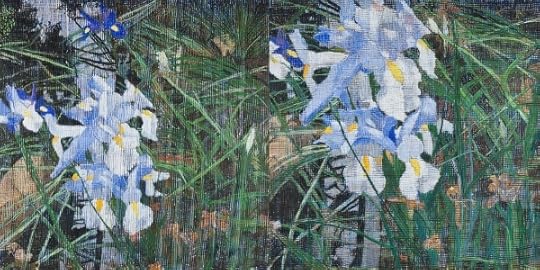
Over the years I’ve had the pleasure of attending three Jennifer Bartlett exhibits. The artist’s bold colors and stunning composition has always made a considerable impression. I wouldn’t say I’ve been blown away by every single work, but it’s been close. This coffee table book contains numerous full-color plates and illustrations along with three essays by noted art historians: Calvin Tomkins, Marge Goldwater and Roberta Smith. For the purposes of my review, I will focus on the essay written by Calvin Tomkins via the below quotes along with my accompanying comments:
Speaking of when Jennifer Bartlett first set out to create her own art: “One of the problems in her own work was that other people’s ideas interested her too much; she had a lot of trouble thinking up her own. Her best ideas always came out of the actual process of working.”
What I love about this quote is how Jennifer Bartlett discovered what many artists and writers have discovered: too much thinking about the creative process can be as much a hindrance as a help; in many ways the best thing to do is roll up your sleeves, grab a paintbrush (or pen) and take the plunge.
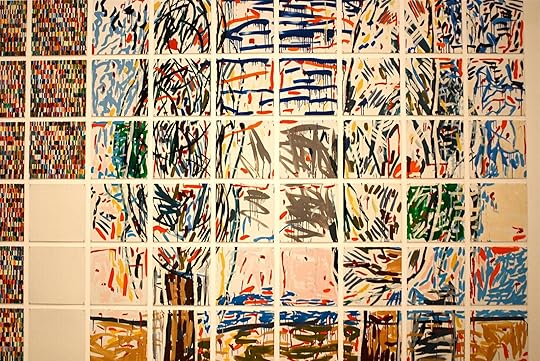
“At this point, late in 1968, she hit on the notion of using steel plates as the basic module for her paintings. The minimal artists often used modular units, but Bartlett’s idea had nothing to do with minimalist sculpture, or with philosophical meditations on “the object.” She wanted a simple, flat uniform surface to paint on, a surface that did not require wooden stretchers, canvas, and all the bothersome paraphernalia of oil paint.”
Must have been an ‘aha!’ moment for the artist – coming upon a material that would allow her to stretch her imagination rather than canvases.
“Bartlett is an exceptionally fastidious worker; some of the inspiration for the steel plates must have come from her abhorrence of mess.”
There is a lesson to be learned for all of us: if you feel inspired to create, go with what you love and avoid what you hate.
“Bartlett’s life did not change dramatically as a result of this first major sale. She paid off a lot of accumulated debts and kept right on painting.”
The mark of a true artist in that she wasn’t creating to make money; rather, she was painting because she was following her bliss in what she loved. The money simply allowed her to spend more time with her art.
“She is a little like Robert Rauschenberg in her willingness to risk failure at every turn. Her mistakes are all made out in the open, and as often as not they are turned into assets.”
In any originality - painting, theater, fiction, poetry, to name several - there is always an element of risk involved. For those bold creators, one thing that rarely pops its ugly head - giving credence to the question: “What will other people think?”
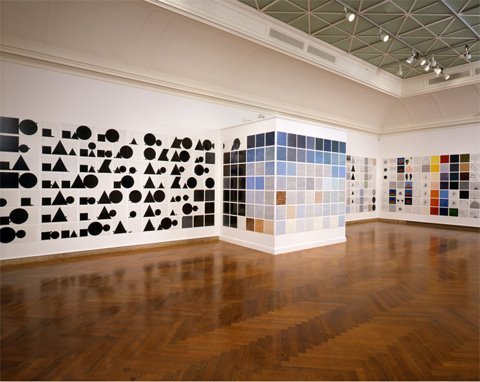
“The series of house paintings – multipart renderings of the same rudimentary house image – expanded her repertory of painting styles. Impressionism, Expressionism, Neo-Realism, Rayonism, Van Gogh, Matisse, Pollock, Mondrian – sometimes the entire history of modern art seemed to be making a guest appearance in her work, without quite upstaging the host.”
Jennifer Bartlett incorporates aspects of other artists into her work but is never bound by those other works, no matter how great. There is nothing as flat and uninteresting as art created as an imitation of someone else. Much better to go with your own vision. Hell, even if your work fails, at least it is your own work and not a repetition or imitation of another.
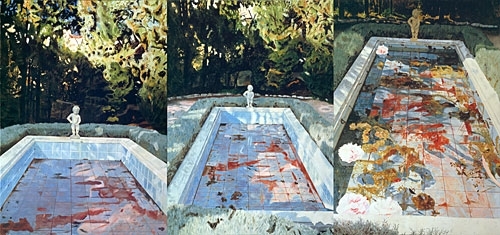
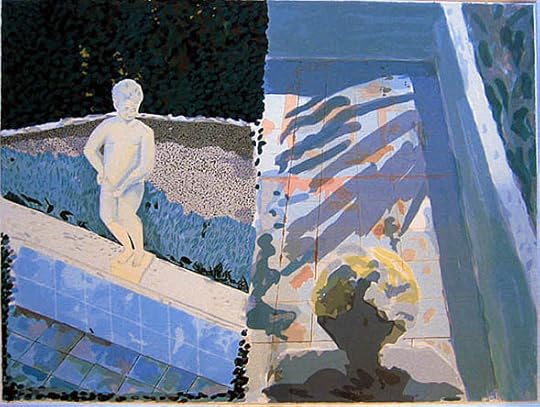
“One of the delights of ‘In the Garden’ is the increasing skill with which the artist renders the banal scene – the moribund swimming pool with its kitschy statue of a small boy urinating, the background of dark, shaggy trees, the shrubs and the perennials in their unkempt beds.”
I recall Schopenhauer saying that the mark of a great artist or novelist is their ability to render the commonplace in uncommon and extraordinary ways.
“Her recent work has been increasingly figurative and involved with landscape, or, to be more accurate, with land-and-waterscape, since Bartlett’s passion for lakes, streams, and the sea has not abated.”
A great artist and creator is forever expanding - no matter how fantastic one's previous work, imagination finds ways to enlarge and transcend.

January 15, 2016
Jennifer Bartlett, happily, caught the eye of NYT critic John Russell, known for....well, er, uh, pinching the beehinies of femme artists...oo-la-la, the canvas couch, shall we ponder? Russell was a blathery UK-born critic and his "fingers" were accepted in London. Today, Who is Jen Bartlett?
Thanks to enablers Roberta Smith / Calvin Tomdick >> she had a brief money-whammy career. Ah, life in NYC art world.. J Russell is dead, Jen is fat.
Thanks to enablers Roberta Smith / Calvin Tomdick >> she had a brief money-whammy career. Ah, life in NYC art world.. J Russell is dead, Jen is fat.
Displaying 1 - 2 of 2 reviews