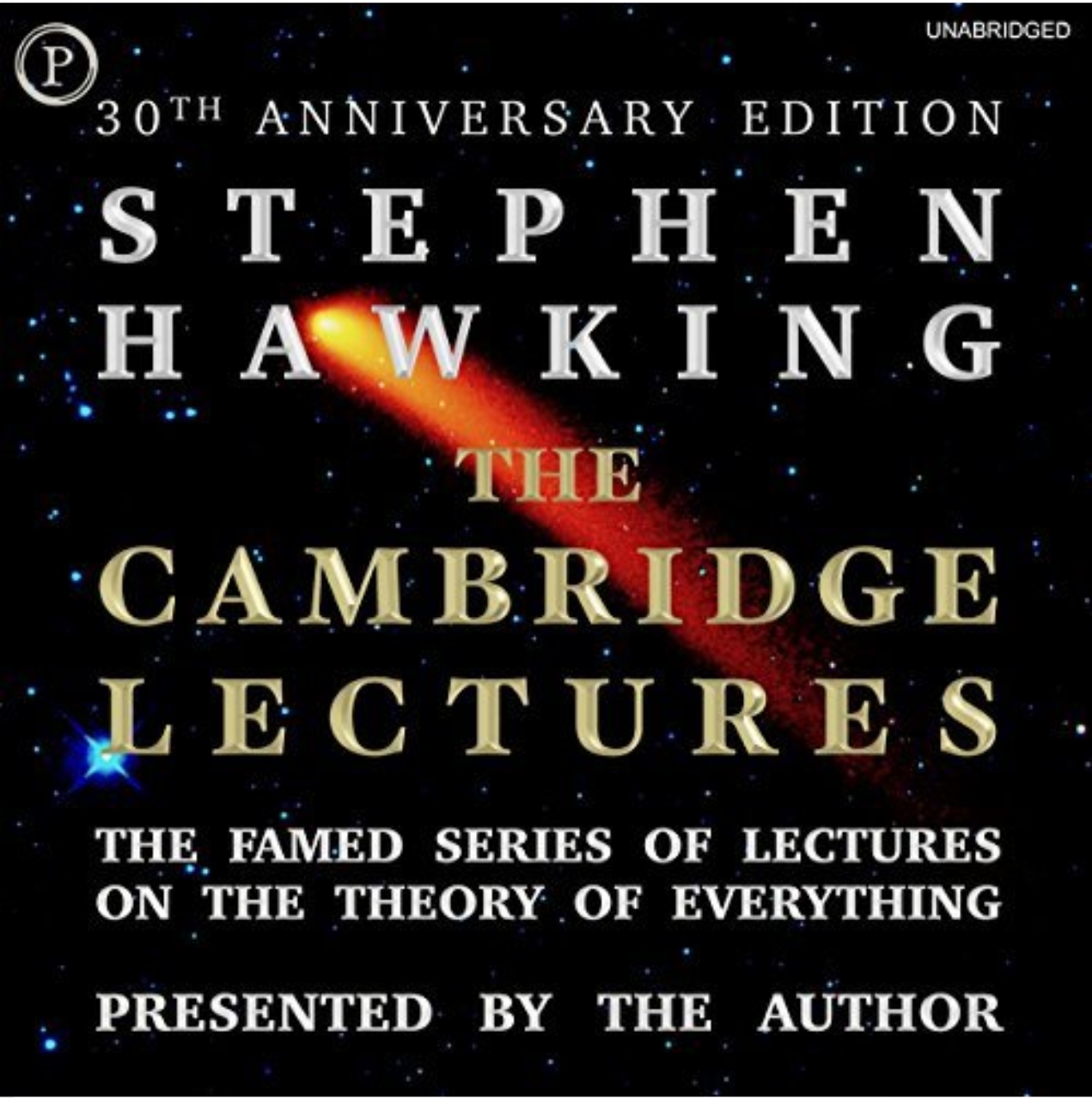
Publisher's Summary Stephen W. Hawking's Cambridge lectures, exploring the most complex theories of physics, both past and present, remain the most important scientific theories known of time, space, and the nature of the cosmos. This 30th Anniversary remastered edition of The Cambridge Lectures offers listeners a unique opportunity to hear the full series of seven famed lectures exactly as Professor Hawking presented them during his tenure as Lucasian Professor of Mathematics at Cambridge University.
Stephen William Hawking was an English theoretical physicist, cosmologist, and author who was director of research at the Centre for Theoretical Cosmology at the University of Cambridge. Between 1979 and 2009, he was the Lucasian Professor of Mathematics at Cambridge, widely viewed as one of the most prestigious academic posts in the world. Hawking was born in Oxford into a family of physicians. In October 1959, at the age of 17, he began his university education at University College, Oxford, where he received a first-class BA degree in physics. In October 1962, he began his graduate work at Trinity Hall, Cambridge, where, in March 1966, he obtained his PhD degree in applied mathematics and theoretical physics, specialising in general relativity and cosmology. In 1963, at age 21, Hawking was diagnosed with an early-onset slow-progressing form of motor neurone disease that gradually, over decades, paralysed him. After the loss of his speech, he communicated through a speech-generating device initially through use of a handheld switch, and eventually by using a single cheek muscle. Hawking's scientific works included a collaboration with Roger Penrose on gravitational singularity theorems in the framework of general relativity, and the theoretical prediction that black holes emit radiation, often called Hawking radiation. Initially, Hawking radiation was controversial. By the late 1970s, and following the publication of further research, the discovery was widely accepted as a major breakthrough in theoretical physics. Hawking was the first to set out a theory of cosmology explained by a union of the general theory of relativity and quantum mechanics. He was a vigorous supporter of the many-worlds interpretation of quantum mechanics. Hawking achieved commercial success with several works of popular science in which he discussed his theories and cosmology in general. His book A Brief History of Time appeared on the Sunday Times bestseller list for a record-breaking 237 weeks. Hawking was a Fellow of the Royal Society, a lifetime member of the Pontifical Academy of Sciences, and a recipient of the Presidential Medal of Freedom, the highest civilian award in the United States. In 2002, Hawking was ranked number 25 in the BBC's poll of the 100 Greatest Britons. He died in 2018 at the age of 76, having lived more than 50 years following his diagnosis of motor neurone disease.
Professor Hawking explains his theroies in very plain language. He also allows in his lecture the possibility of the existence of God. One of his argumdnts for God, is that some of what we observe in the Universe is too precise in it's mesurements (a little too much and the Univere expands so much that there would be non left today since the Big Bang, and not enough of some measurements and the Universe would have contracted back to it's state before the Big Bang, never expanding beyond that.)
He also shows a lot of his well know charm and humor. One of the first things he says is that he apoligizes for the "American" accent of his voice, he has not yet been able to teach it proper English. First I thought that voice would be annoying or distracting, but no. The annunciation of the sound of his voice is very very good. Since you may have heard him speak, then it simply becomes the voice and accent of the well know Astrophysicist.
I am not a genius by any means, but I understood many and much of what Professor Hawking was talking about. Much of what he says are reasonings and science that I've grown up with. Interesting thing is, his mentioning the existence of God is something that I believe as well, that God if he exists,is just the most interesting and advanced scientist we have ever known. For 3 and a half hours it is well worth your time to give these historic lectures a try.