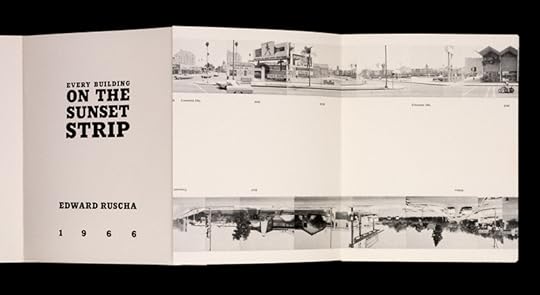
Ed Ruscha took the photographs contained in this publication with a motorized Nikon camera mounted to the back of a pick-up truck. This allowed him to photograph every building on Sunset Boulevard (between Crescent Heights Boulevard in Hollywood and Doheny Drive in Beverly Hills), while driving -- first down one side of the street and then the other. The pictures were then pasted in order, the individual buildings were labeled with their respective addresses, and presented with the north side of the street at the top of the page, with the south side of the street inverted and aligned below it.
Edward Ruscha is a towering figure of American Pop Art whose multidisciplinary practice redefined the visual language of the late twentieth century. Born in Omaha and raised in Oklahoma City, Ruscha moved to Los Angeles in 1956 to study at the Chouinard Art Institute, where he was mentored by Robert Irwin and Emerson Woelffer. Rising to prominence in the early 1960s alongside the influential Ferus Gallery group, he gained international acclaim for his "word paintings"—monosyllabic oils like OOF, BOSS, and HONK—which isolated typography against monochromatic backgrounds, reflecting his background in commercial art and a fascination with the "deadpan" irreverence of the Pop movement. His work is inextricably linked to the vernacular of Southern California, capturing the sprawling aesthetics of Los Angeles through iconic depictions of the Hollywood sign, stylized gas stations, and continuous photographic surveys such as Every Building on the Sunset Strip. A master of diverse media, Ruscha has famously experimented with unconventional materials, including gunpowder, blood, axle grease, and various food products like chocolate syrup and caviar, to create works that bridge the gap between commercial graphics and fine art. His influence extends significantly into the "New Topographics" photography movement and conceptual art, challenging traditional views of the urban landscape by dispassionately documenting America’s suburban structures. In 1962, his work was featured in the groundbreaking New Painting of Common Objects exhibition, widely considered one of the first Pop Art surveys in America. Throughout his storied career, he has been the subject of major retrospectives at the world’s leading museums, including the Centre Pompidou, the Whitney Museum of American Art, and the Museum of Modern Art. Ruscha has also contributed to public spaces through monumental commissions for the Getty Center and the Miami-Dade Public Library. In recognition of his enduring impact, he represented the United States at the Venice Biennale in both 1970 and 2005, and in 2013, he was named one of Time magazine’s 100 most influential people in the world. His artistic reach even touched popular culture, with his typeface "Boy Scout Utility Modern" and his collaboration on cover art for Paul McCartney and The Beatles. Beyond his own production, Ruscha has served as a trustee for the Museum of Contemporary Art and the San Francisco Museum of Modern Art, underscoring his leadership within the arts community. His unique "cool gaze" remains a quintessential chronicler of the American West, blending the cinematic proportions of Hollywood with the mundane reality of the open road. Today, his works are held in premier permanent collections worldwide, cementing his legacy as a defining artist of the postwar era who transformed the way we read, see, and experience the modern environment.
I dream of a world where such a book was made about every street on the planet.
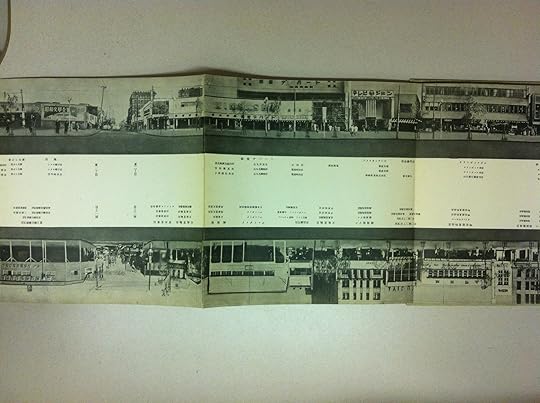
An element of intrigue surrounding the book is whether it was influenced by Yoshikazu Suzuki and Kimura Shohachi's Ginza Kaiwai/Ginza Haccho, a two-volume study of Tokyo's Ginza district issued 12 years before Sunset Strip. The Japanese work came with a leporello format photographic study of Ginza which can only be described as uncannily similar to Ruscha's.
Spent a little time this morning uspooling this across my table in special collections. LOL, felt like it was never going to end there for a while. I love that this existed before Google street view was even a glimmer in somebody's mind. I admit that I didn't really enjoy how one side of the street was upside down - the actuality of that hurt my head.
Hilariously my library classified this into California/Los Angles (LC class F) instead of photography. Oh, catalogers of yore at my institution, you made choices.
“The inference of narrative is further reinforced by their smoky, grissaille surfaces, since, in Ruscha's previous work, such dissolving monochromatic atmospheres almost invariably allude to the potential entropy of things remembered in the process of being forgotten.”
I read this book before and after I attended the exhibit Ed Ruscha Now Then at LACMA. The book as well as the exhibit showcase the evolution of Ruscha’s work from the time he graduated from art school in Los Angeles in the 60s to the present day. Ruscha’s greatest hits are here and also work i hadn’t seen or known about- he has expanded beyond the Pop and Conceptual work eras for which he is known. Ed Ruscha’s art encapsulates the Los Angeles experience and the essays in the book further discuss this. His work captures Los Angeles’ streets, signs, syntax, and vibe, changing with the decades. The book placed the works in the exhibition in context.