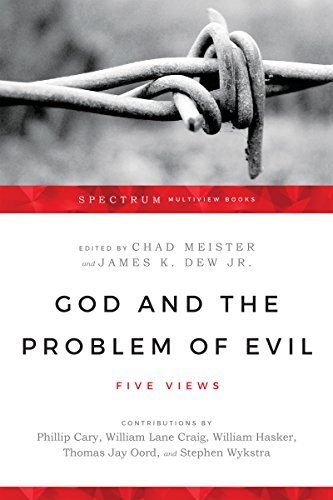
Evil abounds. And so do the attempts to understand God in the face of such evil.
The problem of evil is a constant challenge to faith in God. How can we believe in a loving and powerful God given the existence of so much suffering in the world? Philosophers and theologians have addressed this problem countless times over the centuries. New explanations have been proposed in recent decades drawing on resources in Scripture, theology, philosophy, and science.
God and the Problem of Evil stages a dialogue between the five key positions in the current debate:
Phillip Cary: A Classic View
William Lane Craig: A Molinist View
William Hasker: An Open Theist View
Thomas Jay Oord: An Essential Kenosis View
Stephen Wykstra: A Skeptical Theism View
According to the classic position, associated especially with the Augustinian tradition, God permits evil and suffering as part of the grand narrative of divine providence to bring about the redemption of creation. Molinism modifies the classic view by adding God's middle knowledge to the picture, in which God has knowledge of what creatures would do in all possible worlds. Open theism rejects the determinism of the classic view in favor of an account of God as a risk-taker who does not know for sure what the future holds. Essential kenosis goes further in providing a comprehensive theodicy by arguing that God cannot control creatures and thus cannot unilaterally prevent evil. Skeptical theism rejects the attempt to provide a theodicy and instead argues that, if God exists, we should not expect to understand God's purposes.
Edited, with an introduction, by Chad Meister and James K. Dew Jr., God and the Problem of Evil hosts a generous and informative conversation on one of the most pressing issues in the Christian life.
An age old conundrum that pesters Christians, either intellectually, emotionally or both, is the question of evil in the moral order and in creation. Not long ago a fresh 199 page manuscript rolled off of the presses at IVP Academic addressing this issue from within the Christian household. “God and the Problem of Evil: Five Views” draws together several philosophical and theological scholars who lay their positions out on the table for all to examine. The book is edited by Chad Meister, author and professor of philosophy and theology at Bethel College in Mishawaka, Indiana, and James K. Drew Jr., author, associate professor of the history of ideas and philosophy and dean of the College at Southeastern Baptist Theological Seminary. The material between the soft covers is not overly academic and is accessible to most adult readers.
“God and the Problem of Evil” comes in two parts. In the first section each of the respective positions is put before the reader in detail covering anywhere from nineteen to twenty-four pages per position. In the second section the individual authors interact with and critique the other writers. The strength, or weakness, of this approach (depending on your temperament) is that the exchanges are corralled and congregated into single chapters in the second half of the book and not hotly debated at the end of each position.
Phillip Cary, professor of philosophy at Eastern University, presents the classic position that traces its lineage back through thinkers and theologians to Augustine of Hippo. The classic view says that “no evil takes place unless God permits it, and that God has a good reason for permitting evil, which takes the form of a greater good that he uses evil to bring about” (14). Cary masterfully weaves together theology, biblical tragedy, story and liturgy that sweep up the reader into hopeful prayer and prayerful hope.
William Lane Craig, Research Professor of Philosophy at Talbot School of Theology and Professor of Philosophy at Houston Baptist University, offers a position based on the work of Jesuit theologian Luis de Molina. Inside molinism is much that one will find in the classic view with the modifying addition of God’s middle knowledge in which “God has decided to actualize a world of libertarian free creatures and to skillfully play the hand that he has been dealt in such a way that his ultimate ends are achieved through creaturely free decisions, despite the sinful decisions they would make and the evils they would bring about” (39). Craig pulls together the theoretical, missiological, and statistical.
William Hasker, Distinguished Professor Emeritus of Philosophy at Huntington University, unpacks an open theist stance with regard to evil. Here “the future is known by God as what might happen, and as what will probably happen, but not as what will definitely take place” and so “it is impossible even for God to know with certainty how those creatures will respond; there is a genuine possibility that they will not respond in the way he intended and desired for them to do” (60). Hasker disagrees with the determinism he sees in a specific-benefit theodicy and optimistically represents a general-policy theodicy of God as a risk-taker.
Thomas Oord, theologian, philosopher, and scholar of multidisciplinary studies who teaches at Northwest Nazarene University in Nampa, Idaho, gives an account of essential kenosis. Under this concept, because God’s nature is “self-giving, others-empowering love” that is “necessarily uncontrolling” then God cannot unilaterally prevent evil (84). In other words, “God’s nature of love makes it impossible for God to withdraw, override, or fail to provide the freedom, agency, or basic existence of others” (85). As Oord works out his theory he makes other interesting and surprising assertions that swim against the vast majority of Christian thinking for two-thousand years (95).
Stephen Wykstra, professor of philosophy at Calvin College in Grand Rapids, Michigan, explicates skeptical theism. This particular outlook is not quite so alarming as the name might imply. As Wykstra notes, “so-called skeptical theism relies strongly on what I’ve here called “conditional theistic humility” – an affirmation that if the theistic God does exist (that is, if mere theism is true), then it is pretty unsurprising that the divine purposes for God’s “actions” will often be beyond our ken. This conditional, modest as it is, removes the sting from some evidential arguments that might otherwise seem lethal to theism” (117). Of all the chapters, Wykstra’s is the most abstract for the non-philosophically trained reader, and yet it is, concurrently, very human and personal.
Once all of the authors have unrolled and displayed their wares, then each gets the opportunity to walk around and point out the weaknesses and potential compatibilities of the other exhibits. It’s in the final section that it becomes clear how three of the positions can actually walk close together (classic, Molinist and skeptical theism) and how the other two are near cousins (open theism and essential kenosis). It is rather unfortunate how Hasker is downright dismissive and demeaning of the classic view, while giving the other positions thoughtful interaction. Beyond that, the rest of the contributors are gracious in their criticisms, while remaining unwavering and more-or-less firm.
I found “God and the Problem of Evil” useful and eye-opening in its design and dissemination. I became roused and reverently praying by the time I finished reading the classical position. I was positively challenged to think hard by several chapters, and was drawn to the outskirts of the ways of the Almighty (Job 26.14) and found my heart touched in places while peering over the edges of skeptical theism. I have no problem endorsing this book!
Thanks to IVP Academic for providing, upon my request, the free copy of the book used for this review. The assessments are mine given without restrictions or requirements (as per Federal Trade Commission’s 16 CFR, Part 255).
A dialogue with the “problem of evil” requires a familiarity with biblical issues and philosophical issues. This book clearly stays in the philosophy lane, with some chapters (notably those who believe in libertarian free will) making little to no biblical defense of their views. The lack of biblical substance was disappointing to me. The emphasis on philosophy also requires the reader to pick up several new technical words if they want to track with the arguments.
I did appreciate the format of this book over the more common “Four Views” series. Rather than each perspective having multiple chapters of critique from the other authors, the editor gave each contributor one chapter to critique all of the other views.
In all, if someone wants a book that surveys how different interpreters understand how the Bible deals with the problem of evil, then a different book would be more helpful.
Maybe I just took to long to read it with too many breaks in between. The first five essays are well written and present the five main arguments succinctly and clearly. The responses not so well. I would have preferred a summary chapter of the five main viewpoints on this topic. This would allow the readers to draw their own conclusions, rather than reading the remaining chapters on which the authors postulate for their own positions.
The final chapter by Stephen Wykstra left the book feeling unfinished. Between his sarcastic tone in almost completely bashing the other four positions, the choice to leave this for the final chapter more than just simply implies that his position is the one that everyone should take.
I’ll revisit the five arguments again and ignore the “conversation” chapters.
While I, at first, pulled this quote from the book because it was kind of humorous, upon reflection it really does seem to be a decent comment on the overarching idea of InterVarsity Press' God and the Problem of Evil: Five Views. Namely, the concept of the problem of evil and the search for potential solutions to it is not for the faint of heart--or, moreover, the faint of mind.
Editors Meister and Dew have compiled five essays from Christian thinkers at various places on the spectrum of responses to the problem of evil (PoE) and have basically thrown them into a cage to figure out which view comes out on top as the most promising solution. Although, the cage is more like a five-sided chess board, and the ensuing fight has more to do with the mind and wit than with any form of hostility or competition.
Without going into too much unnecessary detail, this 'five views' book gives each author roughly twenty pages to lay out and defend the core tenets of their approach to the PoE. For those unfamiliar--although it's likely obvious to almost everyone in some capacity what the phrase 'problem of evil' entails--the PoE deals with the challenge allegedly posed by the reality of suffering and evil to the existence of God. It seems clear that bad things (sometimes truly horrific things) take place; the question is, does this make God's existence less likely or impossible? The committed Christian would say no, of course, but is there any good reason for thinking that? Each of these five authors spells out their view, and then they are allotted ten further pages to critique each other's views.
Briefly, the perspectives on offer (and their respective proponents) include:
-The 'Classic' view (Phillip Cary) -The Molinist view (William Lane Craig) -The Open Theist view (William Hasker) -The Essential Kenosis view (Thomas Jay Oord) -The Skeptical Theist view (Stephen Wykstra)
I won't go into any detail here on any of the views or my personal opinion on them, although I think there is a clearly 'best' view upon reading and reflecting on these options. I will, however, say that this book is a fantastic primer or introduction to this topic. Everyone--theist and nontheist alike--has thoughts, questions, doubts, worries, etc. about evil and suffering when they see or experience it. These thoughts almost without fail relate to and affect our thoughts about God--either affirming the nontheist’s disbelief, casting doubt on the theist’s belief, or even strengthening the theist’s belief, depending on where their thoughts end up. Being able to think through and be conversant with this topic on at least a ground level is essential, in my opinion. This ‘five views’ book is a fantastic place to start.
Each author has a view that is sufficiently different from the others to justify their place in the compilation, although it becomes clear how close or distant some views are in relation to others pretty quickly. I also don’t think there is any essay that is ‘unworthy’ from either a writing perspective or an ideological perspective--some essays are better than others in terms of readability and coherence, but all meet a kind of minimum standard for a more lay-level book like this one.
As I said, I won’t analyze the different views here, or give my opinion on the ‘winner’, but I will say it was with the hope of seeing Oord’s contribution--and the rebuttals to it--that I picked this book up. I wasn’t disappointed in this regard; Oord is clear and concise, as are the rebuttals to his view. His was probably the perspective I was least familiar with and now I at least have a better grasp on what he’s getting at (and what it might look like to respond to it). As a matter of fact, I feel more familiar and comfortable with all of these views now, which is great! Some I had already ran into in other avenues of research, but others I honestly hadn’t seen any kind of explication of (or rebuttal to). It was nice to see the variety of points and counterpoints offered within less than 200 pages of very accessible material.
I wanted to mention in particular that the essay by Wykstra was an especially welcomed surprise. I didn’t have anything against Wykstra, or even really know who he was or what his view consisted in, but nonetheless it was refreshing to hear from a Christian thinker who was so...different in his style. His inclusion and use of stories and personal anecdotes in his essay was at first a little off-putting--’I came here for boring philosophy, not memoirs!’ But I very quickly was taken in by the way he was able to weave his views in with these stories and launch out from them into the key points of emphasis of his views and the views of others he would go on to disagree with. I very much look forward to reading more from Wykstra in the future!
One final comment about the book will reveal why this is a four-star and not a 5/5--I was a little unhappy with the overall structure in the end. I’ve read only a few other books in this fashion, consisting of several different views and counterpoints. In those other books, which I believe were in the Zondervan series, they had the same idea (point, counterpoint), but the structure would maybe be set up as ‘one essay--short responses from everyone--another essay--short responses from everyone--etc.--short concluding essays’. This compilation’s layout wasn’t necessarily bad. It was nice to be able to see all five views laid out back-to-back without rebuttals, although this did make the proceeding rebuttals a little harder to follow sometimes, as with some of the earlier views it was difficult to recall some things they had said. So, I might prefer the ‘essay--responses’ structure better overall. HOWEVER, my main disappointment, besides all that, was the lack of final, concluding essays from each author! In the other books, after each author had their views eviscerated by the other authors, they all were able to have the ‘last word’ on the topic in a short concluding/response essay. This might have lengthened the book by several pages, but I was really wanting to see how some of the contributors would have responded to the critiques brought by some of the others. Some of these rebuttals seemed to be outright refutations in some cases, so it was definitely disappointing to not get a more rounded out experience with some kind of wrap-up essays.
Overall, this ‘five views’ book is very well-written, clear, concise, and covers a broad spectrum of positions. I recommend it for anyone interested in exploring the PoE at an introductory level, but especially the Christian pursuing such a thing. Honestly, I think almost every Christian needs to sit down and wrestle their way through this book. Even if a lot of it goes over their head, something good and useful is bound to stick and, ultimately, hopefully, lead them to see God a little more clearly in light of--and in spite of--the evil and suffering around us.
Some of the most helpful books in the field of biblical and theological studies have come in the form of multiview dialogs. These books are especially useful for laity looking to survey the landscape of ideas, and the format is exceptional for argument analysis. The most recent of these books, from the Spectrum Multiview Books series, seeks to address an age-old problem with a bit of modern flare—God and the problem of evil.
God and the Problem of Evil: Five Views edited by Chad Meister and James K. Dew Jr. brings together five theological minds with very different views of God and the reconciliation of such to the existence of evil in the world. The book is comprised of two parts. Part one is a positive presentation of each of the five views. Phillip Cary represents the classical theist view, arguing that no evil takes place unless God permits it, and in doing so, his purpose is for a greater good to be brought about in the world. William Lane Craig represents the Molinist view, arguing that divine middle knowledge essentially becomes the solution to the problem. William Hasker represents the open theist view and argues that God created humanity as free creatures. Thus, it is impossible for him to know with certainty what they would do in any given situation. Thomas Oord represented a modified open theist view which he refers to as an essential kenosis view. Oord argues that God, for the sake of love, emptied (kenosis) himself of the ability to control the actions and effects of free creatures, and thus, is unable to stop evil from taking place. Lastly, Stephan Wykstra represents a more philosophically abstract approach to the problem of evil which is labeled the skeptical theism view.
The second part of the book comprises the responses of each contributor to the other contributors’ essays. Each response essay is brief and curated into a single chapter. For example, Cary’s response essay interacts with Craig, Hasker, Oord, and Wykstra in a single chapter. In my experience, the format of the book hasn’t provided as much room for interaction, and actually, makes the book more difficult to navigate then if the each response followed the positive presentation in the first section (e.g. each contributor interacts with a single view immediately following the positive presentation). Consequently, while the content of the interaction between the views is helpful, it is rather brief and sometimes seems outright dismissive (e.g. Hasker’s interaction with Carey). That said this is the biggest shortcoming to an otherwise excellent display of scholarly engagement on a very important and far reaching theological topic.
God and the Problem of Evil: Five Views edited by Chad Meister and James K. Dew Jr. offers an up-to-date engagement with the current landscape on one of the most theologically problematic questions to meet the modern age: if an all-loving and all-powerful God exists, then why is there so much evil in the world? Despite the lackluster organization of the response section, the book shines with deep theological reflection and worthwhile interaction. It’s a well-done primer that I wouldn’t have any problem recommending to others interested in the topic. Trust me, its worth the reflection!
Theodicy, or the problem of Evil usually goes like this: If God is all-knowing, all-powerful, and all-loving, why does He permit evil? God must necessarily possess these essential characteristics, yet we all have experienced or observed evil, often ubiquitous evil. How can this be reconciled? Theologians, philosophers, seekers and believers have grappled with this dilemma since Job. The explanations, like Sisyphus’ boulder, never quite reach completion. As each nears the summit of understanding, reasonable (or obvious) objections roll it back down, to have another take a try, only to be doomed to the same fate. We keep trying because we want to understand God, and that’s a good undertaking.
In the excellent book, “God and the Problem of Evil”, five Christian theologians/philosophers argue their views of the problem in brief, comprehensible essays. The book concludes with each presenting their objections to the positions of the other four. It’s an excellent format, highly readable, and satisfyingly thought provoking. The reader should understand that the book examines only the intellectual aspects of the problem of evil. The far more perplexing issues of the personal/pastoral problem, its impact on the victim of evil, is beyond the scope of this book. One particular example raised by one of the contributors is especially haunting in this regard.
I am tempted to interject my own critiques in this review, but the reader will be better served by their own consideration of the essayists’ positions and critiques. That, after all, is the purpose of the book. I will only say that I personally found some of the positions far more reasonable, if incomplete, than others (one in particular). As the problem of evil has persisted throughout millennia, it is hardly surprising that there isn’t a clear “winner.” Each has its own Sisyphean limitations. And, I do think that reveals the truth: there always will be things about the nature of God and His purposes that will remain beyond our earthly comprehension. Paul tells us that we see “in a mirror dimly” (1 Corinthians 13:12). That is our earthly limitation. It’s valuable to consider these difficult questions, and I believe God wants us to do just that. After all, He gave us an intellect and His Word so that we might strive to understand Him better to His glory. But, there is an element of hubris to think that any human explanation will suddenly be the “eureka” so long sought. Read this book to deepen your understanding, not to reach an unassailable conclusion.
This book should be better. The original five chapters are good, summarizing the positions. But the response chapters are severely lacking in both engagement of the other authors and further elaboration on the issues. It was helpful for understanding what the competing views are, but not why any is superior.
Decent for a multiple views book. As you expect, some interesting views out there! The Skeptical Theist view is as well as the Augustinian views are strongest in my opinion