This collection of interdisciplinary analyses addresses the issue of the language of the brain. The contributors include computer scientists, neuroscientists, psychologists, linguists, and historians. The resulting collection reflects the state of knowledge more than a generation after John von Neumann entitled his tantalizing and provocative lectures The Computer and the Brain. John von Neumann was one of the first to address the highly controversial issue of appropriate models to use in discussing cognitive science. The issue he raised most pointedly, and one that is still hotly debated, is the language of the brain. In his Silliman lectures he questioned the validity of using the computer as an interpretive model for human thought, asserting that the language of the brain is not mathematical. Later in the same lecture series, however, he attributes a statistical pattern to the brain. This paradoxical stance of von Neumann's is representative of the rapidly shifting nature of cognitive science, and of the study of the nature of language.
*Following my trend as of late to briefly capture the essence of charmingly old or neglected books*
This book was given to me while I was studying abroad in Budapest, Hungary at Eötvös Loránd University by a professor I was doing research with at the Hungarian Academy of Science - Wigner Research Centre Institute for Particle and Nuclear Physics. I mention this mainly because it's basically a collection of old and influential research papers organized from a Hungarian commemoration event of John von Neumann, a physicist of whom the Hungarians are rightfully really proud of as he was probably the smartest man that we know of that has existed on this planet, haha (they actually called him a martian!)
Anyway, this work contains a collection of papers by him and others who wrote on the intersection of both human and artificial intelligence. I really can't do it justice right now with a lengthy written review, so I'll just leave you with a few snapshots of the book to give you a taste of its historical value.
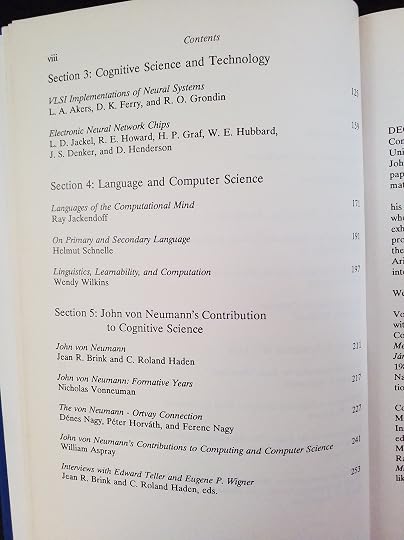
Here are the contents:
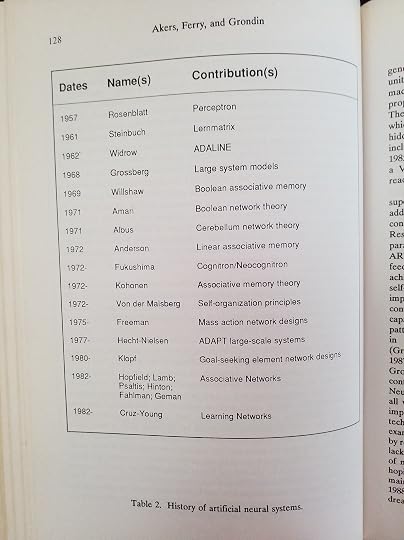
Here's a neat table that briefly records the dates and contributors to the first AI systems and theories:
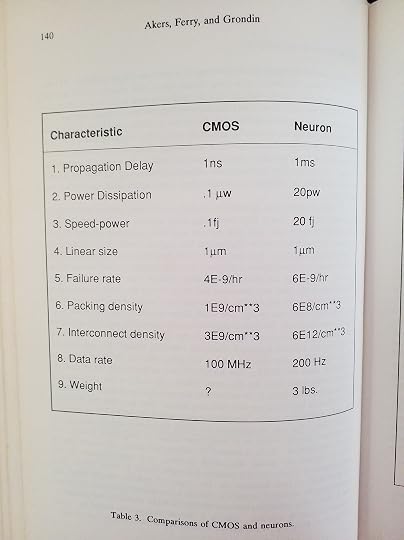
A table on the comparison between digital and biological systems:
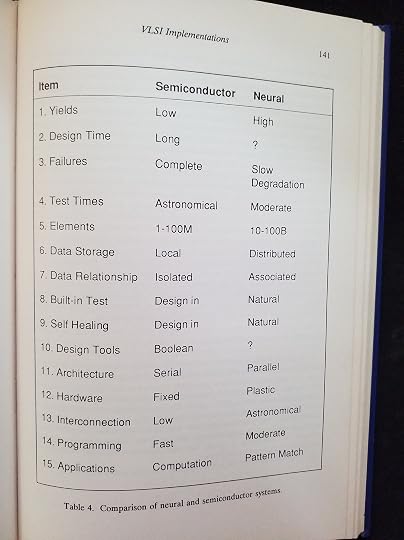
And another one (mainly posted because I thought their classification scheme was kinda cute):
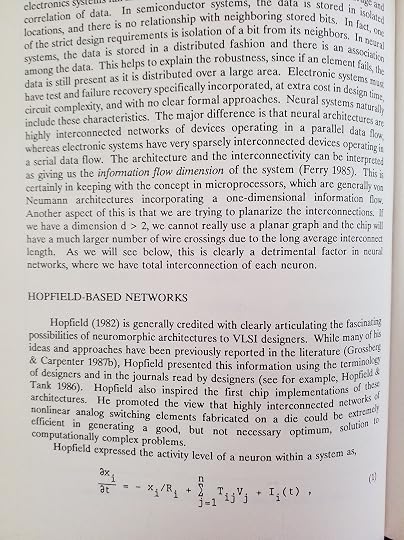
The infamous grand-daddy of modern-day deep learning...the Hopfield Network! (note the mathematical type-set!)
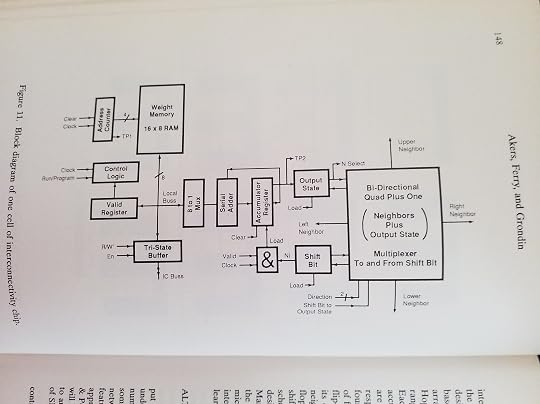
The primitive form of a computer chip:
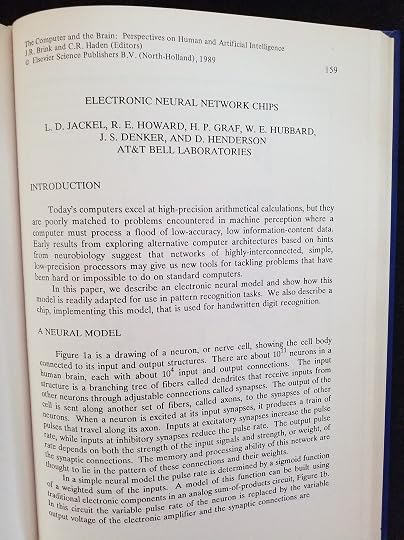
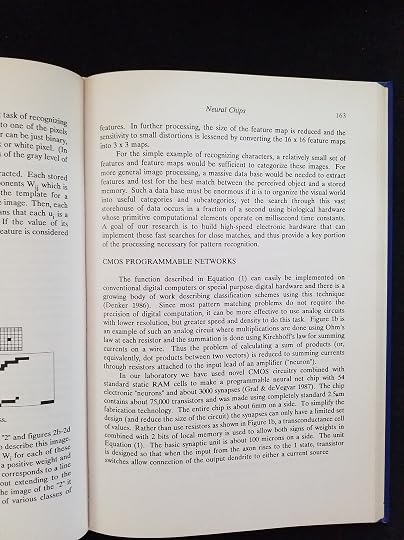
And a physical electronic implementation of a neural network! (note where this research was coming from!)
Hope you enjoyed that little piece of history :)
Feel free to get in touch with me if any of this is interesting since I don't think this book has been digitized yet.