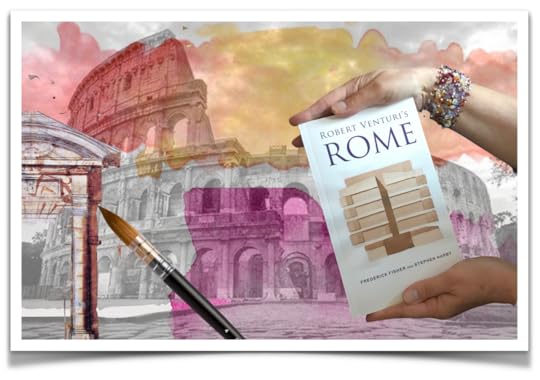
Robert Venturi's Rome is a guidebook to the city of Rome as seen through the eyes of Robert Venturi and his classic text Complexity and Contradiction in Architecture by two subsequent Rome Prize fellows and architects, Frederick Fisher and Stephen Harby. Fisher and Harby take the reader on a journey back through time by visiting and discussing the Roman buildings and places that exemplify Venturi's revolutionary ideas. The buildings and what they meant to Venturi are re-examined with the perspective of fifty years of architectural advancements. The volume is full of imaginative and analytical watercolor illustrations painted exclusively for the book and inspired by the small black and white illustrations in Venturi's work.
In the original book, published in 1966, Venturi viewed architecture, landscape and art as different manifestations of common aesthetic themes. Venturi wrote this seminal publication following a two-year Rome Prize fellowship at theAmerican Academy in Rome, and there is no doubt the city had a profound influence on his thinking. Many buildings in Rome serve as examples that illustrate his theories. From the Pantheon, through works by his favorite artist, Michelangelo, and on to 20th century buildings by Armando Brasini and Luigi Moretti, Venturi reveals Rome as a complex and contradictory city. Complexity and Contradiction in Architecture became one of the era's most significant theoretical works on architectural theory and is still fundamental to the development of every young architect's outlook on architecture. Thus, Fisher and Harby's Robert Venturi's Rome pays homage to the design influence this publication has had, and will continue to have, on the design world.
“This guide is intended for all travellers to Rome, whether of the armchair or shoe leather variety, and whether the traveler is novitiate or veteran”
Robert Venturi wrote Complexity and Contradiction in Architecture in 1962, at the age of 37 when he was spending two years at the American Academy in the city, gleaning all he could about the city of such rich and diverse architectural styles, both complex and contradictory. Both authors studied his seminal work when they were students. In the original, Venturi illustrated his book with black and white photos, but in this volume by Fisher and Harby there are beautiful watercolours that bring magic to the pages, a deft and light hand.
When Venturi was in the city, the buildings were largely covered in grime and soot and his photos capture that two dimensionality. Now, when many buildings have undergone cleaning and renovation, a lighter medium is ideal to capture the light and the innate dancing of light that is present in the city. Watercolour is ideal to bring to life the light and shade, that chiaroscuro. Thus, Stephen Harby shares his watercolours as they describe selected buildings around the city, some well-known like the Pantheon, the Vatican.. to Luigi Moretti’s more stark and linear post World War II apartment building, Casa Girasoli, in Parioli, which I would now choose to visit when I am next in Rome. Porta Pia by Michelangelo would also be on my list.
This is such a diverse and wonderful selection of buildings dotted around the city, all beautifully brought to life. If I had one niggle it would be the format of presentation – a book slightly larger than A5 size and in order to access some of the double page illustrations, you would have to crack the spine (sacrilege in our house!). But wonderful to be able to slip it into your bag as you tour the city.