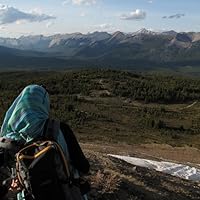
Alaska’s perch at the geographic corner of civilization isn’t all wilderness and reality TV. There’s a darker side too. Above the 49th parallel some of the nation’s highest rates of alcoholism, suicide, and violent crime can be found. While it can easy to write off or even romanticize these statistics as the product of a lingering Wild West culture, talking with real Alaskans reveals a different story.
Journalist Mary Kudenov set out to find the true stories behind this “end-of-the-road” culture. Through her essays, we meet Alaskans who live outside the common adventurer a recent graduate of a court-sponsored sobriety program, a long-timer in the Hiland Mountain Correctional Center for women, a slum-landlord’s emancipated teenage daughter, and even a post-rampage spree killer. Her subjects struggle with poverty and middle-class aspirations, education and minimum wage work, God and psychology. The result is a raw and startling collection of direct, ground-level reporting that will leave you deeply moved.
Mary Kudenov is the author of Threadbare: Class and Crime in Urban Alaska (University of Alaska Press, 2017). She holds a MFA in Creative Writing from the University of Alaska. Her work has appeared in several literary magazines including Alaska Quarterly Review, Permafrost, Fourth Genre, Chautauqua, and The Southampton Review. In 2016, Mary was named an essayist of note in the Best American Essays series for “A History of Smoking.” She lives in North Carolina with her husband and son.
This essay collection takes readers behind the scenes in Alaska to see the gritty reality that is ignored by all the "reality" TV shows and guided tours. While the book takes place in Alaska, it doesn't tell the story of a uniquely Alaskan experience. Rather, this book illuminates the human experience -- the struggles and triumphs that come along with finding your way in the world. Whether you're an Alaskan or not, and whether you're interested in Alaska or not, you'll be able to relate to this book and appreciate its many moments of beauty and heartbreak.
This collection is haunting and hopeful, but not in an easy way, not in an answering way. Kudenov's wisdom is more complicated than that. The writing is beautiful, the tragedies big and small, and the scope of its questions breathtaking.
(Disclaimer: I am personally acquainted with this author, but I consider this a fair and honest review.)
It’s a good thing Mary Kudenov’s debut is a slim volume or I’d have been up all night finishing it. The writing shines a light on a life most of us cannot imagine. Kudenov offers an unflinching look at her own life and a compassionate view of some of the difficulties of living in a culture that endures so much darkness, both literal and figurative.
But it’s the writing itself that makes this book stand out for me. Kudenov is highly skilled at making the gritty lyrical and vice versa. Each essay contains enough tension to keep you reading while somehow maintaining an enormous amount of depth. It’s like Alaska itself: You come for the beauty that shines within the difficulty.
Kudenov is a master storyteller, effortlessly (it seems) weaving the past and the present together to make a point that often makes you shake your head and want to cry and at the same time sings with redemption.
Consider this excerpt from the opening essay: "At sixteen years old, I was still a mystery to myself, and I didn’t know Mark apart from what I’d heard in town gossip. But I believed something, and it grew out of me like a dandelion: what the papers didn’t report, couldn’t, (because what kind of person can sympathize with the monster that “stacked the dead dogs ten-high like cord wood”?), was that somewhere in that mad, gun-slinging drunkenness, was a sick man ready to skip town and desperate to show one last act of mercy."
Breathtaking in its brevity and depth, this book resonates long after the final word. I’m glad it was short, but I can’t wait for the next one.
These essays are heartbreaking, but unveil stories of our marginalized neighbors. Highly recommend this read, especially for those who reside in Alaska!
My favorite vignettes were the ones describing East Anchorage, a beautiful, vivid portrayal evincing a truth seldom discussed: There are far more Alaskans living in urban poverty than living the 'Alaskan' lifestyle seen on TV.
Who chose the cover of this book? I have never seen a window that opens like that in Alaska.
Compelling short stories that gave snapshots, mere moments in the lives of the author and her community. Mary Kudenov brings us the Alaska behind the postcards of bears and mountains, bringing to the forefront people we see but do not hear. Issues addressed include economic class, access to necessities, and social justice issues. I am left thinking about some of Kudenov's neighbors and coworkers, and of my own. It is a rare book that makes such a firm connection that you stop and think about your own life and your connection to others.
I'm lending my copy to a friend and do recommend it.
Short collection of essays. Follows the life of the author from her hometown memories in Haines and Moose Pass to her 20's struggles and ultimately her career in development at "Sally's". An internal 'redemption' arc mirrored in opposite by the poverty and criminality of east Anchorage.
All in all fine, but there's no reason for taking artistic liberties like saying the sun sets in Anchorage after 2am during peak summer. I hope "Mark" is doing okay.
Wow. Mary Kudenov has both the eye and the way with words to show her story. Living in Anchorage, I can see the places she's talking about, so I may be seeing more than she's saying, but regardless, this is a raw blunt book full of things "nice people" don't see or want to admit. The story about her landlord made me want to throw things.