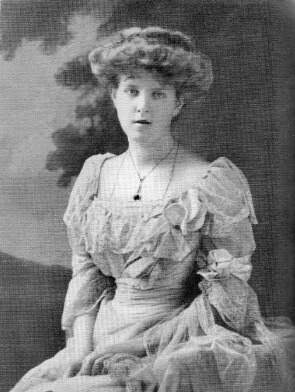
Meriel Buchanan (1886 - 1959) was British memorialist. The daughter of the last British Ambassador to Imperial Russia, she wrote a number of articles and books about her experiences during that time, most Recollections of imperial Russia (1919) and Ambassador's daughter (1958).
Although several books have been written about Russia and the Revolution in its time period, few of them are illuminating. One of them that does really send some gleams of light through the mist is Miss Meriel Buchanan's Petrograd, the City of Trouble, 1914-1918.
The writer is the daughter of the late British Ambassador in Russia. She was in the capital all through the war and the Revolution till the beginning of its last year, having opportunities for seeing all sorts of people, from the Emperor and his Consort to street-loafers and policemen, and keeping a calm, clear, untroubled, and yet sympathetic English eye upon everything.
She gives us the atmosphere of that huge, bewildered, fate-stricken capital, that fair Northern giantess spellbound and helpless in the coils of an unholy wizardry, better than any other writer of these times. Even if her judgment of men and events may be erroneous the book would be worth reading for the singular charm of its descriptive passages. Miss Buchanan's word-painting is exquisite, and her pictures of the Kremlin, and the Crimea, and of Petrograd in the rose and gold of its summer pageantry, or lying white and still under the thin blue wintry sky, linger on the memory.
She writes well of Russia and the Russians, for she loves them, and moves us to pity and sorrow for the great, simple, helpless people, preyed upon by surely the shabbiest and most ignoble gang of miscreants whom the frothy waves of revolution ever drifted out of the underworld.
This book of Miss Buchanan's is the first attempt of any writer in any language to give to the world a sense of the atmosphere of Russia under the shock and terror of those world-shaking events. Miss Buchanan has placed us all under a very real and serious debt. She has also done Russia a noble service.
Contents I. THE EVENING REVIEW AT KRASSNOE II. JULY 24 III. DECLARATION OF WAR IV. MOSCOW V. FIRST DAYS AT THE HOSPITAL VI. 1915 VII. THE SECOND WINTER VIII. THE CRIMEA IX. SUMMER, 1916 X. THE COURT XI. THE MURDER. OF RASPUTIN XII. THE GATHERING OF THE STORM XIII. MONDAY, MARCH 12 XIV. THE EMPEROR'S ABDICATION XV. THE FIRST WEEKS OF THE REVOLUTION XVI. SPRING, 1917 XVII. THE WOMEN OF RUSSIA XVIII. BOLSHEVIK RISING OF JULY XIX. JULY 17 AND 18 XX. THE TAKING OF THE FORTRESS XXI. THE FAILURE OF THE RUSSIAN ARMY XXII. THE COUP D'ETAT OF KORNILOFF XXIII. A SOLDIER XXIV. AUTUMN, 1917 XXV. THE BOLSHEVIKS STRIKE XXVI. THE BOLSHEVIKS IN POWER XXVII. THE MOCKERY OF GOVERNMENT XXVIII. NEGOTIATIONS FOR PEACE XXIX. RULE OF THE RED GUARD XXX. ANARCHY XXXI. EAST DAYS IN PETROGRAD XXXII. THE SOUL OF RUSSIA XXXIII. THE JOURNEY FROM RUSSIA
Meriel Buchanan was British memorialist. The daughter of the last British Ambassador to Imperial Russia, she wrote a number of articles and books about her experiences during that time, most notably: Recollections of imperial Russia ( 1923) and Ambassador's daughter (1958).
Meriel was the only child of Sir George Buchanan (1854-1924), and his wife Lady Georgina Meriel Bathurst (1863-1922). As her father was a career diplomat, Meriel early life was spent in the many countries where her father was posted: Hesse, Baden, Bulgaria, Germany, Italy, the Netherlands and Luxembourg. In 1910 the Buchanan family moved to Saint Petersburg, when Sir George Buchanan was appointed as the British Ambassador to Russia.
In her early twenties at her arrival in Russia in 1910, she had a prominent position as the daughter of the British Ambassador at the court of Tsar Nicholas II of Russia. This allowed her to meet many important figures at the Imperial Court. She was particularly close to Grand Duchess Victoria Feodorovna of Russia who took her under her wing. Meriel was popular in social circles and carried out a flirtation with Duke Alexander Georgievich of Leuchtenberg, a great grandson of Tsar Nicholas I and a distant cousin of Tsar Nikolai II. Duke Alexander, was the son of George Maximilianovich, 6th Duke of Leuchtenberg, and Duchess Therese Petrovna of Oldenburg. Both sets of parents were opposed to their romance. The Duke of Leuchtenberg refused his permission because Meriel, although daughter of a distinguished ambassador and possessing royal blood herself, was neither considered the equal of Alexander nor have a sizable fortune. Meriel’s parents realized the impossibility of the situation and were fearful of a diplomatic scandal. Meriel’s mother especially forbidding her daughter to associate with the young duke. Eventually, Alexander did not take their romance seriously.
Meriel Buchanan had literary ambitions and published two novels based on her experiences living in Eastern Europe : White Witch ( 1913) and Tania. A Russian story (1914).[5] During World War I, Meriel and her family remained in Russia. Her mother took of the organization of a hospital where Meriel worked as a nurse. Her father remained as the British Ambassador even after the fall of the Romanovs. The family left Russia in January 1918.
Meriel's two novels, published before the war, were not a success.[5] She then turned to non-fiction, writing a number of books about the Romanov family, the Russian nobility and her experiences living in Russia during the last years of the reign of Tsar Nicholas II, beginning with Petrograd, the city of trouble, 1914-1918, published in 1918.
She married in 1925 Major Harold Wilfred Knowling of the Welsh Guards (d 1954), and had one son : Michael George Alexander Knowling (b 1929). In 1958, the year before her death, she published an account of her father's diplomatic career under the title Ambassador's Daughte
Meriel Buchanan (1886-1959) was the daughter of the British Ambassador to Imperial Russia. The Buchanan family was stationed in the then capital of Petrograd (now and previously St Petersburg) during WWI and the Russian Revolution of 1917. They of course met many important people, and from their windows they also had a grandstand view of events unfolding during that time.
Meriel Buchanan
This book (160 pages) is a curiosity filled with personal impressions, suppositions, apocryphal stories, hearsay as well as contradictions in what she was told.