European literature and theory of the twentieth century has been intensely preoccupied with questions of 'Desire', whereas 'love' has increasingly represented a fractured and strange, if not actually suspect, this is a prime symptom of an age of deep cultural mutation and uncertainty. Paul Gifford's book allows this considerable contemporary phenomenon to be observed steadily and whole, with strategic understanding of its origins, nature and meaning. Gifford paints a clear and coherent picture of the evolution of erotic ideas and their imaginary and formal expressions in modern French writing. He first retraces the formative matrix of French tradition by engaging with five classic "Plato's Symposium", the "Song of Songs", the myth of Genesis, the tension between Greek Eros and Christian Agape and the repercussions of Nietzsche's declaration of the 'death of God'. Modern variations on these perennial problematics are then pursued in ten chapters devoted to Proust, Val
An interesting book that look at 10 french authors and their conception of Eros (which is implied to be desire, love and transcendence combined) and Agape, a slippery term with heavy religious connotations that is implied to be the precondition of Eros.
Gifford starts out by examining three foundational texts (mental sub-soil) that the French authors draw from: Plato's Symposium, the Song of Songs, and the Book of Genesis. The Symposium and Genesis play more fundamental roles here as they are primarily where Eros and Agape derive from, respectively.
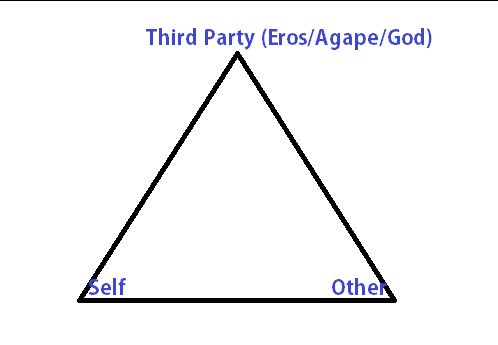
Throughout the book there is said to be a triangular structure that constitutes Eros/Agape, which is confirmed in the chapter on Pierre Emmanuel, who calls it a 'sacred-erotic triangle'. The idea is that there is a Self, an Other, and some ambiguous and enigmatic "Third Party". To me, it is not that ambiguous or enigmatic: the Third Party in my opinion is meant to be transcendence-as-such, generally speaking: God.
On pg. 72 there is a quote from Jean-Luc Marion defining Eros and Agape: "Eros is desire-love, capturing and self-related .... Agape represents the altruistic forms which may reach the 'oblative level of 'charity'... their deeper unity should not be lost sight of." He also says that both aspects are present in "human love-relationships, like an alternative current, conferring on the acts and feelings of love... a positive and negative 'charge'".
So, I think this Third Party is the alternating current of Eros/Agape, which, if it is love-desirous, transcendent, and oblative, that sounds pretty close to God to me. Most of the writers examined follow this triangular structure where at the base there's Self/Other (which is almost always synonymous with Male/Female with the exception of Proust, Plato, and arguably Bataille) and at the apex is the Third Party.
Here is a diagram of the typical 'sacred-erotic triangle' as I conceive of it:
There are different variations, for example Proust thinks the Other is essentially unattainable and the more you desire the less you can get (reminded me of some sort of pseudo/proto-Lacanian objet petit a) and Breton thought that lovers existed in "a cloud of unknowing and incommunicability...."
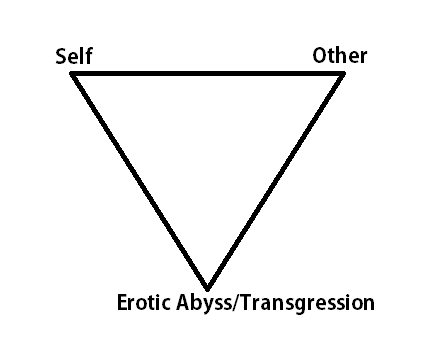
Here's where Bataille comes in:
Bataille inverts the "transcendence of Eros" and makes it infernal, abyssal, transgressive. He flips the Third Party on it's head like Marx flipped Hegel on his. He wasn't the absolute first to think of something similar: De Sade sort of did, but de Sade was primarily preoccupied with the Self only, the Other was only there to satisfy the Self. With Bataille, Eros is a mutual effort to transgress taboos and plunge into the depths of the erotic abyss. That is why is he cool, and good, and awesome.
As for critiques for the book itself, I think Gifford went a bit overboard with the obscure phrases: for example he uses the phrase "ame sœur" which seems virtually identical with the English phrase of "soulmate". There might be some connotation it has in French it doesn't have in English, but be prepared to use Google because he uses foreign phrases liberally.
I also think some author choices were a bit strange, why Claudel and Emmanuel instead of Marion and Ricoeur (who he cites somewhat often). Marion is given a bit of treatment in Irigaray's chapter but he's almost just treated as a Masculine version of her. Also, a chapter on Lacan would have been very good, and while he is not French, I think it would have been good to have a chapter on Freud as part of the "mental sub-soil" section setting up the rest of the book, perhaps even replacing the Song of Songs chapter which doesn't seem to come up much at all except for the refrain "Who is it that who...?" Freud is saturated throughout this book and I feel like not having a chapter on him is a fairly big omission.
One thing I was worried about was that I would have had to read the authors in question to get anything out of this: luckily this is not the case. Gifford does a good job of explicating their views on Eros/Agape without any prior knowledge of the writer-philosophers in question (though a background in philosophy, psychoanalysis, and theory in general is a must: this is not an overly dense read but its not easy going either).
Overall, a book I enjoyed reading even though the question as to what love, desire, transcendence and if Eros can actually be deciphered is left as an open question...