Jump to ratings and reviews
Rate this book

South Tyrol: A Minority Conflict of the Twentieth Century

Rate this book
South Tyrol, a region in the heart of the Alps about half the size of Connecticut, brings into sharp focus an important part of twentieth-century history. Tyrol, a province that had been part of Austria for over 500 years and was almosttotally German-speaking, was split in two after World War I and the southern part awarded to Italy as "spoils of war."

182 pages, Paperback

First published September 1, 2003

Loading...
Loading...

About the author

Rolf Steininger

71 books8 followers
Rolf Steininger is a German historian and university professor for contemporary history.

Steininger studied English language and literature and history at the universities of Marburg, Göttingen, Munich, Lancaster and Cardiff. He received a doctor's degree in 1971 and habilitated at the University of Hanover in 1976. In 1980, he became a professor in Hannover. In 1983 he was appointed to a professorship at the University of Innsbruck.

From 1984, Steininger has led the Institute for Contemporary History in Innsbruck. His work concentrates in particular on the history of Post-War Germany, Austria and South Tyrol.

From 1995, Steininger has held a Jean Monnet chair, and is Senior Fellow of the Eisenhower Center for American Studies at the University of New Orleans and member of the executive committee of the European Community Studies Association. He was visiting professor at the universities of Hanoi, Saigon and Cape Town.

Ratings & Reviews

What do you think?
Rate this book

Friends & Following

Create a free account to discover what your friends think of this book!

Community Reviews

5 stars
3 (15%)
4 stars
10 (52%)
3 stars
5 (26%)
2 stars
1 (5%)
1 star
0 (0%)
Displaying 1 - 1 of 1 review
Profile Image for Warwick.
Author 1 book15.6k followers
August 12, 2017


The South Tyrol is one of those strange, liminal parts of Europe that make you feel like you're strolling around a 3D blow-up of the Treaty of Versailles. Nominally part of Italy, but ethnically and culturally almost entirely German, it's a fascinating (and very beautiful) Interzone, a case study in how the twentieth-century's sometimes arbitrary border changes, decided on by ministers and embassy officials, affected communities on the ground.

Italy was given permission to push its borders north after the First World War, more or less as spoils of victory. The result was that Tyrol, which had been a province of Austria for five hundred years, was suddenly cut in half, to the great consternation of the Tyroleans on either side of the new border.

South of this border, Fascist Italy was in no mood to be accommodating to its new citizens. ‘The method that one must employ with Germans is the method of violence,’ Mussolini advised: German-speaking associations were broken up, marchers on traditional parades were shot, and the use of German was banned almost overnight from any use in business, government, law-courts or schools. German newspapers were shut down, and the very name ‘Tyrol’ became proibito – from now on, the South Tyrol was officially the Alto Adige, or, if it must be referred to in German, the ‘Oberetsch’.

Toponymy was weaponised. Travelling through the area now, you can see that all of the towns and villages have both German and Italian names, but apart from a couple of major cities (like Bozen/Bolzano) these Italian names are virtually all the twentieth-century inventions of one man – Ettore Tolomei. An ardent nationalist, Tolomei was determined to assert the inherent Italianità of the area, and he spent years devising Italian versions of every town, hamlet and Alp in the South Tyrol. As Steininger points out, this is really the first time that

the entirety of the indigenous nomenclature of place names, including the names of geographical features and farmsteads, were transformed into another language through one man's act of will.
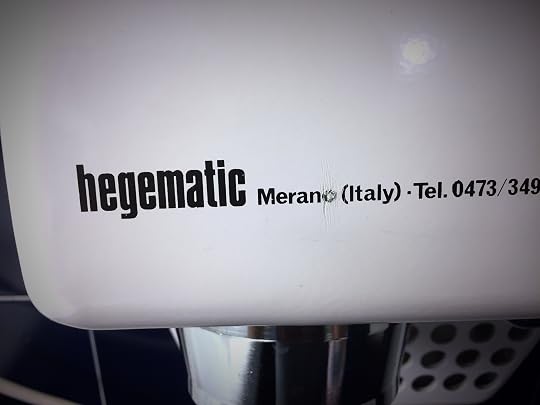

Unfortunately, Tolomei often didn't understand the German names very well, and many of his Italian versions are extremely superficial or completely arbitrary. Some were straight translations – so Mittewald became Mezzaselva – but he often got the etymology wrong, thinking for instance that Blumau meant ‘flower valley’ and dubbing it Prato all'Isarco. Sometimes he just stuck an Italian ending on a German placename and called it a day.


Still a sore point…Meran(o) with the ending scratched out. I saw this one on a hand-drier in a Sexten bathroom

The South Tyroleans responded by putting almost their whole culture underground, even to the extent of setting up a series of so-called ‘catacomb schools’, where teachers, secretly trained in Switzerland, would instruct local children in German behind closed doors using smuggled textbooks.

South Tyrolean society developed a close emotional link with Germany. It was understandable, but the timing couldn't have been worse. After Hitler came to power in 1933, the Nazis found South Tyrol a fertile ground for their propaganda, and South Tyrolean resistance groups, looking for allies, often concluded that the German Nazis were preferable to the Italian Fascists. The Italians were meanwhile shipping in huge quantities of Italians from the south to pursue their campaign of ‘majorification’.

This campaign was furthered by a bonkers 1939 vote – the ‘Option’ – which gave individual South Tyroleans the choice of remaining in South Tyrol and accepting Italianisation; or, of emigrating to Germany. ‘The bitter alternative was either to betray one's Germanness by staying or to betray one's homeland by going.’ Unbelievably, 86 percent of people voted to leave for Germany – a result due in no small part to the aggressive propaganda of local Nazi-affiliated groups.

Hitler appointed no less than Reichsführer-SS Heinrich Himmler to manage this feat of ‘human resource reallocation’ (i.e. ethnic cleansing). It was by dealing with the South Tyroleans that Himmler would refine the mass transportation and infrastructure skills that he would later put to such deadly use with other groups. By 1943, some 75,000 South Tyroleans had been redistributed in ‘Greater Germany’.

So what happened after the war? Well, around 50,000 of the emigrants eventually came back. In the meantime there was a lot of diplomatic back-and-forth about whether South Tyrol should formally be reunited with Austria, but, Italy having switched sides in 1943, it was not felt desirable to punish them too harshly: there were fears that Rome, if too offended, might turn to Communist Russia for support instead. This is why Steininger calls South Tyrol ‘the first victim in the still undeclared Cold War’.

After a protracted political stand-off – complicated by a separatist bombing campaign during the 1960s – the issue was eventually resolved, sort of, with a UN-backed agreement between Italy and Austria signed in 1969. This agreement, known as the Package, was not fully implemented until 1992, but it gave South Tyrol sweeping powers of autonomy, self-government, and protection for linguistic minorities. Steininger considers this solution to be a model for resolving similar ethnic conflicts elsewhere (and it has indeed been taken as such – it was referred to in discussions over South Ossetia, for instance).

I would have liked a few more details about daily life for the South Tyroleans through these periods – diaries, letters, something like that – but as a brisk run through the salient facts, this book does an excellent job and fills a gap in the English-language literature. Pour yourself a healthy schnapps – or cappuccino – and enjoy.
Displaying 1 - 1 of 1 review