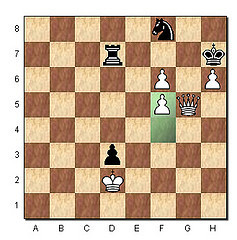
A fine example of how routine the queen sacrifice is at top level. In this position: Shirov, Black, resigned yesterday against Carlsen, White. His reasoning was as follows. The only move he can make which doesn't immediately lose material is 65... Kh8. But then White sacrifices his queen with 66. Qg7+, and after 66... Rg7 67. fg+ Kg8 68. gf=Q+ Kf8 69. Kd3 White has a winning pawn ending. It was all so obvious that he just gave up rather than bother to let Carlsen demonstrate it. Most strong players would have done the same.
__________________________________________
The combinations in this book are all forcing queen sacrifices - usually some variant on SACRIFICE QUEEN!! check, check, check, mate. The queen sacrifice in the following game, which I played against the airplane's computer on the way home from Japan, is much messier and probably not even sound. But where else am I going to publish it? And at least it has some amusement value.
So, with some light annotations, here's the game. Note: I had to reconstruct it from memory, so it's possible a couple of the moves are wrong. But I'm pretty sure the position with the queen sacrifice (move 26) is correct.
Somewhere over Siberia, October 2 2010
White: Manny Black: Virgin Entertainment System computer
Torre Attack/Nimzo-Indian
1. Nf3 Nf6 2. d4 e6 3. Bg5
A typical anti-computer opening which I've used with some success in the past.
3. ...h6 4. Bh4 Nc6?!
This looks odd, though I didn't manage to show what, if anything, might be wrong with it.
We've reached an almost normal looking Nimzo-Indian position, except for that weird knight on c6. I wanted to punish Black, so I lashed out with:
13. d5?! Ne7!
I'd completely missed this obvious reply. Now I didn't know what to do.
14. de Be6 15. e4 fe 16. Be4 c6 17. OO Qd7
Black just keeps cooly developing his pieces, and I couldn't find any way to use my lead in development. Meanwhile, I'm starting to feel the weakness of my queenside pawns.
18. Qd4
To stop him castling queenside, but he just castles kingside instead.
18. ...OO!?
My first though was that this was insanely dangerous, but maybe it's quite alright. My next few moves show I've completely lost the thread.
19. Qd2? Rf6!
Black carries on finding good squares for his pieces.
20. Re1 Raf8 21. f4 Qc7 22. Qe2
An indication of how confused I have become. I couldn't find anywhere to attack, but vaguely hoped something would happen down the e-file. It also seemed worthwhile to keep his g-pawn under observation.
22. ...Qa5
I really didn't want to start defending my queenside pawns, so I kept trying to play attacking moves.
23. Rad1 Qc3
Computers love taking pawns, and, truth to tell, there's no reason not to take this one.
24. Qe4
I threaten mate in one, but he's quite happy to play the obvious defence.
24. ... Nf5
I wondered about the possibility of sacrificing my queen on e6, but it seemed hopeless. 25. Qe6 Re6 26. Re6 Nh4 27. gh Rf4 and I must be completely lost. I decided to tuck my king away on a safer square and see what happened next.
25. Kh2 Kh8?!
A real computer move. This may not be a mistake, technically speaking, but it can't possibly improve his position. Now the queen sacrifice finally looks like it might give me a chance. Anyway, I didn't think I'd get a better opportunity to confuse things.
26. Qe6!!? Re6 27. Re6 Nh4 28. Rh6+
The point. I can take with check and recapture on h4 with the rook, keeping my pawns intact.
28. ... Kg7 29. Rh7+
If I take on h4 at once he'll play Rh8 and exchange off my attacking force, so I flick in this check first.
29. ... Kf6 30. Rh4 Qa3
True to form, the computer carries on trying to take all my pawns. I wasn't sure there was anything wrong with its plan, but at least I now had attacking possibilities.
31. Rh6+ Ke7
It's not going to be satisfied with a draw by perpetual check, so it runs away.
Okay, things have gone about as well as they could. I have both my rooks on the seventh rank, but now what? My first thought was to play 36. Bf5+ and win his g-pawn, but it looked too slow - he was about to start running his a-pawn. Suddenly, I saw a better chance.
36. f5!
I already have one passed pawn, and it's not at all easy for him to stop it and simultaneously guard against my rooks.
36. ... a6?!
Did it fail to see what was coming, or am I by some miracle actually winning here? I don't know! At any rate, it's acting as though there's no defence. Sometimes computers get depressed for reasons obscure to human beings.
37. f6
He can't take it because of mate on the eight rank.