Anime and manga are powerful pop-culture phenomena, capturing people’s imaginations in the pages of comic books, on television and smartphone screens, and at cosplay festivals, where children and adults alike don elaborate costumes and share creations based on the original art. Somewhere along the way, many of these cute, stylized characters jumped the Pacific, and we too became smitten with Hello Kitty and collecting adorable Pokémon. But this isn’t the first time artists embraced popular culture and enjoyed enormous commercial success. In the seventeenth, eighteenth, and nineteenth centuries, Hokusai, Kuniyoshi, and their contemporaries produced colored woodblock prints of beautiful courtesans and brave samurai for the masses.
Hokusai x Manga offers fascinating insight into the most widely consumed examples of popular culture in the history of Japanese art. Woodblock prints, or ukiyo-e , were a central medium of early mass culture, and they served as a fantastical escape from everyday life. As Japan transformed into a modern nation and society, the demand for popular art didn’t disappear, and the forms were merely adapted from one cultural context to another, changing to reflect the high-energy urban streets of Tokyo, but retaining many of the basic elements. Dozens of lively, colorful images—from shunga sheets to selected excerpts from manga by Jirō Taniguchi, Inio Asano, and more—are interspersed throughout the book, making Hokusai x Manga as fun to read as it is informative.
Hokusai x Manga will give Japanophiles and pop-culture enthusiasts everywhere an entirely new perspective and on these captivating chapters in the history of Japanese art.
Look at all the pretty pictures! They're interesting and fun to look at and there isn't a lot of info in here otherwise. Sure, there's some in the form of short introduction to certain categories of images, but not a very well-structured description of the progression between one chapter and the next.
This isn't necessarily surprising, as the book was created based on an exhibition in The Hamburg Museum of Arts and Crafts - and somehow it made its way into a bookshop in Romania, where I came across it. (How did it get here? I'm still baffled; based on the number of Goodreads ratings for it, it doesn't seem to have been a huge and unexpected success - but this is globalization for you, I guess)
It mostly covers older pop culture in Japan, which is just fine. It incidentally *doesn't* cover anatomically incorrect depictions of sexual organs in the chapter about stamps depicting 'erotic' art, so keep kids away from it unless you feel like explaining that a. boys' willies don't that big; b. why some people would want to draw them that size anyway.
Now, despite the fact that there isn't *more* about the way popular culture developed and its context (as I was complaining above), "Hokusai x Manga" provides a few neat details, mentioning one or two things about stately courtesans who brought men to ruin, and geishas walled within their pleasure quarters and struggling to repay the debts they'd incurred when their parents sold them into that life (yup, they were sold as kids).
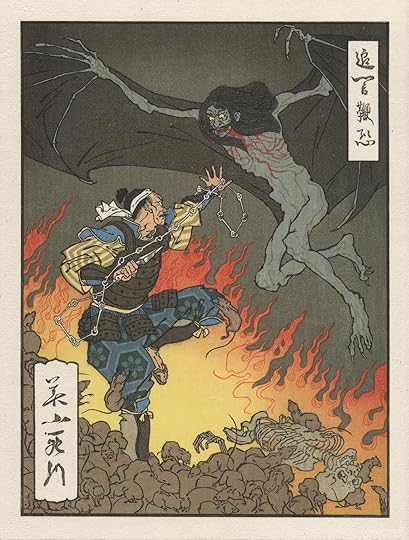
It has beautiful woodprints of Tokyo and Fuji (including some famous Hokusai-made ones), horror-style images of demons, depictions of actors who were great stars back in the 18th and 19th centuries, pages from drawing manuals (Hokusai had one of those, too), some of the precursors of manga, and a bit about manga itself. Oh, and a section about an American guy who made woodprints which look like traditional Japanese ones, but based on video games. I spotted a Dracula who looks a lot like Vlad Țepeș (aka the historical figure who inspired him) in one of them:
(Jed Henry - Yokai Dracul)
It's fun, and I would recommend it to others if they found it in a library somewhere, but not necessarily if they find it in a bookshop somewhere. Unless they feel like they really like the pictures.
Hokusai x Manga offers good analysis on the history of ukiyo-e and its relevance to modern manga; however, a more considered analysis on how the art form went on to influence western comics and animation would have made this a more complete history. Nevertheless, this book does provide a great introduction on ukiyo-e and would be a worthy addition to any art collector's or anime fan's bookshelf.