Jump to ratings and reviews
Rate this book

Krazy and Ignatz

Krazy and Ignatz: Shed a Soft Mongolian Tear

Rate this book

58 pages, Hardcover

Published January 1, 1992

Loading...
Loading...

About the author

George Herriman

224 books48 followers
George Herriman was an American cartoonist celebrated for creating the groundbreaking comic strip Krazy Kat, a work widely regarded as one of the most inventive, poetic, and influential achievements in the history of comics. Raised in a culturally diverse environment and navigating complex racial identities throughout his life, Herriman developed a singular artistic voice that combined humor, surrealism, philosophical reflection, and emotional nuance. He began his career as a newspaper illustrator and political cartoonist before transitioning fully into comic strips, producing several short-lived features and experiments that helped him refine his sense of rhythm, timing, and visual storytelling. Krazy Kat, which emerged from an earlier strip called The Dingbat Family, became his defining work and ran for decades in newspapers across the United States. The strip centered on a triangular relationship among three main characters: Krazy, a blissfully optimistic and androgynous cat; Ignatz Mouse, who continually expressed his contempt or affection by throwing bricks; and Offisa Pupp, a dutiful dog who sought to protect Krazy and maintain order. What might have been a simple gag became, in Herriman’s hands, a lyrical exploration of love, longing, misunderstanding, and the complexities of emotional connection, articulated through shifting perspectives, inventive language, and a dreamlike visual landscape inspired by the American Southwest. Herriman developed a distinctive style that blended loose, expressive brushwork with carefully considered composition, often altering backgrounds from panel to panel to evoke mood rather than physical continuity. His dialogue employed dialects, puns, poetic phrasing, and playful linguistic invention, creating a voice for Krazy Kat that felt both musical and deeply human. The strip attracted a passionate following among intellectuals, writers, and artists, including figures such as Gilbert Seldes, E.E. Cummings, Willem de Kooning, and many others who recognized its sophistication and emotional resonance. However, Krazy Kat never achieved the widespread commercial popularity of contemporaries like Popeye or Li’l Abner and often relied on the support of influential newspaper magnate William Randolph Hearst, who admired Herriman’s work and insisted it remain in publication despite fluctuating readership. Herriman also produced the comic strip Baron Bean, as well as numerous illustrations, editorial drawings, and commercial work throughout his career, but it was Krazy Kat that defined his legacy and shaped the development of visual narrative art. The strip influenced generations of cartoonists and graphic storytellers, contributing to a lineage that includes artists working in newspaper strips, comic books, underground comix, graphic novels, animation, and contemporary experimental media. Herriman maintained a private, quiet personal life, working diligently and steadily, drawing inspiration from the landscapes of California, Arizona, and New Mexico, which he visited frequently and often featured in his art as stylized mesas, desert plateaus, and open skies. His deep engagement with the American Southwest brought texture, symbolism, and environmental presence to Krazy Kat, making setting an integral emotional and thematic component rather than a mere backdrop. Although widely honored posthumously, his work was recognized during his lifetime by peers and critics who understood the originality of his vision. Today, he is acknowledged as one of the key figures who expanded the expressive potential of the comic strip form, demonstrating that sequential art could convey subtle emotional states, philosophical ideas, and complex storytelling with elegance and humor. Herriman’s legacy endures in the ongoing study, republication, and celebration of Krazy Kat, which continues to be admired for its innovation, sensitivity, and unique artistic spirit.

Ratings & Reviews

What do you think?
Rate this book

Friends & Following

Create a free account to discover what your friends think of this book!

Community Reviews

5 stars
5 (55%)
4 stars
4 (44%)
3 stars
0 (0%)
2 stars
0 (0%)
1 star
0 (0%)
Displaying 1 of 1 review
Profile Image for Jonathan.
208 reviews73 followers
November 4, 2015
For those who don't know anything about Krazy Kat this is what you need to know: it was a weekly newspaper comic strip created by George Herriman, it ran from 1916 to 1944, the year of Herriman's death. The main characters are Krazy Kat, Ignatz Mouse and Officer Pup. Ignatz likes nothing better than to throw a brick at Krazy Kat's noodle, in fact, it's more of a compulsion. Krazy Kat takes the brick-throwing as a sign of Ignatz's love and yearns to be bonked on the head by a brick. Officer Pup respects Krazy Kat and constantly tries to thwart Ignatz's attempts—sometimes he's successful and sometimes he's not. This all happens in the slightly surreal semi-desert-like area of Coconino County (or Kokonino Kounty - in Krazy Kat Komiks we often have to replce 'c' with 'k') which is based on the real place in Arizona. Krazy Kat's gender is a bit ambiguous as sometimes he's a 'he' and sometimes a 'she'; I'm not sure if it was intentional but I think that Herriman just enjoyed leaving it ambiguous. There are many more characters besides the main three such as Don Kiyoti, Kolin Kelly, Walter Cephus Austridge, Dr Y Zowl etc.

The simple set-up of 'Kat loves mouse/mouse hates Kat/Dog hates mouse but loves kat' is played out again and again. Very often the stories are pretty simple but they are imbued with Herriman's surreal landscapes, his playful wordplay, phonetic dialogue and experiments with the structure of the comic strip. Herriman loved alliteration and poetic narrative; here are some examples:
Krazy, stunned and bewildered by the mystery and marvel of the radio gives vent to a spasm of speculation—which induces a mild attack of cranial vacuity.
And so—ladies and gentmens, Krazy Kat's first number will be a Katnip Kantanta in the Key of 'K'
After having trailed a marauder mouse miles and miles over the mauve mystery of Moen Kopi, from Oljeto to Kaibito, Officer Pupp admits himself baffled.
I've often wondered what readers thought of 'Krazy Kat' at the time as it seems to be quite an intellectual comic strip and certainly not one we'd expect to see in a newspaper today. Wikipedia states that the public reaction was quite mixed but that the publishing magnate William Randolph Hearst loved Krazy Kat and so it continued to appear in his newspapers.
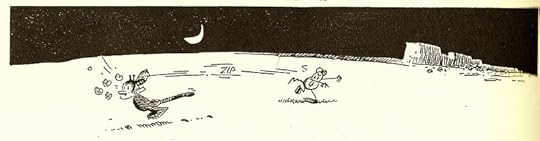
Krazy Kat is a joy to read and if you've never read any before then they're definitely worth giving them a go. You may be able to find the odd reprint volume in your local library rather than paying for a personal copy, especially as there have been quite a lot of reprint volumes over the years. In fact, Fantagraphics have finished off reprinting all the remaining Krazy Kat material.

Krazy-Kat_Mongolian-Tear-003-300px

♫ ♪ ♫ There is a heppy land fur fur awaay! ♫ ♪ ♫

Displaying 1 of 1 review