After two years of captivity, a young Nez Percé Indian escapes from the Spanish settlement and begins a long and tragic journey to his home in the north, taking with him the stallion that sires the first of the Appaloosa breed.
Born December 11, 1902 in Venus, TX, Glenn Balch was a talented essayist who published many articles in Field & Stream and other outdoor magazines. He was also known for his many juvenile novels. His love for dogs, horses, and the great outdoors marked his life from very early on.
His earliest life memories involved being put on the back of a horse, and first dog, Trix. Early on, his love of reading was fostered and encouraged by his family. After going to college at the age of 16, he wrote for the collegiate newspaper and was involved in athletics. After graduation, he wanted a career outdoors, so he applied to the Forest Service as a fire guard. One reason was that a career as a forest ranger seemed like steadier work than the life of a cowboy. Eventually he received an offer to be a fire guard in Garden Valley, Idaho and in 1925 he moved to the Gem State, together with his new bride.
After that first fire season, he rode horseback from Garden Valley to Boise to apply for a newspaper job and was hired by the Idaho Statesman. He spent the next five years as a roving reporter, traveling about the state, combining hunting and fishing expeditions with his newspaper work. He wanted to spend more time doing his own writing, so resigned from the Statesman after his divorce and relocated to Boise. The Statesman did not want Balch to resign, so they offered him a position as a night telegraph editor, leaving his days free. Balch found it still prevented him from doing his own writing and also interfered with a newly found passion for polo, which was popular in Boise in the 1920s and 30s. With his love of horses, horseback riding, and athletic competition, Glenn Balch wanted to be part of the polo scene. In the Spring of 1931 he enlisted in the Idaho National Guard and became a member of its Boise polo squad. In 1932, he began to get his articles published in both Field & Stream and The American Boy. In 1937 he enrolled in a writing class as Columbia University in New York, where he met Elise Kendall, a fellow student from Florida. She became his second wife. On their return to Boise in 1938, they bought a house, settled down, and began raising a family. Balch had one daughter, Betty, from his first marriage to Faula Mashburn, and three more children-daughters Mary and Nikki and son Olin-with his wife Elise. His first novel was published in 1937.
When the United States entered World War II, he entered active duty as a captain in the U.S. Army Air Corps. He was commanding officer of the 10th Combat Camera Unit in the China-Burma-India campaign and was awarded the Bronze Star.
After the war was over, he resumed his career as a writer of juveniles, writing many. Several of his books were translated into foreign languages, and two were illustrated by acclaimed illustrator Ezra Jack Keats. In 1965 his novel Indian Paint was made into a motion picture starring Johnny Crawford and Jay Silverheels.
His 34th and last book was published in 1976. He died in September of 1989 from injuries after an automobile accident on August 29. The following year, two of his novels were republished as part of Idaho's statehood centennial commemoration.
This is a review of the 1969 Weekly Reader edition. I used to have a copy as a youth and recently bought a replacement copy. However, if I had remembered the ending of the book I probably wouldn't have. It is odd to hold a book that is the same age as myself -- both the book and I were "published" in 1969.
I'll let you know right now that this is a sad book. The sad parts come out of nowhere, which lets you know keenly how the character feels when he realized what has happened. If you don't like sad books, then skip this.
That being said, it's a very well-written adventure of a Native American taken into slavery, escaping and trying to get home -- all the while leading a stallion that he does not know how to ride. There's not many horse books which show a Native American in a good light so I really appreciate this. My paternal great grandmother was a Native American. I don't know what tribe, since a mixed race marriage was considered shameful.
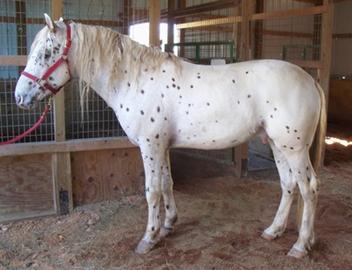
The illustrator is wonderful -- but clearly did not bother to read the text too closely. The Native Americans are often shown wearing only breechclouts (sp?) but the text clearly mentions that they are wearing robes. Also, the color of the main stallion is wrong. Here we see a stud with dark head, neck and forequarters with white spotted parts past his withers -- but the text calls him a white horse with dark, faintly blue-ish spots -- something like this fella here:
Although there is more about living off the land and Native American customs than about horses here, Balch does have the horses act like real horses, which I like to read. I used to be homeless and lived for a while in the woods outside of Bath, England, so reading about living off the land interests me more now than it did when I first read this book decades ago.