Jump to ratings and reviews
Rate this book

Russian Absurd: Selected Writings

Rate this book
A writer who defies categorization, Daniil Kharms has come to be regarded as an essential artist of the modernist avant-garde. His writing, which partakes of performance, narrative, poetry, and visual elements, was largely suppressed during his lifetime, which ended in a psychiatric ward where he starved to death during the siege of Leningrad. His work, which survived mostly in notebooks, can now be seen as one of the pillars of absurdist literature, most explicitly manifested in the 1920s and ’30s Soviet Union by the OBERIU group, which inherited the mantle of Russian futurism from such poets as Vladimir Mayakovsky and Velimir Khlebnikov. This selection of prose and poetry provides the most comprehensive portrait of the writer in English translation to date, revealing the arc of his career and including a particularly generous selection of his later work.

280 pages, Paperback

Published February 15, 2017

Loading...
Loading...

About the author

Daniil Kharms

242 books415 followers
Daniil Ivanovich Yuvachev (Даниил Хармс) was born in St. Petersburg, into the family of Ivan Yuvachev, a well known member of the revolutionary group, The People's Will. By this time the elder Yuvachev had already been imprisoned for his involvement in subversive acts against the tsar Alexander III and had become a religious philosopher, acquaintance of Anton Chekhov during the latter's trip to Sakhalin.

Daniil invented the pseudonym Kharms while attending high school at the prestigious German "Peterschule". While at the Peterschule, he learned the rudiments of both English and German, and it may have been the English "harm" and "charm" that he incorporated into "Kharms". Throughout his career Kharms used variations on his name and the pseudonyms DanDan, Khorms, Charms, Shardam, and Kharms-Shardam, among others. It is rumored that he scribbled the name Kharms directly into his passport.

In 1924, he entered the Leningrad Electrotechnicum, from which he was expelled for "lack of activity in social activities". After his expulsion, he gave himself over entirely to literature. He joined the circle of Aleksandr Tufanov, a sound-poet, and follower of Velemir Khlebnikov's ideas of zaum (or trans-sense) poetry. He met the young poet Alexander Vvedensky at this time, and the two became close friends and inseparable collaborators.

In 1927, the Association of Writers of Children's Literature was formed, and Kharms was invited to be a member. From 1928 until 1941, Kharms continually produced children's works and had a great success.

In 1928, Daniil Kharms founded the avant-garde collective OBERIU, or Union of Real Art. He embraced the new movements of Russian Futurism laid out by his idols, Khlebnikov, Kazimir Malevich, and Igor Terentiev, among others. Their ideas served as a springboard. His aesthetic centered around a belief in the autonomy of art from real world rules and logic, and the intrinsic meaning to be found in objects and words outside of their practical function.

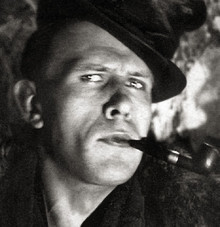
By the late 1920s, his antirational verse, nonlinear theatrical performances, and public displays of decadent and illogical behavior earned Kharms — who always dressed like an English dandy with a calabash pipe — the reputation of being a talented but highly eccentric “fool” or “crazy-man” in Leningrad cultural circles.

Even then, in the late 20s, despite rising criticism of the OBERIU performances and diatribes against the avant-garde in the press, Kharms nurtured a fantasy of uniting the progressive artists and writers of the time (Malevich, Filonov, Terentiev, Vladimir Mayakovsky, Kaverin, Zamyatin) with leading Russian Formalist critics (Tynianov, Shklovsky, Eikhenbaum, Ginzburg, etc.,) and a younger generation of writers (all from the OBERIU crowd—Alexander Vvedensky, Konstantin Vaginov, Nikolai Zabolotsky, Igor Bakhterev), to form a cohesive cultural movement of Left Art. Needless to say it didn't happen that way.

Kharms was arrested in 1931 together with Vvedensky, Tufanov and some other writers, and was in exile from his hometown (forced to live in the city of Kursk) for most of a year. He was arrested as a member of "a group of anti-Soviet children's writers", and some of his works were used as an evidence. Soviet authorities, having become increasingly hostile toward the avant-garde in general, deemed Kharms’ writing for children anti-Soviet because of its absurd logic and its refusal to instill materialist and social Soviet values.

He continued to write for children's magazines when he returned from exile, though his name would appear in the credits less often. His plans for more performances and plays were curtailed, the OBERIU disbanded, and Kharms receded into a very private writing life. He wrote for the desk drawer, for his wife, Marina Malich, and for a small group of friends, the “

Ratings & Reviews

What do you think?
Rate this book

Friends & Following

Create a free account to discover what your friends think of this book!

Community Reviews

5 stars
7 (35%)
4 stars
8 (40%)
3 stars
4 (20%)
2 stars
1 (5%)
1 star
0 (0%)
Displaying 1 - 5 of 5 reviews
Profile Image for Larissa Shmailo.
Author 13 books53 followers
July 6, 2018
I reviewed this extraordinary work for Jacket2, and cannot say enough about Cigale's translation, how well it conveys Kharms, an increasingly important literary figure. All Kharms's wit, pathos, intellect is here, as though there were no division between Russian and English. Cigale captues every nuance, every twist, and translates the humor, so difficult to do, through every punch line. I think this is the book that will introduce Kharms to a mass audience in the English-speaking world.
Profile Image for Meghan.
Author 1 book13 followers
February 16, 2018

Books can be weird. I can read Russian Absurd, which are absurd vignettes recovered from Kharms' notebooks, written in the 1920s and 1930s, pieces as the introduction says that may not have been intended for public consumption, and they don't seem dated and they don't seem foreign and they don't seem like something I should never have heard about until now. True, a lot of old women tend to fall out of windows, but I can picture myself as an old woman tumbling after defenestration, so that seems all right. And the man alternates between looking terrifyingly serious:
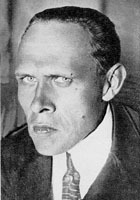


to a foppish Pushkin-esque dandy:


to simply terrifying:
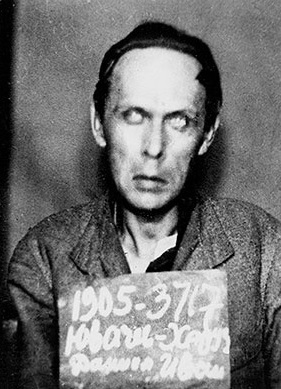


He starved to death in 1942. That hurts my heart. And there's so much out there, so much writing I may never get to know, hidden in notebooks in languages I don't speak.


The sky is shimmering with lamps

And we are flying like the stars


I am glad your friends saved your notebooks Daniil Kharms. I am glad I got to read from them.


Russian Absurd by Daniil Kharms went on sale February 15, 2017.


I received a copy free from Netgalley in exchange for an honest review.


ETA: I have, as I always do with deceased authors, checked yes to Netgalley's Are you interested in connecting with this author (interviews, events, etc)? They have yet to conduct even one séance for me to talk to the dead.

Profile Image for Tom Allman.
88 reviews
January 7, 2017
Silly and whimsical this is not, jarring and disturbing is more of an apt description. Did I mention that Kharms was a children’s author who hated children? I took my time reading this. It did not lend itself to a straight-through reading. You really need to read each entry then digest them separately. Indeed, they are written at different points in the author's life and are presented chronologically.
I was shocked and drawn to this collection at the same time. I would recommend this book to someone who is interested in Absurdism, the weird and authors like Gogol, Pushkin and Bulgakov.
Of special note was the short story ‘The Infinite; that is the answer to all questions...' for its beautiful blend of prose and mathematical theory from which I lifted the following quote;
“One cannot pry under an infinite line; we cannot grasp it with our thoughts. It doesn’t intersect with us anywhere; for anything to be intersected, its end, which does not exist, must be discovered.”
If you do seek this out, I would recommend the print copy. I received a digital copy from Net Galley in exchange for an honest review. I felt that I lost quite a bit of the aesthetics by reading it in that format. I have already added it to my wishlist.
Well done to the translator of the notebooks, Alex Cigale. I can only speculate how hard it is to translate from a foreign language into English, let alone translating absurdist literature.
13 reviews17 followers
November 19, 2018
Wonderful translations of a Russian master of the absurd. Kharms is full of wonders, laughs and gives the reader a glance into a life of a writer who found a vision that help us deal with the inherent absurdity of modern life. Highly recommended.
Profile Image for Mandy.
3,688 reviews347 followers
February 10, 2017
Daniil Kharms (1905-1942) was one of the Soviet Union’s most important writers during the 1920s and 1930s, but fell foul of the regime, was arrested in 1941 and imprisoned in a psychiatric hospital where he died during the siege of Leningrad and buried in a mass grave. In a timely quirk of fate, activists now believe they have found the likely location of the grave. This volume is a selection of his writings, most of which were suppressed during his lifetime. His work is not always easy to get to grips with as his decidedly modernist and avant-garde work is not to everyone’s taste. His stories are often called “anti-stories” as they usually eschew narrative and are often absurd with a surrealist twist. Often they are very short indeed, only a paragraph or a couple of sentences, and often completely pointless – or so it seems to me. Black humour, the grotesque, violence and death are constant themes. Personally I don’t find them funny, or even amusing. This is not my sort of writing. However, I am aware of his place in Soviet literature and I was pleased to discover more of his work. An important book for anyone interested in Russian literature.
Displaying 1 - 5 of 5 reviews