Wilhelmine von Die Geier-Wally. Eine Geschichte aus den Tiroler Alpen Als Fortsetzungsroman ab 1873; 1875 als Roman in zwei Bänden. Vollständige Neuausgabe. Herausgegeben von Karl-Maria Guth. Berlin 2016. Umschlaggestaltung von Thomas Schultz-Overhage unter Verwendung des Anna Stainer-Knittel, Selbstbildnis in Lechtaler Tracht, 1869. Gesetzt aus Minion Pro, 11 pt.
Glad I read this classic that took the world by storm in the 19th century. It's an odd book, full of Lutheran symbolism, what it means to be a "good girl". Featuring insta love (one sided), vultures, headstrong girls, mean father, mean villagers, kindness outside the community, isolation and plenty of Alpine scenery. Wally did get on my nerves at some points, but overall, as I said very glad I read this now. There is no drama like 19th century drama!
Well, this was my favourite kind of classic – the kind I tackle prepared for something olden-timey and perhaps a little dull, only to plunge right into an alpine telenovela – complete with insta-love, tragic misunderstandings, obsessive plots, dire peril, pining, mountaineering heroics, jealousy-inspired murder attempts, and surprise siblings! It was wild.
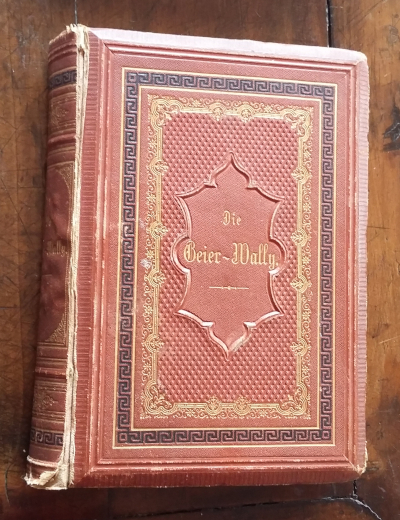
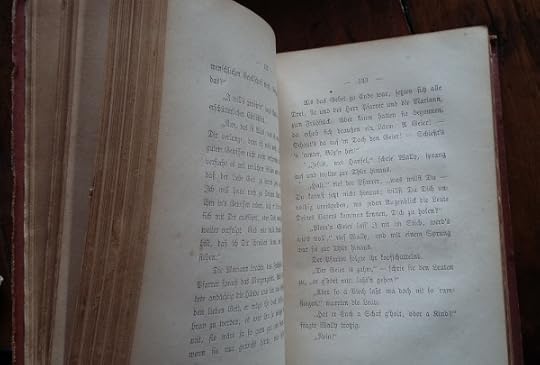
This was a really interesting reading experience – for starters, this is the oldest book I own, having been published in 1875. I should probably have it restored by a bookbinder at some point, if I can find such a mythical beast. I also haven’t read anything in Fraktur typeface in a long time, but I did get used to it surprisingly quickly (except for those blasted near-identical long s’s and f’s - c'mon, surely those were the product of a printer just maliciously trolling).
Let’s have the plot real quick: The titular Wally (no daft jokes please, the poor girl’s name is Walburga), inspired by real-life Austrian painter and youthful badass Anna Stainer-Knittel, is the strongest, most beautiful and bravest girl in her tiny, super-judgey Tyrolean village, and wows everyone by robbing a bearded vulture’s nest as a young girl and raising the chick. At sixteen, when she falls in love (at first glance *sigh*) with Some Dude her cranky father doesn’t approve of, he furiously banishes her to a barren wasteland in the high mountains with no company but her pet vulture, a time she promptly uses to get even more badass and self-sufficient. She then spends the rest of the novel surviving a ton of trials and tribulations (there is a hypothermia plot!!), including various very sensible encounters with very sensible people who try to gently hint that maybe her entire purpose shouldn’t be about Some Dude that she’s never even properly met. (This lands about as well as such advice has landed with any teenager ever.) There’s also an absolutely exhausting procession of would-be suitors that Wally mocks, rejects and usually physically beats up. (Which would be hilarious if the whole thing weren’t so rapey.) Meanwhile, Some Dude appears to be hooking up with some other chick – heartbreak ensues! What to do! Kill yourself! No, have him murdered! Change your mind! Rescue him from the murder plot you orchestrated! (I have *definitely* seen soaps with this exact plot.) Repent! Lament! Last-minute twist! Maybe end up happy? (But only if you stop insisting you have worth as an independent person and submit your whole self to a man, of course.) What a ride.
I love that this was written by a woman in the 19th century who heard a story about a girl who stole an eagle, and decided to run with it. It’s deeply steeped in the patriarchal bullshit, rampant xenophobia, rigid gender roles, bigotry and omnipotence of the Catholic church in Tyrol at the time (I grew up in the region and it’s appalling and hilarious how much of this crap I recognised from a hundred years later), and it’s pointedly framed as a Taming of the Shrew sort of narrative; nevertheless, underneath all these constraints there’s a gripping, adventurous story with a compelling, complex main character who has no interest in damselling and who has real flaws and a wealth of character development. I loved that she got to be flawed, that she made mistakes and faced consequences for them. Granted, a lot of it is written as a morality tale but intentionally or not, the character and her rich emotional life still shone.
The love story was definitely the weakest link, especially since Joseph was… well, basically a smug asshole. Self-involved, condescending, rash, violent, just ugh all around. Think Victor Hugo’s Phoebus (the original, not the Disney version) – a thoughtless, callous dick who genuinely thinks he is god’s gift to women. Literally any of the other prospects would have been better options – I mean, Vincent was a douchecanoe as well, but at least he had that Byronic brooding thing going, and each of the Rofen brothers were worth ten of Joseph. Not to mention there was a super-promising set-up for a good enemies-to-lovers f/f?? (But I wishfully digress.) All the wooing was also appallingly rape-centric, with literally scores of suitors trying to “force” Wally, and her accepting it as a sort of challenge. The character was heavily inspired by Brunhild from the Nibelungenlied, both by implication and actual reference, so that element was not unfamiliar, but boy was it squicky.
Idiotic love tangles aside, the imagery was incredibly powerful and the depiction of alpine life at the time both vivid and authentic. I was genuinely engrossed.
Felix Mitterer adapted this story for a play back in the 90s - unfortunately he decided to be extra-purist about it and decreed that the ONLY correct way to experience it was on an open-air stage on location, going so far as to decline to publish the text. Which sucks for all of us who cannot time-travel, because I'd have loved to see how he modernised this. There is such a fantastic feminist story buried under all the morality claptrap, and it's definitely overdue for a modern retelling.
Ein schönes Buch, das trotz Dialekte der Figuren leicht zu lesen ist. Es ist sehr Empfehlenswert wenn man Literatur aus dem 19. Jahrhundert über die Emanzipation der Frau lesen möchte. Dennoch bin ich mir nicht so sicher ob ich bei meiner Analyse den Part des Christentums so sehr mag...