Jump to ratings and reviews
Rate this book

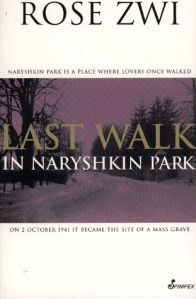
Last Walk in Naryshkin Park

Rate this book
This account tells the story of Lithuanian Jews caught in the sweeping history of the first half of the century in Europe.

252 pages, Paperback

First published September 1, 1997

1 person is currently reading
31 people want to read

About the author

Rose Zwi

9 books1 follower

Ratings & Reviews

What do you think?
Rate this book

Friends & Following

Create a free account to discover what your friends think of this book!

Community Reviews

5 stars
6 (46%)
4 stars
6 (46%)
3 stars
1 (7%)
2 stars
0 (0%)
1 star
0 (0%)
Displaying 1 - 6 of 6 reviews
Profile Image for Dean Benjamin.
5 reviews2 followers
September 8, 2021
It’s difficult to overstate how important this book is in the documentation of what happened to the Lithuanian Jewish community. The research behind the narrative is immense; the detail that Zwi is able to convey went far beyond my expectations.

For anyone who descends from Lithuanian Jews, this book is critical in understanding what our history is, and understanding what happened to those whose fates we never learned about. For Lithuanians, this book is critical in seeing the country’s unsanitised history with regards to Lithuania’s role in the mass murder of Jewish people. For everyone else, this is an important part of human history, a story of what can happen anywhere, of what has happened in other parts of the world. May the world never forget what happened here. May no other group of people experience this again.
107 reviews10 followers
July 5, 2010
A terrific book about the Jews of Lithuania. Such a terrible topic to read about but so worth it. May they never be forgotten.
Profile Image for Paul Shore.
Author 1 book30 followers
January 13, 2017
Powerful... heartbreaking... real! Should be required reading in high schools and for all politicians!
Profile Image for Lisa.
3,818 reviews489 followers
January 27, 2025
This Holocaust Memorial Day (HMD) marks the 80th anniversary of the liberation of Auschwitz-Birkenau, the largest Nazi concentration camp complex.  The theme for Holocaust Memorial Day 2025 is For a Better Future.  This comes at a time of rising antisemitism in Australia (see here, scroll down for my rolling updates) and around the world and research that shows 20% of people in France had never heard of the Holocaust.

So as in previous years I have chosen to participate in Holocaust Memorial day by reading a Holocaust memoir, written by the Mexican-born South-African-Australian writer and anti-apartheid activist, Rose Zwi (1928-2018). Last Walk in Naryshkin Park (1997) is the story of her quest to find out what happened to her father's family who perished in the Holocaust, and in particular to learn the fate of her uncle Leib Yoffe — a musician, a barber, a revolutionary and a soldier about whom differing stories were told.

The book is told in three sections, tracing her family origins in Lithuania and their exile in Mexico and South Africa; then her first visit to Lithuania which left her with many unanswered questions, and finally a further visit where she has more success in finding people who remembered her family.

Rose Zwi's own story begins in Mexico, where her Lithuanian father Gershon had fled in the face of rising antisemitism.  Thriving Jewish communities had existed in Lithuania for centuries, but it had a history of pogroms and exile too.  As a child, Zwi was not aware of antisemitism in Oaxaca, where her secular parents did not advertise that they were Jewish.  Gershon and his brother Bentze opened a shop in town, and his wife Sheva was beginning to enjoy life in Oaxaca, when...
...one afternoon, she was woken from her siesta by the sound of shooting and shouting.  Grabbing me [Rose] from her cot, she rushed into the courtyard to find a crowd gathered around a grotesque papier-mâché figure of a man with an enormous nose and horns.  The men were shooting into the air, yelling, and throwing up their sombreros.  The women were ululating and shaking their fists at the papier-mâché figure.

'What's happening?' Sheva asked Juanita.

'Today we celebrate a great religious holiday,' Juanita explained. 'Today is the day we kill the Jews.'

'Have you ever seen a Jew?' Sheva clutched me to her breast.

'God forbid!' Juanita crossed herself. 'That,' she pointed to the evil-looking figure at the centre of the incensed crowd, 'is a Jew.'

Gershon finally gave in to Sheva's pressure to leave Mexico.  Not even Bentze's entreaties could persuade Sheva to remain in a country where Jews were shot in courtyards.  First papier-mâché ones, she said, then real ones. She wanted to go to South Africa where her mother, sister and two other brothers had settled. (p.31)

The move meant that their savings towards bringing the rest of the family out of Lithuania were exhausted. Her father opened a barbershop in Johannesburg but it was the middle of the Depression and there was no spare money to send to help support family back home, earning Gershon hostility from his brother Lieb who did not understand how this could be in 'the golden country'.

In South Africa, with the rise of right-wing Afrikaner nationalists, economic problems were blamed on the Blacks and the Jews.
'This time I'm not running,' Gershon told Sheva.  'It's the same everywhere.  In der heim it was Lithuania for the Lithuanians.  After centuries of living there, we hadn't qualified as Lithuanians.  We ran from Oaxaca because they shot papier-mâché Jews. And here the Blackshirts and the Greyshirts desecrate synagogues and clamour for a halt to Jewish immigration.  Everyone's got a 'Jewish Problem.' But what's the solution?' A homeland of one's own, I argued with my father when I was growing up. Utopian fantasies, was his predictable response. (p.35)

To read the rest of my review please visit https://anzlitlovers.com/2025/01/27/l...
Profile Image for Jeremy.
778 reviews17 followers
June 10, 2020
A beautifully written and very sad memoir of the Author's family, and her search for them in Zhager, Lithuania, where most of them were murdcered in 1941
Profile Image for Sunshine.
7 reviews
June 10, 2014
Last Walk in Naryshkin Park
Rose Zwi writes about her family who were from Lithuania. Her parents before the Second World War left their small town Zagare, near the border of Latvia and went to Mexico,then to South Africa. Not all of her family left, but most of those who did not go were murdered in the Holocaust. Her father could not afford to bring them out and died of a broken heart. Zwi later travels to Lithuania to meet the widow and daughter of her father's favourite brother.

The Lithuanians in the Second World War murdered thousands of Jews . They did this before the Nazis came - after they pretended none of this had happened.
Zwi writes about the history of Lithuania and its Jews who were part of the population since the fourteenth century. There is more of a focus on the twentieth century and the Second World War.
I could not read some of the text where it was too disturbing. Zwi is bitter and ends her book with a bitter reflection. But could she have felt differently?
Displaying 1 - 6 of 6 reviews

Can't find what you're looking for?

Get help and learn more about the design.