A cult figure in his own lifetime, Henri Rousseau (1844-1910) produced some of the most original and recognizable artworks of the modern era. This volume provides not only a comprehensive overview of his career, but also a penetrating insight into the sources that inspired his work."
Henri Rousseau. The artist who was frowned upon as not being up to the standards of other contemporary painters and was ridiculed as drawing like a child. Now recognized as a genius who inspired avant-garde artists, he remains a self-taught, natural enigma.
It's easy to look at his work and frown upon it. Except I can't, as I have little sophistication regarding works of art. I just like what I see and I love Rousseau. The colours are exceptional, the simplicity...and the subjects have absolutely nothing to do with reality (i.e., American Indians being attacked by gorillas). Yet that is what draws me to his paintings. Imagine that he was considered so awful, his paintings were sold on the street as canvas to be re-used by 'better' artists!
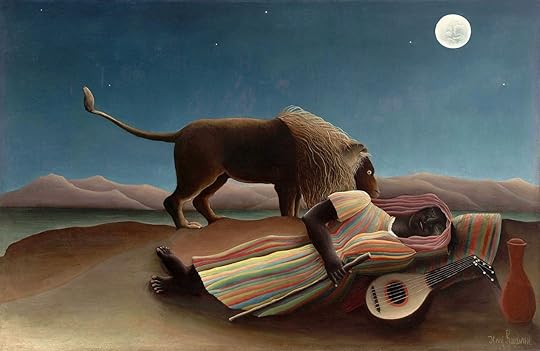
THE SLEEPING GYPSY
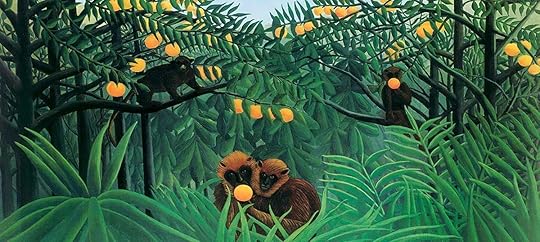
MONKEYS IN THE JUNGLE
As to the book itself, I had a difficult time with the various essays. There are more words than artwork, which is frustrating. Plus, the general message is the same throughout: Look at this artist who was laughed at by others. Okay, but focused on over and over and over. There was some biographical data, such as Rousseau not being trusted with money (he was arrested twice for theft and fraud), but it was all jambled together. Overall, an okay book to learn about the artist, but books about painters should have more artwork.
A nicely done book that accompanied an exhibit at the National Gallery in DC a couple years back. One of the things that comes across in both the exhibit and the book is that Rousseau wasn't working in a vacuum, of course -- there were some very specific things in his environment that had an outsize influence on his art. In particular, visits to the Botanical Gardens in Paris served as inspiration. The animals he observed Paris zoo also populated his paintings.
Interestingly, although Rousseau never actually left Paris, he constructed elaborate visions of tropical worlds from popular images of exotic places that were in circulation in the Paris of his time.
The prints in this book are lovely -- vibrant colors and clearly detailed. Anyone with an interest in this singular artist will be enchanted.
A series of erudite and at times self-important essays, written to accompany exhibitions at the Tate Modern and The National Gallery of Art. The book does not follow any sequential logic either in the narrative or in the accompanying photos, making it difficult to follow.
I did appreciate viewing the naïve jungle scenes and learning that they were all based on caged animal in Le Jardin des Plantes for, unlike other of his contemporaries, Henri Rousseau never left France.
I've always found Rousseau fascinating, but a lot of the essays in this book focus more on academic mumbo jumbo and the writer's own theories than the artist or his work. Pictures are good and there's some interesting stuff here, but I'd advise skimming and skipping a lot of the essays.
This is actually the second time I read this book, and I love it, in spite of its many errors. Rousseau is the most that I can hope to be. Please, God, let me one day be like Rousseau.
I saw this exhibit, a revelation, in Paris. There is so much more to this painter, his context and influence, than one would ever guess when seeing one of his paintings, almost as a token, in museum perm collections. The exhibit went on to the Tate and NGA,DC. This excellent book is the English version of the exhibit catalogue; fine reproductions and photos, very good essays.
This was a great exhibition & it's a really cool catalog, esp. if you're into self-taught artitsts. Rousseau's work has such a great sense of fun & enjoyment to it, almost like illustration.