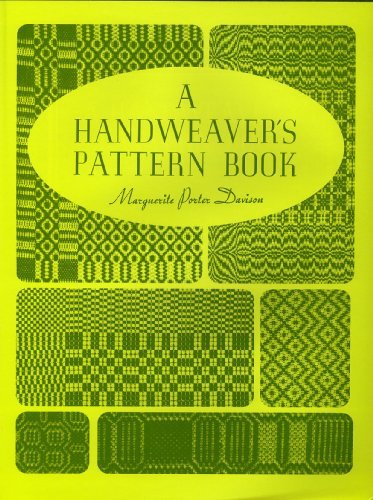
An invaluable resource for four-harness weavers. It is a book for weavers ready to break away from published magazine patterns who want to create their own unique cloth. This book is a record of 345 threadings, tie-ups and treadlings for varieties of different weave structures. Originally published in 1944, it continues to be reprinted which is a testament of it's value to all weavers.
Marguerite Porter Davison began her career at Berea College under the guidance of Mrs. Anna Ernberg, who was encouraging the mountain people to bring forth their traditional colonial weaving patterns. As Mrs. Ernberg's assistant, Mrs. Davison became thoroughly familiar with these well-established and long-loved patterns.
Despite the cares of raising a family and of time generously given to numerous worthy causes, Mrs. Davison engaged extensively in weaving, teaching and lecturing. In later years much of her efforts were devoted to writing and publishing. She was an active member of the Associated Hand Weavers and of the Pennsylvania Guild of Craftsmen.
Today her published works live on, ensuring that her weaving patterns remain in the hearts and hands of those who carry on the tradition.
Known among the guilds as the hand weaver’s bible, this book contains an impressive and wonderfully rich collection of 4 harness patterns with large, easy to read illustrations alongside the drafting patterns it takes to achieve each one, as well as multiple variations for each draft. Clear, concise, easy to follow if you understand how to read the weaver’s “cartoons” as they call the treadling patterns, but they are so intuitive you could almost use this book to learn from.
yo hace muchos años atrás me dedicaba al tejido en telar. Este libro ha sido muy interesante para mí, solo que está escrito en Ingles por lo que es un tanto difícil su interpretación. Azángaro - Puno - Perú, 14 de Febrero del 2020.
Got this book from my local library when taking a weaving class. It's so interesting to see how many variations can come from the differences in threading your loom in a certain way, not to mention variations in color or type of yarn, etc. The teacher of my weaving class recommended this book as a good source for patterns, and she also told the class that the woman who collected the patterns for this book was just working in the northeastern part of the United States. This is a huge compendium for such a small regional area, not to mention the fact that she was collecting patterns for such a short amount of time!